

Meta Purchased Stratasys 3D Printers for Robotics and XR
18 November, 2025
Meta enters advanced manufacturing. Stratasys also took part in the U.S. Navy’s Trident Warrior exercise, supporting distributed production
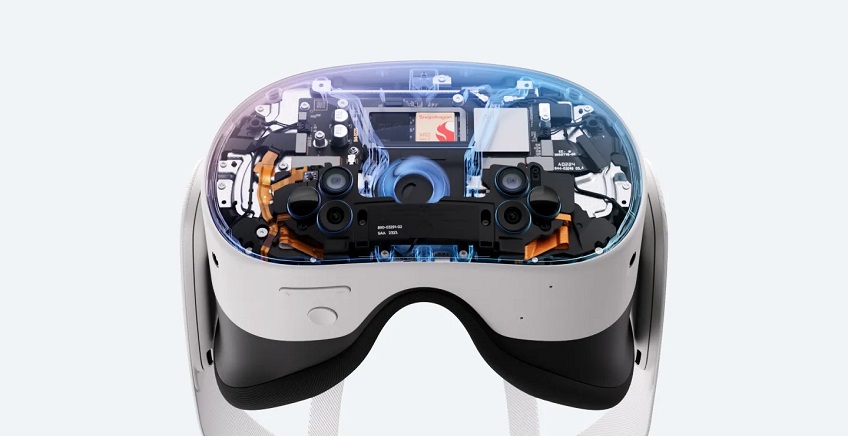
Image above: Meta’s Quest headset. Source: Meta
By Yohai Schwiger
During Stratasys’ third-quarter earnings call, CEO Dr. Yoav Zeif revealed that “one of the largest American technology companies — a global leader in social networks, artificial intelligence, and virtual and augmented reality hardware” — purchased four of the company’s new F3300 3D printers. While he did not name the customer, the clues unmistakably point to Meta, the parent company of Facebook, Instagram, WhatsApp, and the Quest headset line.
According to Zeif, the systems will initially support large-scale prototyping for the customer’s “automation platforms” and for developing “its next robot.” Over time, the same printers are expected to transition into production of end-use parts for the company’s XR devices. Zeif stressed that the customer ran a lengthy evaluation against competing solutions and ultimately chose Stratasys because of its ability to move from design to production on the same machine — a capability he described as critical for fast-cycle, globally competitive tech giants.
Meta’s Humanoid Project
The F3300 units purchased are industrial-grade FDM systems with large build volumes, engineering-grade materials, and high long-term geometric precision. Practically, that means they can produce not only early-stage prototypes but also final, production-quality components for robotics platforms, camera housings, sensor mounts, and complex XR mechanisms. Choosing such machines suggests a need for equipment capable of producing thousands of identical parts at industrial standards, supporting internal automation pipelines that change frequently.
Over the past year, reports have indicated that Meta is developing an advanced humanoid prototype featuring tactile sensing, haptics, and AI-driven control systems. Research published by the company has shown a robotic hand capable of evaluating texture, friction, and stiffness, and Meta has been investing heavily in robotics for locomotion, manipulation, and complex task execution in dynamic environments.
Zeif’s reference to “automation platforms” likely points to Meta’s internal manufacturing and testing infrastructure — a sprawling ecosystem of robotics, sensors, and automated rigs used for module assembly, quality assurance, and rapid prototyping. This world of jigs, fixtures, manufacturing tools, and test stations increasingly relies on high-throughput 3D printing, enabling Meta to iterate mechanical elements at high frequency.
“We see enormous potential here,” Zeif told analysts. “The customer selected us after a lengthy evaluation. These printers passed the highest-level certifications and tests. They’re starting with prototyping, but moving quickly into production on the same machine — and that gives them a major speed-to-market advantage.”
Stratasys Printers in the U.S. Navy’s Trident Warrior Exercise
Stratasys posted a challenging yet steady quarter. Revenue came in at $137 million, down about 2% year-on-year amid ongoing caution in capital-equipment spending. Gross margin declined due to higher U.S. tariffs and a shift in product mix, but operating expenses fell meaningfully, resulting in $1.5 million in adjusted net profit. The company maintained positive cash flow, ended the quarter with roughly $255 million in cash and no debt, and reaffirmed its full-year revenue guidance of $550–560 million with modest Non-GAAP profitability.
Defense was a standout. Stratasys reported strong activity with Boeing, Embraer, Honeywell, TE Connectivity, and L3Harris. The company also participated in the U.S. Navy’s Trident Warrior 25 exercise, which tested distributed manufacturing and advanced maintenance capabilities across thousands of kilometers. Stratasys printers were deployed at seven global sites — both as forward positions producing critical components at the edge and as part of reach-back operations, where Stratasys Direct facilities supplied complex parts. All printed components met full military specifications, demonstrating how a hybrid production network can shorten supply timelines, reduce logistical dependence, and improve operational continuity for deployed units.
Stratasys also highlighted significant progress in the dental market, which it views as a major growth engine. The company appointed Chris Cabot, formerly of Affordable Care, to lead global dental operations. It launched new post-processing solutions that reduce manual labor and minimize reliance on harmful chemicals, and it removed TPO from its dental resins to streamline safety and future regulatory approvals.
Despite macroeconomic headwinds, Stratasys is positioning itself not just as a prototyping provider but as a partner in advanced manufacturing. The Meta-scale customer win, deepening defense-sector traction, expansion in dental, and a strong balance sheet all reinforce management’s optimism as distributed production, automation, and rapid development cycles increasingly become the industry standard.
Posted in: News


