Quantum Transistors Achieves 99.9988% Fidelity in Diamond-Based Qubits
17 December, 2025
Israeli company sets a world record in quantum gate performance, combining an independent manufacturing platform with a data-center-ready approach that eliminates the need for extreme cooling
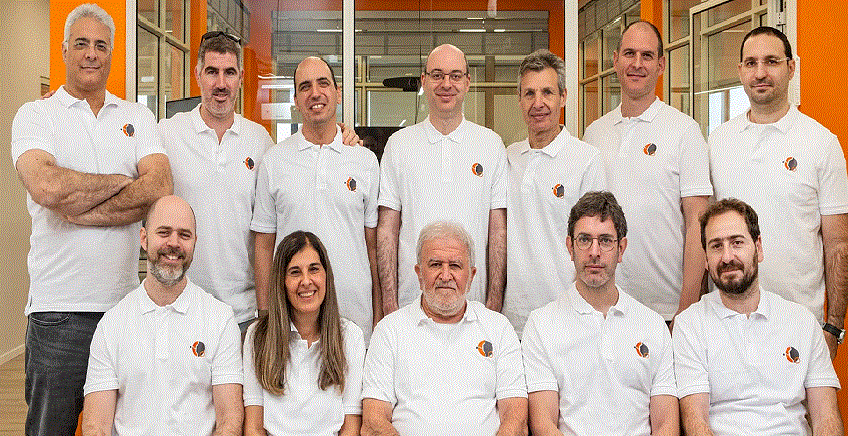
[Pictured above: The Quantum Transistors team. Source: Company website]
Israeli startup Quantum Transistors has announced what it describes as a major breakthrough in quantum computing: its diamond-based processors have reached a quantum gate fidelity of 99.9988%. In an industry where differences of mere thousandths of a percent can determine whether a system will ever scale into a practical quantum computer, the achievement represents a significant leap—one that positions the company at the forefront of the global race toward scalable quantum hardware.
The result is based on a proprietary technique developed by the company known as PUDDINGs, which dramatically reduces the impact of environmental noise on qubit operations. The approach enables highly stable quantum gates without relying on complex or extreme cooling systems. In quantum computing, fidelity measures how closely a performed quantum operation matches its ideal theoretical outcome—making it one of the most critical benchmarks in the field.
Quantum Transistors’ technology is built around ultra-pure synthetic diamonds, in which the company deliberately creates minute atomic defects known as color centers. These are locations in the crystal lattice where a carbon atom is missing or replaced by another atom, producing unique energy states. In such configurations, the spin of a single electron can be precisely controlled using light and electromagnetic fields, allowing it to function as a qubit—the fundamental unit of quantum information.
A key advantage of diamond-based qubits lies in their solid-state nature: unlike superconducting approaches, they do not require temperatures close to absolute zero. Quantum Transistors aims to turn this inherent advantage into an industrially scalable capability. To that end, the company already operates independent fabrication processes in Israel and is among the very few players worldwide capable of building a full quantum chip on diamond—from material production through to the integration of photonic connectivity between qubits.
Beyond the material advantages of diamond, the company has developed its proprietary PUDDINGs quantum control system—short for Power-Unaffected, Double-Detuning-Insensitive Gates. The system is designed to mitigate environmental noise by using advanced control-pulse engineering that makes quantum operations resilient to fluctuations in power and frequency, two of the dominant sources of error in quantum systems. According to the company, this approach significantly reduces gate error rates and underpins the newly reported fidelity record.
While still relatively young, Quantum Transistors has already reached several commercial milestones. In recent years, it secured funding from the European Union under one of the bloc’s largest quantum research programs, enabling the expansion of its R&D efforts and the establishment of a dedicated manufacturing facility. The company’s long-term ambition is to deliver quantum processors that can be directly deployed in data centers—without massive cryogenic infrastructure or prohibitively expensive equipment.
Such a shift could transform quantum computing from cumbersome experimental systems into an integral component of advanced computing infrastructure, opening the door to far broader industrial adoption.
The Promise of Diamond Qubits
Diamond-based qubits have emerged in recent years as one of the most promising directions in quantum hardware. While companies such as IBM and Google lead the superconducting approach, and ion-trap systems demonstrate exceptional accuracy but face challenges in scaling, diamond defects offer a unique combination: high quantum stability within a robust, heat-tolerant solid-state environment, along with natural photonic connectivity between qubits. These properties make diamond an attractive candidate for distributed quantum architectures.
Until now, the central challenge has been maintaining very high fidelity in environments that are not tightly controlled. It is precisely in this area that Quantum Transistors’ latest results represent a meaningful breakthrough.
The company’s achievement signals growing technological maturity and addresses one of quantum computing’s most persistent obstacles: error rates. If these fidelity levels can be preserved in multi-qubit systems and supported by stable manufacturing processes, the technology could help move the field closer to a point where quantum computing becomes a practical tool rather than a long-term promise.
Quantum Transistors has set itself an ambitious goal—not another experimental quantum machine confined to the lab, but a quantum processor designed for integration into server farms and cloud environments. The road ahead remains long, but the latest announcement places the company on that path with a technological milestone few have reached to date.
Quantum Transistors was founded in 2022 by Shmuel Bakhinski, who also serves as the company’s CEO. The company operates from Israel and employs several dozen people across research, development, and manufacturing.
Posted in: News
Posted in tags: Quantum Computing , Quantum Transistors