Rivian Unveils Autonomous Driving Platform, Signals Shift Into an AI Company
17 December, 2025
At its Autonomy & AI Day, the EV maker introduced a next-generation autonomy stack built around a custom chip, a large driving model, and LiDAR integration, targeting Level 4 autonomy from 2026
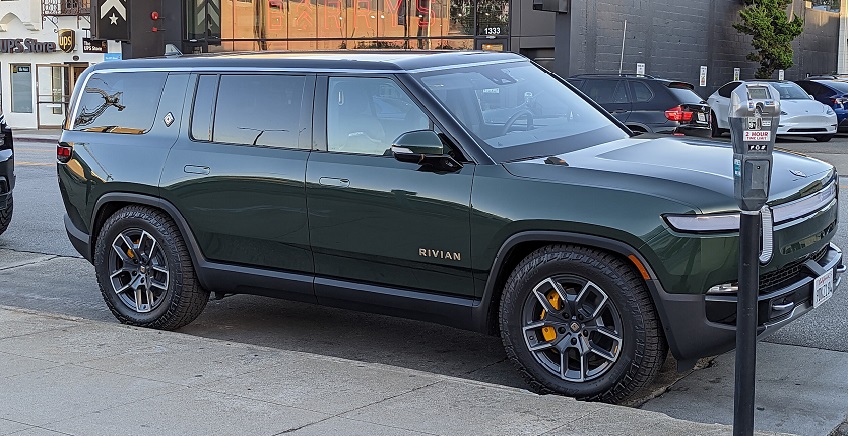
[Pictured above: Rivian R1S SUV. Source: Wikipedia]
At its Autonomy & AI Day event held last week, electric vehicle manufacturer Rivian unveiled its technological roadmap toward advanced autonomous driving and, for the first time, revealed the core of its next-generation autonomy platform. The announcements centered on a proprietary compute chip developed in-house, a new software platform based on a large driving model, and deep integration of artificial intelligence across all layers of the system.
Rivian is a U.S. electric vehicle manufacturer focused on premium electric SUVs and pickup trucks, best known for its R1T and R1S models. In 2024, the company delivered approximately 50,000 vehicles. According to the roadmap presented, the new technologies will be rolled out gradually across Rivian’s next-generation vehicles—led by the upcoming R2 platform, expected to reach the market starting in 2026. Initial deployments will offer advanced semi-autonomous capabilities, paving the way toward Rivian’s longer-term goal of Level 4 autonomous driving. Taken together, the announcements position Rivian not merely as an EV manufacturer, but as a company architecting the future of autonomy through a vertically integrated AI system—more akin to cloud and deep-tech companies than to traditional automakers.
A Custom Chip as the Foundation of Autonomy
At the heart of Rivian’s autonomous driving platform is a custom inference chip, designed specifically to run real-time autonomous driving models after several years of internal development. The chip delivers roughly 1,600 TOPS in sparse mode—an efficiency-oriented compute approach that skips unnecessary operations—and is optimized for continuous, low-latency processing of multi-sensor data streams while maintaining controlled power consumption. According to Rivian, the chip is a central pillar of its next-generation autonomy platform and is expected to replace the NVIDIA-based compute solutions used in earlier generations of the company’s driver-assistance systems.
With this move, Rivian joins a very small group of automakers that have chosen to develop their own dedicated processors for autonomous driving—a path previously taken primarily by Tesla. The decision reflects a strategic view of AI hardware as a long-term competitive asset rather than an off-the-shelf component.
Sitting above the hardware layer is a software platform built around large AI models for driving. Rivian describes a unified model that combines visual perception, scene understanding, and decision-making, replacing the traditional pipeline of separate functional modules. This marks a shift from a conventional ADAS architecture to a foundation-model approach to driving—one that learns from massive datasets, improves continuously, and is better equipped to handle edge cases. Training and refinement of the model are driven by data collected from Rivian’s vehicle fleet and fed back into the system through ongoing software updates.
LiDAR and the Sensor Stack Debate
Central to Rivian’s strategy is a clear commitment to a multi-modal sensing architecture, combining cameras, radar, and the future integration of LiDAR sensors. This choice represents one of the company’s most significant points of differentiation from Tesla. While Tesla adheres to a camera-only approach and has entirely abandoned LiDAR for ideological and cost reasons, Rivian has opted for a more pragmatic path—viewing LiDAR as a critical enrichment layer for three-dimensional spatial understanding.
From Rivian’s perspective, LiDAR is not a replacement for vision-based perception, but a complementary system that adds redundancy, improves object-detection accuracy, and is particularly valuable in challenging lighting conditions and edge-case scenarios. The decision also sends a clear signal to the sensor ecosystem that LiDAR still has a meaningful role to play in autonomous driving, especially when deeply integrated into a unified AI stack. For companies such as Israel-based Innoviz, Luminar, and others, this represents significant potential—not only because Rivian could emerge as an important customer, but because its architectural choice reinforces LiDAR’s position as a core component of automotive sensing systems.
Autonomy as Rivian’s Core Value Engine
Beyond the specific technologies, Rivian’s announcements reflect a broader strategic shift in which autonomy and AI are positioned as the company’s future value engine. Autonomous driving is not framed as another vehicle feature, but as part of a comprehensive AI system built on vertical control over chips, software, and models—designed to turn these capabilities into internal strategic assets rather than dependencies on external suppliers.
In parallel, Rivian emphasized that it is embedding AI across its broader operations, from data collection and fleet analytics to optimization of development and manufacturing processes, as well as maintenance, logistics, and customer service. This mindset brings Rivian closer to the operating model of cloud and AI companies than to that of traditional automakers, aligning it philosophically with technology-driven players such as Tesla and Apple.
The broader implications for the industry are clear. The battle for autonomy is no longer about which sensor is superior, but about who controls the entire AI loop—from data to models to compute. Custom chips are becoming strategic tools, large driving models are replacing modular architectures, and autonomy is increasingly viewed as an evolving platform rather than a one-time promise. Rivian may still be some distance from fully realizing Level 4 autonomy, but the direction it has outlined offers a glimpse of what the industry is likely to look like in the years ahead—one in which the vehicle is, above all, an AI system on wheels.
Posted in: AI , Automotive , News