Shahaf PY Expands into Concrete 3D Printing Manufacturing
19 March, 2026
The company plans service bureaus and robotic platforms for construction and defense, aiming to scale from prototyping to serial production in 3D-printed concrete
By Yohai Schweiger
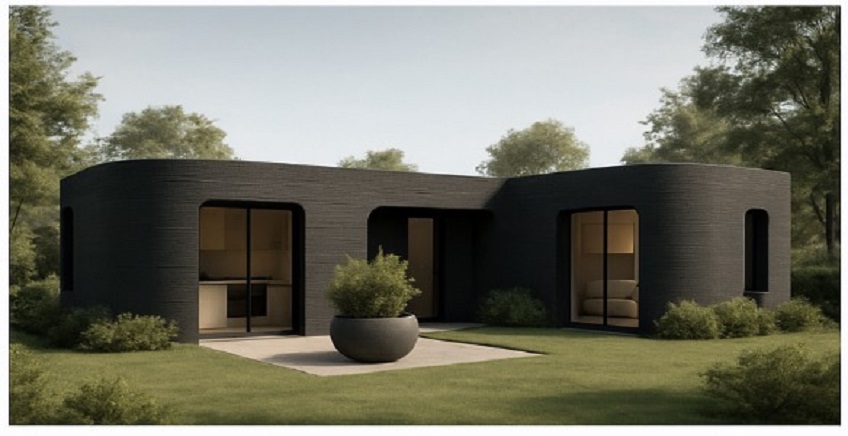
Shahaf PY, a company based in Kibbutz Moran and active in 3D concrete printing for the construction industry, is looking to expand its business model beyond supplying printing systems and build a full manufacturing operation — from service bureaus for prototyping and production runs to the future deployment of robots on construction sites and in defense applications.
According to founder and CEO Eran Carmi, speaking with Techtime, the move is driven by growing demand in the construction sector for solutions that can shorten processes, reduce dependence on manpower, and enable greater design freedom. “There is a shortage of labor in construction, while demand for building continues to rise. Younger generations are less interested in entering construction work, while projects themselves are becoming more complex. This is exactly the space where automation and concrete printing can create real value.”
“Concrete is a living material”
The company’s roots lie in the world of complex architectural projects. About five years ago, it decided to enter the field of printed architecture after identifying a gap between the design vision of architects and engineers and the production capabilities available in the market.
“We went out into the world looking for printers capable of producing facades and complex architectural elements, and realized there were no printers truly designed for architecture, design, and construction,” Carmi said. “The challenge was both scale and raw material, and that is where we realized our advantage would be in concrete printing.”
Shahaf’s system is based on proprietary mixing and feeding systems, printheads, and software developed by the company for large-scale 3D concrete printing in complex geometries. The printing method is FDM — layered printing — but its application in concrete presents very different challenges from those known in plastics or metals. For the physical execution of the print movement, the system is integrated with robotic arms from KUKA and ABB, fitted with printing components developed by Shahaf.
According to Carmi, the core of the technology is not only the machine itself, but the ability to manage a material that changes in real time. “Concrete is a living material. From the moment it meets water, chemical processes begin and its properties change dynamically. That means there must be a very strong connection between the hardware, the software, and the material. You need to precisely control print speed, geometry, and material behavior.”
To address this challenge, the company has also developed software that manages the printing process, plans work paths, supports BIM integration, and aims to translate complex design into industrial execution.
From thermal-management walls in data centers to fortifications
According to Carmi, the technology’s main advantage is its ability to break free from the constraints of traditional formwork and molds. Instead of producing each component according to a rigid قالب, different and complex shapes can be printed in customized form, with relatively fast transitions between versions and products.
“Architects today do not want to remain loyal to a mold,” he said. “Partly because AI tools now allow designs to be generated very quickly, there is a growing need for much more flexible execution.” In his view, the combination of digital planning, robotic printing, and material control opens a new space for formal freedom alongside functional manufacturing.
That capability is not intended only for aesthetics. Shahaf is targeting applications in which geometry itself creates engineering or economic value. These may include walls with internal cavities that can help manage heat in data centers, acoustic walls whose tailored internal structure can significantly reduce the amount of concrete required, complex concrete molds, landscape architecture elements, infrastructure components, roads, large industrial tanks, as well as solutions for marine architecture and underwater systems.
“We are not enslaved to the mold,” Carmi said, “which means we can rethink not only the shape of an element, but also its function.”
This direction aligns with broader needs in the global construction market. The sector faces a chronic labor shortage, rising costs, long schedules, and growing demands for efficiency as well as lower waste and emissions. The cement industry is also one of the most polluting in the world, so any solution that enables structural optimization, reduced material use, and less dependence on manual formwork attracts increasing attention.
For Shahaf, this is not only a technological opportunity but also a business opportunity: offering the construction sector a way to produce complex components faster, with greater flexibility, and with more precise use of material.
A full platform, from AI-based design to on-site printing
Against this backdrop, the company is trying to build a broader business model than system sales alone. One of its main directions is the establishment of robot farms that would serve as service bureaus for concrete printing. In such a model, customers could bring in a design, order a prototype, and later produce small batches or complex components without having to build a full manufacturing operation of their own.
“In my opinion, the major breakthrough between prototype manufacturing and serial production will happen דווקא in concrete,” Carmi said.
Alongside its civilian activity, Shahaf also sees potential in the defense market. According to Carmi, work in this sector began after October 7, with the rapid printing of fortifications for communities. Since then, the company has also been examining ballistic protection applications and direct field printing.
His longer-term vision is a system that could move on a tracked platform, connect to a concrete source, and print in the field according to the required geometry, with as high a level of autonomy as possible. “The goal is for the end user to be able to do everything in the field,” he said.
Looking ahead, Carmi sees Shahaf as a company that connects digital design, AI, and industrial manufacturing. One of the capabilities the company is developing is software that can convert a design generated in AI tools into a plan that is adapted for execution by the printer.
If that direction matures, Shahaf will seek to position itself not only as a supplier of printing systems, but as a manufacturing platform for printed concrete — one that links architecture, engineering, robotics, and materials, and is aimed at serving the construction, infrastructure, and defense markets.
[Main image: Shahaf PY]
Posted in: News
Posted in tags: 3D Printing , Shahaf PY