
MS Tech Develops Biological Sensor for On-Site Monitoring of Soil Contamination
3 February, 2026
MS Tech wins Innovation Authority grant to develop coated quartz-crystal sensors enabling real-time field detection of soil contamination worldwide
By Yohai Schwiger
Herzliya-based MS Tech has been awarded a research and development grant of approximately $1.7 million from the Israel Innovation Authority to develop a new generation of bio-sensors designed for real-time monitoring and diagnosis of soil and groundwater contaminants. The grant was awarded as part of the national “Green Soil” consortium, established in 2025 and led by Elbit Systems, which brings together 16 industrial companies and academic institutions to develop and implement advanced biological technologies for the treatment of contaminated soil and groundwater.
The goal of the project is to create a solution capable of mapping areas affected by pollutants such as fuels, industrial chemicals, PFAS contaminants (persistent chemicals that are difficult to break down), and explosive residues. Today, contamination assessment relies almost entirely on expensive and time-consuming laboratory tests that require the collection and shipment of numerous samples to specialized facilities. This process often leads to lengthy projects, high costs, and delays of months or even years in the development of new urban areas.
“There is a real technological gap today,” says Doron Shalom, CEO of MS Tech, in an interview with Techtime. “There are very few systems that can analyze soil directly in the field. Everything is based on laboratory work, which is cumbersome and expensive. The ability to conduct on-site testing in real time is a revolution that will change the way contaminated soils are handled.”
The new sensors being developed by MS Tech are designed to do exactly that—enable rapid identification of contaminants within seconds, without the need for heavy laboratory equipment. The global market for soil monitoring and remediation is considered one of the fastest-growing segments in the environmental sector and is estimated at tens of billions of dollars annually, with major activity centers in the United States, Europe, China, and Canada. Hundreds of thousands of former industrial sites and decommissioned military bases require precise mapping before they can be cleared for redevelopment, driving growing demand for fast and cost-effective solutions. In Israel alone, the market is estimated at hundreds of millions of dollars.
Sensor Sensitivity Depends on the Coating
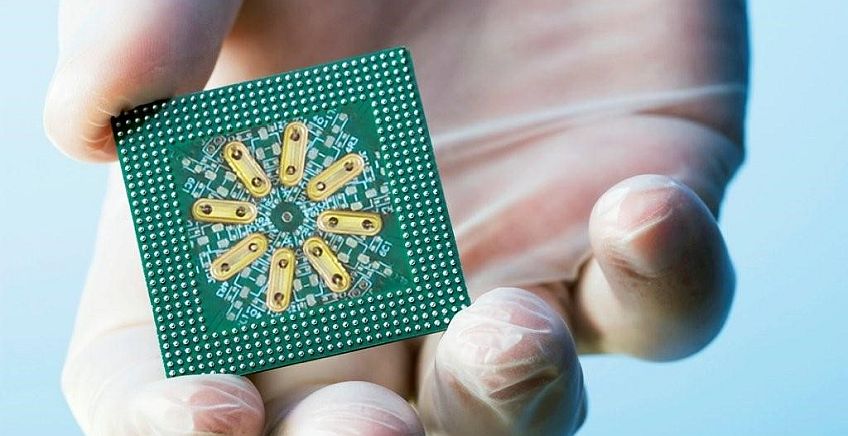
To understand the significance of the new project, it is necessary to examine the core technology behind MS Tech. Unlike traditional “chemical sensors”—which are based on analytical chemistry, electro-chemical reactions, or ionizing radiation and typically require bulky laboratory equipment, reagents, and lengthy testing processes—MS Tech has developed an advanced physical sensing platform built on quartz crystals. These crystals offer exceptional frequency stability and high sensitivity to minute changes in mass. After precise processing and calibration, they vibrate at highly accurate frequencies. When molecules of a specific substance bind to the surface of the crystal, they cause a tiny but measurable shift in vibration frequency—a change that can be detected in real time with high precision.
The company coats the crystals with specialized layers of polymers, antigens, and other molecular materials that function as selective chemical “filters.” Each coating reacts to a different type of molecule, effectively turning the crystal into a sensor tailored to identify a specific substance. By combining several differently coated crystals in a single system, MS Tech can detect a broad range of contaminants, distinguish between them, and deliver near-instant results—without complex chemical processes and without the need for laboratory infrastructure.
MS Tech was founded in 1998 by veterans of Israel’s defense industries and initially focused on developing sensors for detecting explosives for the Israeli defense establishment and the U.S. Pentagon. At the time, most detection systems relied on heavy analytical chemistry and ionizing radiation. The company chose a different path—developing miniature nano-sensors and bio-sensors based on physical sensing principles.
“For years, most technologies in this field were based on analytical chemistry and ionizing radiation,” says Shalom. “Those methods cannot compete with the world of nano-technology and bio-sensors that can be miniaturized and used in the field—that’s where our advantage lies. Our sensors are built on natural quartz crystals that deliver high sensitivity and fast response times, and we apply selective coatings of various types. Each coating turns the crystal into a dedicated sensor by defining its frequency and sensitivity. Over the years, we expanded into additional fields and became a national knowledge center in bio-sensing.”
Security Screening at Airports in India
Alongside its activity in homeland security and defense, MS Tech operates in medical diagnostics, food safety, and environmental monitoring, and its products are used in more than 72 countries. One of its major growth engines in recent years has been the security screening market for airports, particularly in the Asia-Pacific region. The company recently announced significant contracts for deploying advanced detection systems at several airports in India—a market that has become a central focus of its operations.
“We are very strong in the security sector, especially in baggage screening at airports,” says Shalom. “Our main growth wave right now is in the Far East, and particularly in India. At the same time, we are entering new application areas such as drones, humanoid robots, and even mobile devices that in the future will be able to perform chemical sensing tests.”
According to Shalom, the move into contaminated soil monitoring is a natural extension of the company’s core capabilities. “Our technology is dual-use—it fits both security and civilian applications. The contaminated soil market is worth billions of dollars. When you know in real time what the contamination profile of a site is, you can make the right decisions about remediation and development. That saves time and money.”
The project under the “Green Soil” consortium marks a strategic shift for MS Tech from its traditional focus on defense toward environmental and agri-tech applications, while relying on the same technological platform it has developed over nearly three decades. If successful, it could transform soil monitoring from a lengthy laboratory process into a fast and accessible field tool—and open up a significant new global market for the company.
Posted in: News
Posted in tags: Bio Sensors , Israel Innovation Authority , MS Tech