Shifters Raises $10.2 Million: “The Robot Should Enter Before the Soldier”
3 June, 2026
The startup develops autonomous ground robots powered by Physical AI and edge computing for military missions and hazardous environments
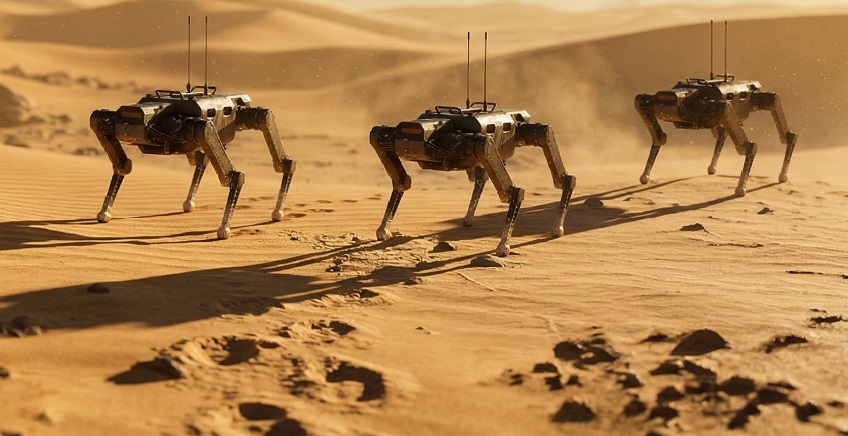
Defense robotics startup Shifters, which develops AI-powered autonomous ground robotic systems, has announced a $10.2 million seed funding round led by Ace Capital Partners. The round brings the company’s total funding to $15 million since its founding in 2023 by CEO Ofer Balin and CTO Asaf Tzafrak. According to the company, it has already conducted demonstrations and pilot programs with defense organizations and is working with Israel’s Ministry of Defense and the Directorate of Defense Research & Development (DDR&D). The new funding will support further AI development, commercial production readiness, and expansion into the U.S., European, and Middle Eastern markets.
Shifters emerges at a time when military robotics is gaining significant momentum. Unmanned systems have become an increasingly important component of modern warfare. In conflicts around the world—including the war in Gaza—ground robots are being deployed for reconnaissance, intelligence gathering, tunnel exploration, suspicious building inspections, and explosive ordnance disposal. The objective is straightforward: send machines into places where the risk to human life is highest.
Yet despite recent advances, ground robotics still faces major limitations. Unlike drones that operate in relatively open airspace, ground robots must navigate chaotic and unpredictable environments filled with rubble, stairs, debris, tunnels, obstacles, and structures that have never been mapped. In many cases, these systems still require close human supervision and, often, a dedicated operator for each platform.
According to Shifters’ founders, this is precisely the challenge they are addressing. While much of the robotics industry remains focused on hardware—motors, actuators, manipulators, and mobility systems—they believe the real bottleneck lies in robotic intelligence.
Four Layers of AI
At the heart of Shifters’ technology is a stack of AI models operating simultaneously. The goal is not merely to move a robot through terrain, but to enable it to understand its surroundings, interpret missions, and act autonomously in dynamic environments.
The first layer focuses on mobility and spatial understanding. Ground robots must constantly make decisions about how to move through stairs, rubble, trenches, obstacles, and narrow passages.
“One of the hardest problems in robotics is not movement itself, but determining how to move through an environment the robot has never seen before,” says Balin. “AI allows us to maximize the physical capabilities of the platform and adapt its movement to the terrain in real time.”
The company combines spatial perception, environmental understanding, and motion control. Rather than simply detecting obstacles, the robot attempts to reason about how to traverse them safely while maintaining stability and mission effectiveness.
A second layer focuses on mission understanding. Instead of executing isolated commands, the system is designed to receive a high-level objective and break it down into actionable steps.
“The technology enables the robot to receive a mission, decompose it into sub-tasks, and execute them until the objective is achieved,” says Tzafrak.
This approach draws heavily on Agentic AI, one of the fastest-growing areas in artificial intelligence. Similar to AI agents used in software environments, the system can plan, make decisions, run multiple models in parallel, and continuously adapt its actions throughout mission execution.
The same capability also simplifies operation. Rather than manually controlling every action, operators can define objectives in natural language while the AI translates intent into tactical actions in the field.
From a Single Robot to Autonomous Teams
The next layer of the technology stack focuses on coordinating multiple robots simultaneously.
“The challenge is not just building a robot that can move,” says Tzafrak. “The more complex problem is enabling multiple robots to understand the operator’s intent, coordinate with one another, and execute missions in unpredictable environments. That orchestration challenge is why Shifters was founded.”
The company’s vision is to deploy teams of autonomous platforms that function as a unified system. Rather than operating independently, robots share information, divide tasks dynamically, and respond collectively to changes in the environment.
These concepts align closely with the emerging field of Physical AI, which seeks to bridge advanced AI models and real-world physical systems. While recent AI breakthroughs have largely focused on generating digital content, the next wave is expected to move into autonomous machines operating in the physical world.
Why AI Must Run on the Robot
One of the most significant technical challenges is computing power. Unlike consumer AI applications, military robots cannot rely on cloud connectivity.
“The robot has to make decisions on its own,” says Tzafrak. “You cannot assume communications will always be available, or that computation can be offloaded to the cloud.”
According to the company, a significant portion of its intellectual property focuses on optimizing AI models to run directly on the platform itself. Shifters uses NVIDIA AI processors and develops edge AI technologies designed to operate within strict constraints involving weight, power consumption, thermal management, and physical size.
As robotic systems become more sophisticated, edge processing becomes increasingly critical. Unlike large AI models running in data centers with thousands of processors, a ground robot must make real-time decisions using limited onboard computing resources while moving through challenging terrain.
For Shifters, the ultimate goal extends beyond building another military robot. “The first entity entering a dangerous environment should be a robot, not a human,” says Balin. “If we can make that happen, we can extend operational reach while significantly reducing the exposure of soldiers to risk.”
If drones transformed how militaries observe and operate from the air over the past decade, Shifters believes that the combination of Physical AI, Agentic AI, and edge computing could drive a similar transformation on the ground. For the company, the future of military robotics will be defined not by stronger motors or more sophisticated actuators, but by the digital intelligence that enables machines to understand their world and act within it.
Posted in: News