The AI Price War: Meta and xAI Take Aim at OpenAI and Anthropic’s Moat
16 July, 2026
Meta and xAI have launched significantly cheaper AI models, raising the question of whether pricing—not intelligence—will determine the industry's next winners
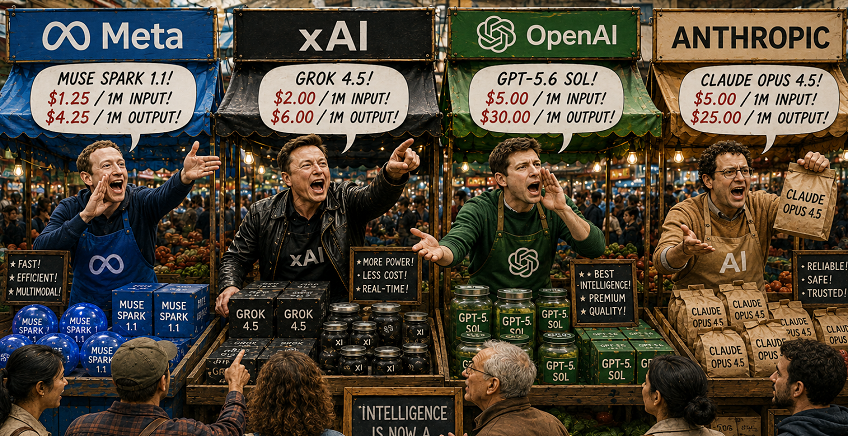
[Image caption: A satirical illustration depicts Mark Zuckerberg, Elon Musk, Sam Altman, and Dario Amodei as market vendors loudly advertising the prices of their AI models]
By Yohai Schwiger
The launches of Meta’s Muse Spark 1.1 and xAI’s Grok 4.5—announced just one day apart—may signal a new phase in the AI race. For the past two years, competition has largely centered on one question: who could build the most capable model? Now, a second question is rapidly emerging: who can afford to sell intelligence at the lowest price?
The target is a market still dominated by OpenAI and Anthropic. Both companies have established themselves as the leading providers of commercial AI models, serving a broad base of enterprise customers and developers. As a result, Meta’s and xAI’s aggressive pricing strategies represent more than a commercial decision—they appear to be an attempt to challenge the current balance of power and capture market share from the industry’s two leaders.
The pricing gap is striking. Muse Spark 1.1 costs $1.25 per million input tokens and $4.25 per million output tokens. Grok 4.5 is priced at $2 and $6, respectively. By comparison, OpenAI’s GPT-5.6 Sol costs $5 for input and $30 for output, while Anthropic’s Claude Opus is priced at $5 and $25. In other words, Meta’s and xAI’s flagship models are priced dramatically below the premium offerings of the two market leaders.
The obvious question is: why?
One possibility is that both companies have achieved technological breakthroughs that significantly reduced inference costs. Yet neither company emphasized that message in its product launch. xAI highlighted improved token efficiency, while Meta explicitly promoted what it described as aggressive pricing. At least for now, the story appears to be less about technology than about competitive strategy.
The real difference lies in their business models.
OpenAI and Anthropic are, first and foremost, AI research companies. Their core product is the model itself, and a significant share of their economic value depends on monetizing access through APIs, subscriptions, and enterprise offerings.
Meta operates under a fundamentally different model. Most of its revenue comes from advertising, meaning it does not need to recover its AI investment from every API call. Lower-priced models can accelerate adoption of Meta AI, strengthen Facebook, Instagram, and WhatsApp, attract developers to its ecosystem, and ultimately reinforce its core advertising business.
xAI also enters the competition from a different position. Although it is not a traditional hyperscaler, it benefits from access to Elon Musk’s broader ecosystem, including substantial capital, computing infrastructure, and strategic distribution channels. For xAI, expanding Grok’s user base may be just as important as maximizing revenue from each API request.
That gives both Meta and xAI greater flexibility to wage an aggressive pricing battle. Meta generates enormous cash flow from its advertising business, while xAI enjoys access to significant financial and infrastructure resources. OpenAI and Anthropic, by contrast, remain much more dependent on generating direct revenue from their AI products.
If that is indeed the strategy, the immediate goal is not necessarily higher profits but faster adoption, greater developer engagement, and larger market share. In other words, the objective is not simply to compete with OpenAI and Anthropic, but to pull them into a pricing battle where Meta and xAI may enjoy structural advantages.
OpenAI and Anthropic have already begun responding. Over recent months, both companies have expanded their portfolios with lower-cost models aimed at customers who do not require their most powerful systems for every task. The emergence of these new pricing tiers suggests that both recognize the competitive landscape is no longer defined solely by model quality.
Behind the pricing battle lies a more fundamental question: do frontier AI models still possess a sustainable competitive moat?
If comparable performance becomes available at significantly lower prices, competitive advantage may shift away from the models themselves and toward distribution, infrastructure, proprietary data, and customer-facing applications. In that scenario, the greatest value will no longer be created where models are trained, but where customers actually use them.
It is still too early to know whether Muse Spark and Grok 4.5 will materially reshape the competitive landscape. One thing, however, is already becoming clear: the next battle in AI will not be fought solely over who builds the smartest model, but over who determines the price of intelligence. For OpenAI and Anthropic—both widely expected to pursue public listings in the coming years—that could prove to be one of the defining strategic questions of their future.
Posted in: AI