
Mobileye to Launch Robotaxi Service, Taking on Waymo and Tesla
17 June, 2026
The company plans to launch an autonomous ride-hailing service in the U.S. with a target fleet of 17,000 vehicles, expanding beyond technology supply into direct robotaxi operations
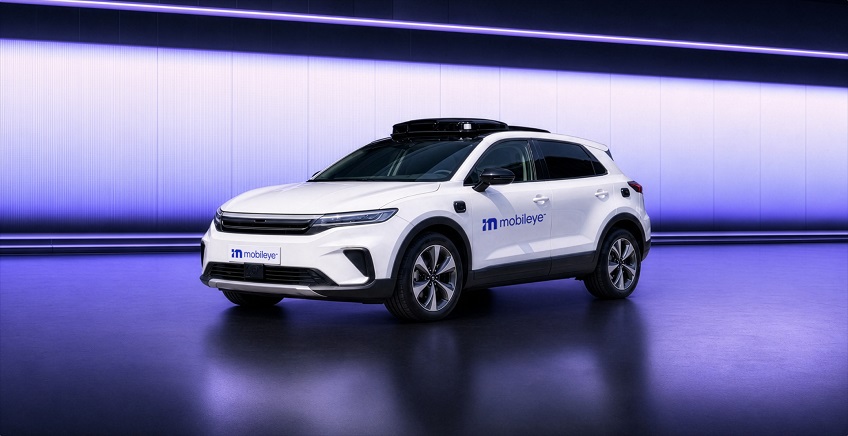
Above: Illustration of Mobileye’s planned robotaxi service. Credit: Mobileye
Mobileye unveiled a major strategic initiative that could significantly expand its role in the autonomous mobility industry. The company announced plans to launch and operate its own robotaxi service in the United States, taking responsibility for fleet operations, user experience, service management, and day-to-day transportation activities.
Under the plan, Mobileye intends to deploy an initial fleet of approximately 100 autonomous vehicles in a major U.S. metropolitan area in 2027. Following the initial rollout, the company aims to scale the service aggressively, targeting roughly 17,000 vehicles within five years.
The service will be built around Mobileye Drive, the company’s autonomous driving platform, and Moovit, the mobility platform acquired by Mobileye in 2020. Moovit is expected to provide the consumer-facing layer, including ride booking, route planning, fleet management, multimodal transportation integration, and operational interfaces.
“The robotaxi revolution is only beginning,” said Prof. Amnon Shashua, Mobileye’s founder and CEO. “Today we are taking the next step by combining our technology with direct operational capabilities in order to build a robotaxi business designed for financial and geographic scale.”
From Technology Provider to Service Operator
The announcement marks a significant evolution in Mobileye’s business model. For more than two decades, the company has established itself as one of the world’s leading suppliers of ADAS and autonomous driving technologies. Its technology is currently deployed in more than 230 million vehicles worldwide, but its business has largely focused on supplying chips, software, and autonomous driving systems to automakers and mobility operators.
The new initiative allows Mobileye to participate not only in the technology layer, but also in the revenue generated by transportation services themselves. Instead of selling only the “brain” of an autonomous vehicle, the company now seeks to capture part of the value created by every ride.
Beyond revenue opportunities, operating its own robotaxi network will provide Mobileye with hands-on experience in fleet management, maintenance, charging infrastructure, customer support, pricing, and remote operations—areas that have become key competitive differentiators for leading robotaxi operators.
The company emphasized that the move does not replace its existing partnerships with automakers and mobility providers. Rather, it represents an additional route to market, with customer-led robotaxi programs and Mobileye-operated services expected to progress in parallel.
Mobileye Drive at the Core
At the heart of the initiative is Mobileye Drive, the company’s full autonomous driving system designed for robotaxis, autonomous shuttles, and driverless transportation services.
The platform combines multiple sensing and software technologies developed by Mobileye over the years, including cameras, radar, LiDAR, REM mapping, and EyeQ processors. Unlike Tesla’s vision-centric approach, which relies primarily on cameras and AI, Mobileye has adopted a multi-sensor architecture in which independent sensing systems operate in parallel and continuously validate one another.
A key component of the platform is the LiDAR technology supplied by Israeli company Innoviz Technologies. Mobileye selected Innoviz’s LiDAR sensors for the Mobileye Drive platform in 2021, and the technology is now integrated into several major robotaxi projects based on the system.
For Innoviz, Mobileye’s expansion could represent a significant commercial opportunity. If Mobileye succeeds in scaling its fleet to thousands of vehicles, demand for the LiDAR systems embedded in Mobileye Drive could increase accordingly.
The ID. Buzz Robotaxi Program
One of the most advanced deployments of Mobileye Drive today is the collaboration between Mobileye, Volkswagen, and mobility provider MOIA.
The project centers on the autonomous ID. Buzz AD, a driverless version of Volkswagen’s electric van designed specifically for robotaxi services. The vehicle integrates Mobileye Drive with a sensor suite that includes cameras, radar, and Innoviz LiDAR units.
More than 100 autonomous ID. Buzz vehicles are already participating in pilot programs across the United States and Europe, with Orlando selected as the first U.S. city slated for commercial deployment. The program is widely viewed as one of the most advanced robotaxi initiatives built on Mobileye technology and offers a glimpse into what Mobileye’s own future service could look like.
If the competition among Mobileye, Tesla, and Waymo has until now focused primarily on whose autonomous driving technology is superior, today’s announcement signals a new phase in the industry’s evolution. The challenge is no longer only teaching a vehicle to drive itself—it is building a scalable transportation business around that capability. For Mobileye, the move may represent the most significant opportunity in the company’s history.
Posted in: News