How to Improve Laser Driver Efficiency
19 October, 2026
The transition from discrete components to an integrated, single-chip driver is the critical factor in overcoming the efficiency and size constraints of portable laser systems
By Ahsan Zaman, Director of Marketing, Silanna
There are three critical elements when it comes to rangefinders: size, battery life and accuracy. A good example of this is for golf rangefinders. These systems need to deliver precise information on the distance of the pin and multiple objects for references including trees, marking stakes etc., which can all be several hundreds of meters away. And in addition to measuring the distance, more advanced rangefinders will have a screen to display information about the course gradients and hazards, built-in wireless communication for updates, GPS etc. and multiple atmospheric condition sensors (wind, atmospheric pressure, temperature, humidity, etc).
Despite the multitude of integrated sensors, processors and displays the battery needs to last for multiple rounds on a single battery or charge. And while bigger batteries can be implemented, size and weight are also issues with the devices needing to be carried around by the users or their caddy. And herein lies the problem, the laser driver behind the rangefinder is exceptionally inefficient.
Indeed, battery life is regularly cited among the most common frustrations with rangefinders. And this inefficiency also results in sizable Bill-of-Material (BOM) with heat sinks to cope with the thermal issues. This means that even relatively simple rangefinders used for Golfing or hunting, are affected by similar issues.
The Inefficiency of Traditional Laser Drivers
The source of this excessive power drain lies in the fundamental design of traditional, discrete laser drivers. To achieve an accurate distance measurement, a rangefinder’s laser must emit a pulse of light. These pulses are quite short (20-50 nanoseconds) but deliver over 100 W of optical power. The traditional model of delivering this is to have a discrete boost to convert from low battery voltage (3.3 V typical) to over 50 V, to charge a capacitor. This capacitor is then rapidly discharged through the laser using a MOSFET switch.
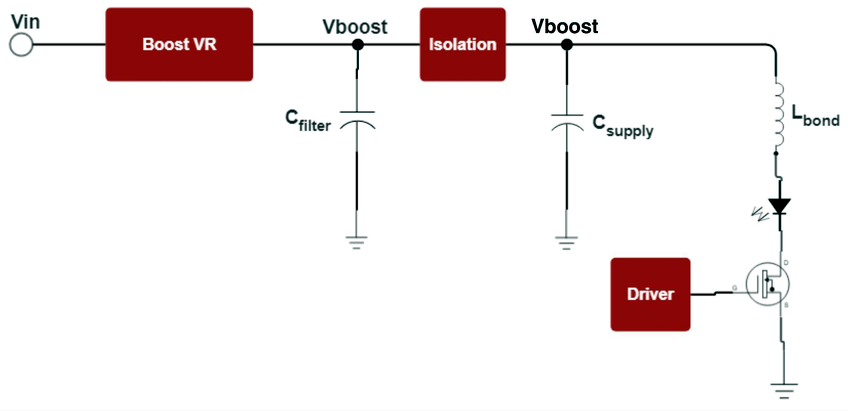
Figure: Traditional architectures require multiple boost stages, and losses are compounded
Doing so requires multiple boost stages and, even if the boost stages in and of themselves are efficient, losses are compounded, so a two-stage process using 90 percent-efficient boost converters results in an efficiency of 81%. Added to this is that the circuitry required to isolate the high-voltage components is also inefficient, with some designs losing as much as 50% of the energy during the transfer process.
Energy is lost as heat at several stages, most notably during MOSFET switching, through the internal resistance of the capacitor, and across the PCB traces. Effective thermal management is required to maximize the performance and lifespan of the laser diode and other sensitive electronics. However, the addition of heatsinks increases the overall size, weight, and cost of the system.
A More Efficient Architecture
Rather than relying on a disparate collection of discrete components, which creates these inefficiencies, it is possible to combine the boost voltage regulator (VR), the high-speed GaN FET driver, and the essential control logic into a single chip.
This high level of integration allows the driver to bypass the inefficient energy transfer inherent in discrete designs. Taking this approach also allows for on-chip logic to directly manage the charging and firing of the laser to provide precise control over the pulses – be it from a vertical cavity surface or edge emitting laser (VCSEL/ EEL).
As a result, such architecture enables increase in peak optical power, so where a standard consumer rangefinder would typically operate at between 5 W and 40 W, this design can deliver over 150 W in pulses shorter than 50 nanoseconds, giving a higher reliability and a greater effective measurement range.
Such high peak power generates a stronger return signal, which is critical for ranging on distant or low-reflectivity targets, like a flagstick against a tree line. This results in a greater effective range and more consistent measurements in challenging conditions. The improvement in efficiency is also dramatic, with overall charging efficiency reaching 85%. This extends battery life and, because the system generates far less waste heat, eliminates the need for bulky heatsinks. The combined effect is a compact device with enhanced accuracy and a longer, more reliable operating range.
Conclusion
The transition from discrete components to an integrated, single-chip driver is the critical factor in overcoming the efficiency and size constraints of portable laser systems. Whether integrated into golfing rangefinders, high-precision hunting scopes, or professional laser distance meters, this architectural shift directly translates into longer battery life, more compact designs, and more reliable readings. By enhancing performance within a smaller footprint, integrated drivers make advanced laser sensing viable across a far broader range of consumer and industrial applications.
More Information: silannasemi.com/lidar-firepower/
Posted in: ElectroOptics , News , Technology
Posted in tags: Silanna