Zeroport Deploys AI Agent Security System at Major U.S. Chip Foundry
16 November, 2026
Hundreds of AI agents access production systems through hardware that keeps networks physically separate. Zeroport has also deployed the system at water and desalination facilities
By Yohai Schwiger
Israeli cybersecurity company Zeroport has deployed a system at a major U.S. chip foundry that allows hundreds of AI agents to work on its production systems, co-founder and CEO Sefi Gertz told TechTime. The system sends commands and returns a live view of the screen through a circuit board that keeps the networks physically separate. If an agent breaks a rule set by the customer, the system can cut the connection. The foundry deployment follows installations at water and desalination facilities and at power utilities. Zeroport is targeting the U.S. as its main market while building an Asia-Pacific distribution network out of Singapore.
At the foundry, the agents run on an on-site GPU cluster on the corporate IT network and access systems on the operational technology (OT) network in real time. “Each of their fabs generates 20 terabytes of data a day,” Gertz said. “Instead of moving the data to the IT network, processing it there and waiting to see what’s happening, the agents can connect to the production systems in real time.” The chipmaker had previously held off on granting that access, he said, over concerns that an agent might stray from its assigned task or take a harmful action. “An hour of downtime costs them about $1.5 million per fab. With our system, they were satisfied that the agents could run on the IT network and work on systems on the OT side.”
A major Japanese chipmaker uses the same system to give technicians access to production systems from its corporate IT network. In the water sector, the system is also used primarily by staff. Gertz said three water-sector customers have deployed it for remote monitoring, maintenance and troubleshooting. Before one desalination plant installed the system, four technicians had to make the trip every day. “They’d get up in the morning, drive two hours, cross the border, spend eight hours at the desalination plant and come back in the evening,” he said.
Commands In, Screen Images Out
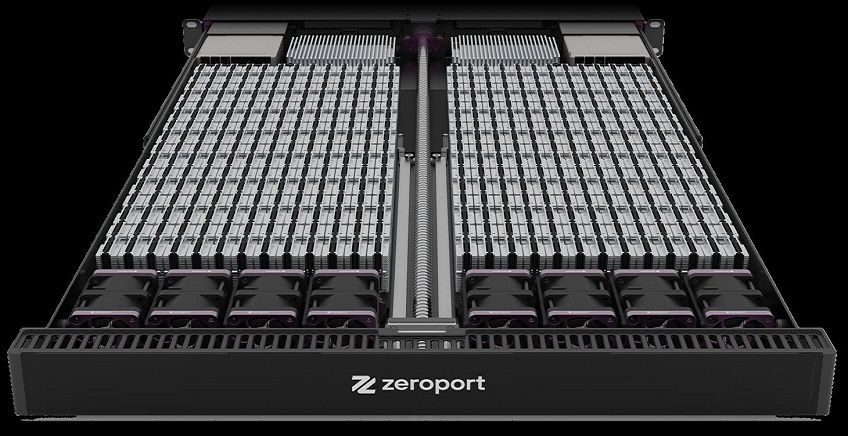
At the heart of the system is a circuit board called Fantom Core. The outward-facing side takes keyboard and mouse inputs and converts them into an analog signal that crosses a physical gap on the board. The other side recreates those inputs on the protected network. The screen image travels in the opposite direction, allowing the user or agent to see the result of each action and continue working. Zeroport says IP packets and files cannot cross the gap. Each board handles one active session, and a single server unit can hold up to 200 boards.
To illustrate how it works, Gertz suggests imagining a video call with a colleague at the office. “She points the camera at the screen you want to work on, and you tell her to type A, B, C, D. Now put that inside a tiny electronic circuit.” A user can open and edit a document on the company’s system while the file itself stays there. “It’s like having the computer in one room and your keyboard, mouse and monitor in another,” he said. “You simply can’t transfer files.”
For AI agents, Zeroport added a monitoring layer called Moativ, which runs on an NVIDIA Jetson AGX Thor module inside the device. It monitors actions and screen activity in real time against rules the customer sets for each session. “For each agent, you can decide what it’s allowed to do, when and where on your network,” Gertz said. “If it opens a folder it shouldn’t or behaves in a way you’ve defined as abnormal, a physical switch on the board cuts the connection.” Zeroport demonstrated the system at NVIDIA’s GTC conference in Berlin in October as part of the NVIDIA Inception program.
From Remote Access to AI Agent Oversight

Gertz and CTO Lavi Friedman founded Zeroport in May 2024 to solve a remote-access problem familiar to operators of isolated systems. They wanted employees and service providers to be able to work on those systems without opening a direct network connection. “Our premise was that an engineer in Tokyo shouldn’t need a VPN to connect to a device in San Francisco,” Gertz said. “A VPN creates a tunnel for IP traffic. If someone takes over your computer, that same tunnel can carry malware into the network you’re working on.” As companies began exploring how to deploy AI agents in sensitive environments, Zeroport used the same hardware to give customers a way to monitor agents as they work.
Zeroport emerged from stealth in January 2026 with a $10 million seed round led by lool ventures, with participation from Clarim Ventures, CyberFuture and Fusion Fund. Gertz said the company has raised $15 million to date, employs 30 people and serves 15 customers across five countries. Alongside the foundry, its U.S. customers include a major insurer and a local government. In Singapore, where Gertz said ST Engineering makes the boards, Zeroport has signed agreements with 12 distributors. The company is also exploring transportation applications. Gertz said it is in talks with a vehicle manufacturer about installing the boards in a fleet of 5,000 electric buses to provide remote access to vehicle data and onboard systems.
Posted in: News