Imagination Technologies is Looking for a Buyer

Imagination Technologies HQ in UK

[Photo above: Imagination’s Headquarters in  Hertfordshire, UK]

Five weeks after the British  silicon IP (intellectual property) provider  Imagination Technologies (IMG.L) announced the sale of its MIPS division that provides RISC based CPU IP, the company announced the commencement of formal sale process for whole Group. In a letter to shareholders, sent on June 22, 2017 Imagination’s Chairman, Peter Hill, informed that over the last few weeks it has received interest from a number of parties for a potential acquisition of the whole Group.

“The Board of Imagination has therefore decided to initiate a formal sale process for the Group and is engaged in preliminary discussions with potential bidders. “The sale process for the MIPS and Ensigma operations, which commenced on 4 May 2017, is progressing well and indicative proposals have been received for both businesses.”

The Company’s business model is based on the licensing of embedded processor intellectual property (IP) in the form of both architectures and implementations. MIPS customers are global semiconductor companies and system original equipment manufacturers (system OEMs). Its technology is standard processor architectures and cores, mainly GPU, CPU and networking, sold to global semiconductor companies and OEMs, through its main divisions: Ensigma, MIPS and PowerVR.

Employing approximately 1,400 employees and traded in London with market value of about $618 million, Imagination struggle a financial crisis and a major uncertainty caused by GPU dispute with Apple. Three months ago Imagination’s largest costumer, Apple Inc, has decided to cut the royalties it pay to Imagination by 2/3, resulted in a law suite of Imagination against Apple. On May 4, Imagination has commenced a dispute resolution procedure under the licence agreement “with a view to reaching an agreement through a more structured process”.

This did not impress the market: UBS analysts estimated that Imagination will record losses in fiscal year 2019. The issue is deeper, lately Techtime has learned from sources close to the company that Apple plans to develop its own GPU processor. A move that will not only  cut off Imagination relationships with its giant costumer – but also creates a formidable competitor in its most important segment of the market.

This is the power of Apple: Three months after it clashed with Imagination Technologies – the company put itself up for sale!

SoftBank Invested $100 Million in Cybereason

CYBEREASON FOUNDERS

The cyber company Cybereason announced the signing of a $100 million investment from SoftBank Corp., a subsidiary of SoftBank Group Corp. Following this financing, Cybereason has raised a total of $189 million in capital from SoftBank, CRV, Spark Capital, and Lockheed Martin since being founded in 2012.

SoftBank is Cybereason’s biggest investor and one of its biggest customers and distribution partners. The company reported a 500 percent growth in revenue and nearly 200 percent growth in employees across the globe last year. Cybereason was founded by elite intelligence professionals (photo above) born and bred in offense-first hunting. It developed its Total Endpoint Protection Platform including EDR & Next-Gen AV.

WannaCry Ransomware Proven

The Cybereason platform is powered by a custom-built in-memory graph, a truly automated hunting engine designed to detect behavioral patterns across every endpoint and surfaces malicious operations in a user-friendly interface. Cybereason is privately held and headquartered in Boston with offices in London, Tel Aviv, and Tokyo. For more information, please visit .

“This new funding allows us to increase our growth through new distribution channels and to develop new technologies’,” said Lior Div, co-founder and CEO. Cybereason’s proprietary, automated SaaS cybersecurity technology and advanced monitoring services have protected hundreds of Fortune 1000 companies. Most recently, It shielded costumers from the global WannaCry Ransomware attack.

Automated Hunting Technology

Cybereason technology is about automating the hunt after threats, and doing it dramatically faster. Sensors on every endpoint in the network silently monitor the entire organisation’s environment without impacting user productivity. All the data from the sensors is constantly relayed to the Cybereason Hunting Engine, which remembers, relates and connects past and present activities. Thus it is continuously grows stronger, smarter and more effective.

The heart of Cybereason Hunting Engine is a custom-built in-memory graph. It interrogates every endpoint by asking 8 million questions per second, 24/7 to uncover malicious tools and tactics. Using machine learning algorithms, the Hunting Engine recognizes hard to find behaviors, including fileless malware and lateral movement. It connects seemingly unrelated or benign events to reveal the full scope of the attack.

RADA Completed On-The-Move tests Tactical Radars

Rada On the Move Radars

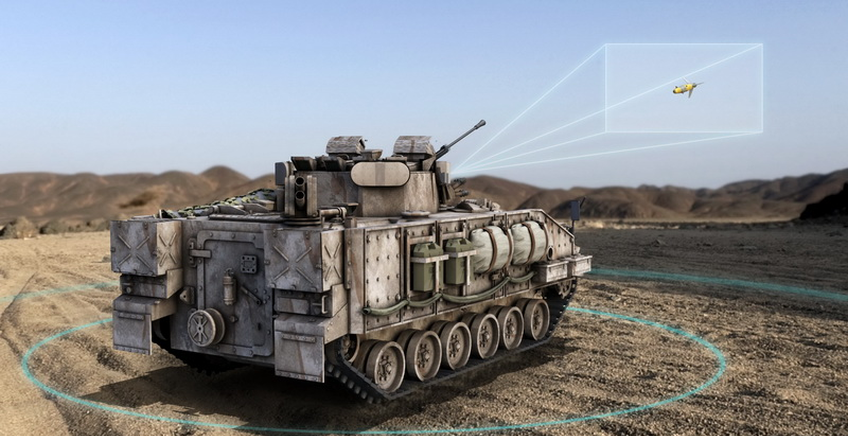
RADA Electronic Industries (Rada) from Netanya, Israel, added mobility to its line of tactical Radars. The company announced the successful completion of advancing the operability of its tactical radars for the maneuver force, providing the On-the-Move (OTM) operation. The OTM capability is a highly desirable operational requirement by tactical maneuver forces, especially when encountering low, slow and small-sized threats such as armed drones and tactical unmanned aerial vehicles (UAVs).

Rada revealed that the capability was recently demonstrated to a strategic customer under a field tests. The radars demonstrated early detection, continuous and accurate tracking of a wide variety of small-sized, low and slow aerial targets from a continuously moving vehicle on varied terrain. RADA’s upgraded RPS-42 MHR-based counter-drone radar systems with OTM capability will be delivered to this particular customer, as well as others, in July 2017.

RADA has implemented the OTM capability on its family of Multi-Mission Hemispheric Radars (MHR) and Compact Hemispheric Radars (CHR) by integrating its radars with Inertial Navigation System (INS). In addition, it has implemented and completed the testing of the sophisticated algorithms and signal processing techniques required for OTM. RADA’s Multi-Mission Hemispheric Radar (MHR) and Compact Hemispheric Radar (CHR) are S-band, software-defined, pulse-Doppler, active electronically scanned array (AESA) radars.

The Turnaround is Nearly Completed

RADA Electronic Industries Ltd. is an Israel-based defense electronics contractor. The Company specializes in the development, production, and sales of Tactical Land Radars for Force and Border Protection and Avionics Systems (including Inertial Navigation Systems) for fighter aircraft and UAVs.

During the first quatrer of 2017, its revenues totaled $4.7 million, up 91% compared to revenues of $2.5 million in the first quarter of 2016. Dov Sella, RADA’s Chief Executive Officer, said the the turnaround of the company, focused on radar technology is beginning to mature. “Looking ahead, we expect the second quarter to be strong. We are increasing our full year revenue guidance towards $20 million for 2017, representing a year over year growth of over 50%, and expect to return to profitability in 2017 on a full-year basis.”

China takes the lead of Smartphone Market

oppo smartphone

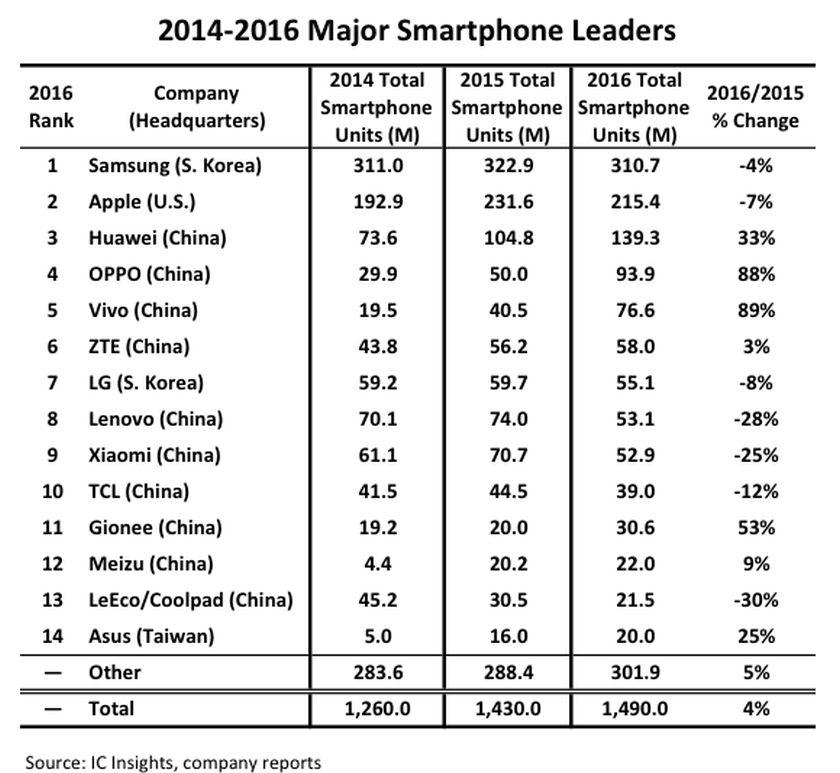
IC Insights recently released its Update to its 2017 IC Market Drivers Report.  The Update includes IC Insights’ latest outlooks on the smartphone, automotive, PC/tablet and Internet of Things markets. It reveals that 7 of the top 10, and 10 of the top 14 companies were headquartered in China with two South Korean (Samsung and LG) and one U.S. (Apple) and one Taiwanese company (Asus) making up the remainder of the companies listed. It is interesting to note that OPPO and Vivo, the two fastest growing smartphone suppliers on the list last year with each company growing almost 90%, are owned by the same China-based parent company—BBK Electronics.

Samsung and Apple dominated the smartphone market from 2014 through 2016.  In total, these two companies shipped 555 million smartphones and held a combined 39% share of the total smartphone market in 2015.  Although these two companies still shipped over one-half billion smartphones (526 million) in 2016, their combined smartphone unit marketshare dropped four percentage points to 35%.

ic insights smartphone report

Samsung’s total smartphone unit sales were down by 4% in 2016 to 311 million units, a weak showing in a total smartphone market that grew by 4%.  With orders sagging for Apple’s pre-iPhone 7 smartphones (the iPhone 7 was first released on September 7, 2016), Apple’s total smartphone shipments dropped by 7% in 2016, much worse than the total 4% growth rate exhibited for the worldwide smartphone market.  Although Samsung and Apple still hold a strong share of the high-end smartphone segment (>$200), it appears that both companies are losing smartphone marketshare to the up-and-coming Chinese producers like Huawei, OPPO, and Vivo.

Overall, there was very little “middle ground” with regard to smartphone shipment growth rates among the top 14 suppliers in 2016.  As shown, seven of the top 14 companies registered declines in 2016 shipments while five companies logged 25% or better increases.  In fact, four Chinese smartphone suppliers’ shipments surged by greater than 30% (Vivo, OPPO, Gionee, and Huawei) in 2016.  LeEco, which only began shipping its smartphone handsets in 2015, became Coolpad’s largest shareholder in October 2016.  As a result, IC Insights combined the two companies’ smartphone sales for 2015 and 2016.

In 2014, Japan-based Sony was ranked 10th in smartphone shipments with sales of 40.0 million handsets.  However, in 2016, Sony’s shipments of smartphones had dropped precipitously to only 15.1 million (with sales expected to increase only slightly in 2017 to about 16 million).  In contrast to the weakening fortunes of Sony, 2015-2016 smartphone sales from most of the top China-based suppliers surged.  In fact, Huawei, the third largest smartphone producer in 2016, has set its sights on surpassing Apple within the next five years.

Combined, the 10 top-14 smartphone suppliers that are based in China shipped 587 million smartphones in 2016, a 15% increase from the 511 million smartphones these 10 companies shipped in 2015.  As a result, the top 10 Chinese smartphone suppliers together held a 39% share of the worldwide smartphone market in 2016, up three points from the 36% share these companies held in 2015 and seven points better than the 32% combined share these companies held in 2014.


Autonomous self-healing Interconnects

Data Center in CERN. Source: Techtime

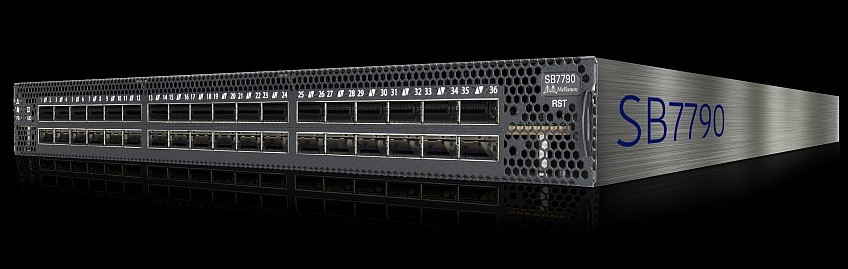
Mellanox Technologies from Yokneam, Israel, revealed a new technology for Datacenter connectivity called SHIELD. It improves data center fault recovery by 5000 times using  autonomous self-healing capabilities of interconnects. SHIELD technology is enabled within Mellanox’s 100G EDR and 200G HDR InfiniBand solutions. It enables interconnect components to exchange real-time information and to make immediate smart decisions that overcome issues and to optimize data flows.

New Kind of Data Center

Mellanox estimates that the CPU-centric data center architecture has come to an end. “A new data centers are now built based on a data-centric architecture. These systems require an intelligent interconnect that can deliver In-Network Computing and Self-healing capabilities, to ensure highest performance, scalability and resiliency,” said Gilad Shainer, vice president of marketing at Mellanox technologies.

“Our SHARP and SHIELD technologies provide the ability to analyze data within the interconnect, and to overcome issues. The result is 10X to 5000X improvements. These technologies are essential for high-performance computing, artificial intelligence, big data, cloud and other demanding applications to ensure highest productivity.”

Dan Olds, principal analyst at OrionX.net, said that the new generations of interconnects have to handle data analysis as well as increase the overall robustness of the system. “SHIELD is a breakthrough technology enabling self-healing interconnect solutions.”

How to Teach Your Car to be Autonomous

Simulation Platform for autonomous vehicle developers

Bringing an autonomous vehicle to the road is not an easy task. Beside the huge technical challenges, the final product must be tested, evaluated, re-tested, re-designed, re-evaluated and receive all the needed approvals. According to Rand Corp such vehicles will need to drive 10 billion miles in order to reach a human-level error rate —and that can take years to achieve. Rand: “Autonomous vehicles would have to be driven hundreds of millions of miles and sometimes hundreds of billions of miles to demonstrate their reliability in terms of fatalities and injuries.”

CEO Danny Atsmon
CEO Danny Atsmon

But the industry do not ready for this: Even the largest developers of autonomous vehicles have only accumulated a few million miles in autonomous mode after years of testing. Cognata, Ltd., a startup company from Rehovot, Israel, has came up with a smart solution to this problem: artificial intelligence, deep learning, and computer vision in a simulation platform that enables autonomous vehicle developers to shave years off the long, costly process of road-testing autonomous vehicles.

Today Cognata announced the launch of its simulation engine, supported by $5 million in funding from Emerge, Maniv Mobility, and Airbus Ventures. The company will use the funding to accelerate product development and commercialization of its new solution.

Realistic Driving Environment

Cognata uses patented computer vision and deep learning algorithms to automatically generate a whole city-simulator including buildings, roads , lane marks, traffic signs and even trees and bushes. The core of the the product  is a deep learning simulation engine leverages reality-grade city mesh combined with DNN (deep neural network) and AI capabilities.

It adds dynamic layer of realistic traffic model of other vehicles and pedestrians. Historic local weather conditions and lighting are added to stress test the system. The simulation engine also simulate the sensor interaction with the external materials including sensors ,saturation and lost packets to receive the most comprehensive autonomous driving simulation feedback loop from each drive.

Cognata Simulator at Work

The simulation engine reproduces sensor input in high fidelity by emulating interactions with real-world materials. Furthermore, Cognata can recreate cities anywhere in the world, allowing a dramatically expanded range of testing scenarios beyond the current limited geographies, to the great benefit of any OEM and Tier-1 autonomous vehicle manufacturer.

Cognata was founded in 2016 by a team of experts in deep learning, autonomous vehicles and computer vision. The CEO, Danny Atsmon, is  a deep-learning expert who formerly served as Harman’s director of ADAS. He explained: “Our simulation platform rapidly pumps out large volumes of rich training data to fuel these algorithms. We introduce a scalable, safe, and cost-effective solution that not only accelerates the development and validation of autonomous vehicles, but also ensures that vehicles can be much safer when they’re deployed in the real world.”

François Auque of Airbus Ventures adds, “After extensive technical evaluation of the team and the technology, we look forward to using Cognata’s technology, which can accelerate the time to market for land-based autonomous systems as well as the kind of aerial systems we are focusing on.” The current investors in the company includes Emerge venture capital firm, Maniv Mobility, Israel’s first venture capital fund dedicated exclusively to the new mobility future, and Airbus Ventures, headquartered in Silicon Valley and Paris.

Elbit brings to Paris its Revolutionary SkEye Sensor

Today’s surveillance technology allows defense and police organisations to gain situational awareness of wide areas by using multiple aerial platforms carrying many optical sensors and to combine all the information sources on the ground. But what if you had only one aerial platform with mega-size camera that gives you all the information needed in a Google style zoom-in capabilities? This is exactly what Elbit’s revolutionary optical payload SkEye gives.

Elbit Systems will reveal at the 2017 Paris Air Show in Le Bourget, taking place this week, its newest innovative wide area persistent surveillance solution – SkEye. The SkEye camera comprises advanced capabilities in the field of imagery intelligence gathering, providing a complete high-resolution picture and up to 80 square kilometer coverage of the Area of Interest  (AOI) to a large number of users.

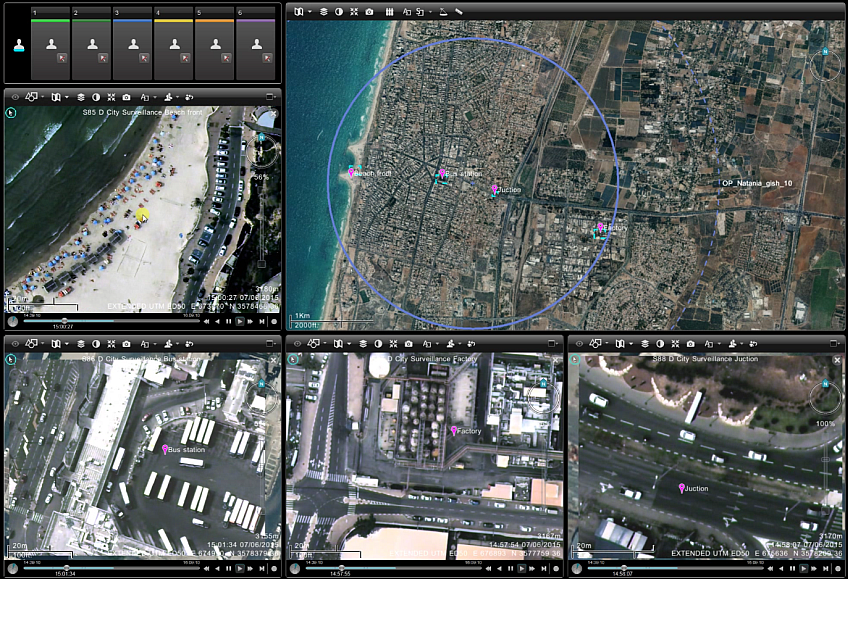
Visual Intelligence (VISINT) gathering was traditionally available in a designated video format. The user could see and record only the area the Electro Optic (EO) payload was viewing, while missing the surrounding area. SkEye WAPS changes this paradigm by persistently observing and recording a wider area than ever before. It offers the system’s users the ability to select real-time or “back in time” video footage within the covered area without being limited to a single segment. Up to ten Regions of Interest (ROI) can be thoroughly analyzed simultaneously using video footage from the recent and previous missions.

Elbit SkEye Operator Screen
Many Simultaneous and Independent Monitoring of Multiple Targets

It means that one SkEye mission can take the place of 10 different flying sensors. While looking over a large Area-of Interest (AOI), operators can zoom into multiple Regions of Interest (ROI) simultaneously and understand the connection between them. This is achieved without neglecting the rest of the area, which is still being recorded and constantly analyzed.

Installation on Manned and Unmanned Platforms

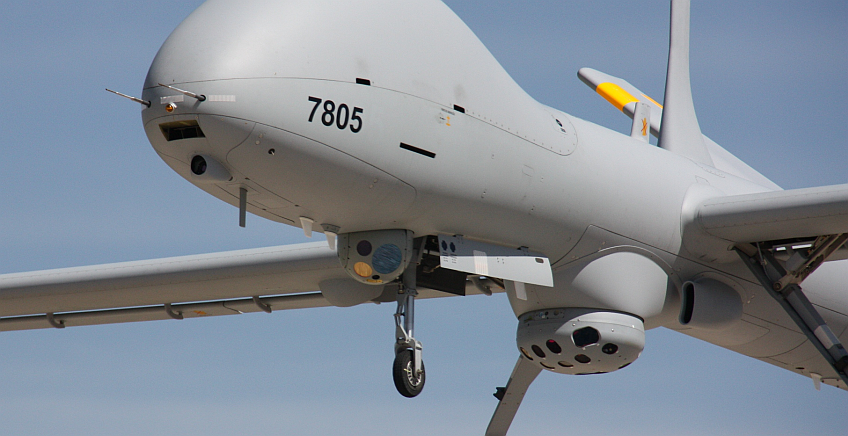
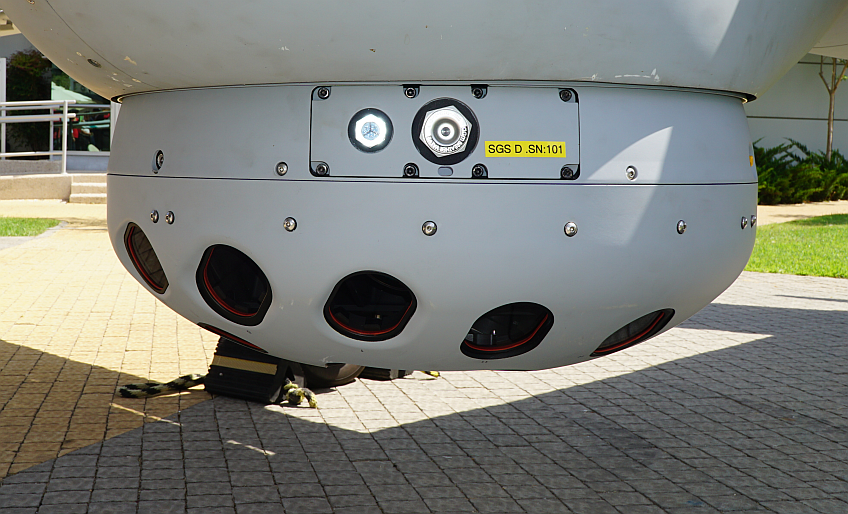
The heart of the system is an airborne segment consisting of the EO sensor unit, an advanced image processing unit, a large mass storage unit and analysis applications. Via an embedded data link, the relevant information is transmitted from the aircraft to the SkEye, Control and Management Center (SCMC) (fixed or mobile), which can be integrated with the customer’s Command & Control (C2) solution.

Elbit offer t supply SkEye onboard its Hermes 450 and Hermes 900 UAS platforms. It is also possible to install the system in manned aircraft such as Twin Otter (DHC-6). Elbit reported this week that it is already operating in various countries globally, and is installed on various types of unmanned aircraft vehicles and light manned aircraft.

SkEye Sensor Close Look
Close Look at SkEye Sensor