“Switching to recyclable packaging does not require any compromises”

By Dr. Shaul Lapidot, CEO of Melodea

Nature is a valuable resource and, for me, a natural partner. Growing up close to it, I have dedicated my professional life to developing innovative solutions that resonate with its existence, from my days as a Ph.D. student in biotechnology to today as an entrepreneur and CEO of Melodea, a company specializing in advanced recyclable technologies for the packaging industry. I see the significance in creating new standards that will help carry on for future generations.

Global Recycling Day 2025 is a good opportunity to express my true belief that the packaging industry has a significant opportunity to create positive change towards becoming greener with today’s innovative solutions, which are finally able to meet the demands of brand owners and manufacturers. 

With over 80% of consumers preferring sustainable packaging, the market clearly indicates a path that aligns business success with environmental responsibility.

Recyclable packaging should be a key goal for reducing waste and lowering companies’ carbon footprints as they establish their sustainability objectives. But this is not enough. The future of packaging relies on solutions that are also market-compatible and balance performance, sustainability, and economic viability.

This is the big news for 2025! The benefits for those in the packaging industry who are willing to make the change are clear: They can have all-in-one recyclable innovative packaging, either from plastic or paper, with competitive manufacturing costs, regulatory compliance, enhanced brand equity and attraction of eco-conscious consumers, and consistent product performance.

The Environmental Crisis is Also a Moral Crisis

Plastic waste is not just an engineering challenge but also a moral responsibility. Every discarded package highlights a system not designed with circularity in mind. Millions of tons of plastic packaging waste pollute our ecosystems, mostly from products used for only minutes. Non-recyclable packaging accounts for 60% of greenhouse gas emissions, 80% of water usage, and 66% of deforestation.

The Technology Is Already Here – Will the Industry Adopt It?

The plastic packaging production industry faces a looming EU deadline in 2030, which requires all packaging to be 100% recyclable to avoid penalties. However, the transition to sustainable packaging solutions has been slow-paced, with only a small percentage of manufacturers making the switch.

The good news for plastic and paper manufacturers is that switching to recyclable packaging does not require any compromises or additional costs. In the past few years, we have seen an increasing demand for solutions that can convert complex, non-recyclable structures into uniform, recyclable packaging. This is a positive indication that companies are committed to pursuing sustainable solutions.

The benefits for clear industry players. By adopting recyclable packaging, companies can enhance brand equity, attract eco-conscious consumers, and showcase innovation. They can also reduce waste, lower their carbon footprint, and position themselves as sustainability leaders in this pivotal era of packaging transformation.

Melodea – An Ongoing Revolution in Recyclable Packaging

 Over the past few years, Melodea has been working on solutions to meet industry demands by offering recyclable plastic and paper packaging. Solutions that enable a practical transition to accessible, cost-effective, and regulatory-compliant recyclable packaging while ensuring the highest quality performance. Our collaborations with global Tier 1-4 brands and leading manufacturers reflect a shared commitment to driving change. However, implementation takes time. To achieve the 2030 targets, we must start taking action today.

Our Solutions – A Practical Revolution for Manufacturers

Melodea’s MelOx NGen, renowned for its outstanding oxygen barrier capabilities, allows manufacturers to reduce metallization levels and move to mono-material packaging structures while saving on raw materials and streamlining processes.

Companies transitioning to recyclable paper solutions can do so confidently, with optimal protection against moisture, oil, and oxygen through MelOx NGen and VBseal synergy.

The Future is in Our Hands – Will We Take the Next Step?

Now is the time to act. Brands, packaging manufacturers, and technology providers should take this small step—it is small for the industry but potentially transformative for humanity and future generations.

The future of packaging depends on innovative solutions that seamlessly balance performance, sustainability, and economic viability – creating a clear competitive advantage for forward-thinking brands in this rapidly evolving market. 

This is the most natural course of action.

The future can be bright if only we keep this in mind! Industry players, let’s unite!


Kubescape Achieves Major Milestone in Open Source Kubernetes Security

[Pictured above: Armo’s founders. ARMO]

ARMO, the leading Cloud Runtime Security company and the creator of Kubescape, announced today that Cloud Native Computing Foundation® (CNCF®), the leading forum for cloud native software, has promoted Kubescape to incubating project status. This promotion represents a significant validation of Kubescape’s growing adoption, maturity, and value to the cloud native security and DevOps communities.

Kubescape, first accepted into the CNCF Sandbox in 2022, is an open source cloud and Kubernetes security project that provides risk analysis, security compliance, threat detection and misconfiguration and vulnerability scanning. Kubescape is the first Kubernetes security scanner that was accepted into the CNCF. It is used by thousands of organizations, including Intel, AWS, Bitnami, Cox, Energi Danmark and more. The project has seen substantial growth in its user base and contributor community since it was launched in late 2021, with over 10,400 GitHub stars and contributions from developers worldwide.

“Achieving incubation status is a testament to the hard work of the maintainers and the incredible support from the Kubescape community,” said Shauli Rozen, CEO and co-founder of ARMO. “Kubescape’s promotion reflects its increasing adoption and the critical role it plays in securing cloud native environments across the globe.”

“For the past three years, we’ve engaged with adopters across organizations of all sizes – from cybersecurity and telecommunications to financial services and e-commerce. The scale of adoption has validated our vision, particularly with Kubescape’s incorporation into AWS security training materials, Intel’s public endorsement, and its contribution to securing other open source projects through platforms like Bitnami. It’s remarkable to see how an informal conversation between friends over coffee has evolved into something that delivers substantial value to organizations worldwide,” said Ben Hirschberg, CTO and co-founder of ARMO.

“Projects like Kubescape provide adopters with a robust series of security capabilities that go beyond vulnerability scanning, to include all aspects of security considerations in Kubernetes environments. Kubescape’s promotion to Incubation shows not only the readiness and desire of adopters to take advantage of the solutions, such as security framework testing and hardening, but also demonstrates growing maturity and cloud native’s continued commitment to feature-rich security tools and projects which address multiple security concerns adopters have today and in the future,” said Emily Fox, Portfolio Security Architect at Red Hat and TOC Sponsor. “The Kubescape project’s incubation announcement and their commitment to simplifying security for adopters places them on a path to gain widespread traction with other adopters, accelerating contributor diversity and setting them up for success towards Graduation.”

Hi Auto will be deployed across all Popeyes UK restaurants

[Pictured above: Popeyes UK drive-thru]

Hi Auto, a leader in conversational AI solutions for quick-service restaurant (QSR) drive-thrus, is working to transform the drive-thru experience at Popeyes UK. Popeyes UK, which operates all of Popeyes Louisiana Chicken restaurants in the United Kingdom, has selected Hi Auto’s voice AI platform to improve its drive-thru operations by delivering a pleasant, consistent, and efficient service for customers.

Under a newly signed multi-year agreement, Hi Auto’s technology will be deployed across all Popeyes UK restaurants. This partnership will support Popeyes UK’s ambitious growth plans, with dozens of new stores expected to open annually.

Hi Auto’s drive-thru conversational AI platform is purpose-built for noisy drive-thru environments. It reduces errors and wait times, addressing key operational challenges and enhancing the in-car ordering experience for guests. With features like algorithmic upselling, branded voices, and multilingual capabilities, Hi Auto transforms drive-thru lanes into dynamic marketing channels. Additionally, its ability to handle Popeyes UK’s “tandem” drive-thru configuration—with two speaker boxes one after another—makes it a perfect fit for their operations.

Since entering the UK market in November 2021, Popeyes has steadily gained recognition among fried chicken enthusiasts. With approximately 3,000 locations across the USA, the brand is establishing a growing presence in the UK as it continues to expand. Popeyes UK aimed to set a new standard in the drive-thru experience and, after evaluating several alternatives and conducting a year-long pilot program at multiple locations, determined that Hi Auto’s technology delivered the best results.

“Hi Auto’s technology is built to perform well in complex environments, and we’re pleased to support Popeyes UK in enhancing their drive-thru experience,” said Roy Baharav, CEO and Co-Founder of Hi Auto. “This partnership, reflecting Hi Auto’s growing momentum, will enable Popeyes UK to deliver a smoother and more enjoyable ordering experience for its guests.”

David Carey, Chief Technology Officer at Popeyes UK, stated: “Hi Auto’s conversational AI allows us to offer a seamless, efficient, and consistently excellent service, even during our busiest hours. As we continue our rapid expansion across the UK, this technology will help us set a new benchmark for speed and hospitality in the QSR industry.”

UK Space Agency Awards SatixFy £1.8M

SatixFy Communications announced that it has secured funding of £1.8 million (approximately $2.3 million) from the UK Space Agency under its C-LEO program, for the development of an advanced software suite for digital satellite payloads. Based in Rehovot, Israel, SatixFy provides next-generation satellite communication systems based on in-house-designed chipsets. The funds will support SatixFy’s development of advanced regenerative and digital beamforming software, addressing the increasing demand for software-reconfigurable satellite payloads.

The software is designed for real-time control and monitoring of LEO/MEO/GEO payloads, whether based on DVB, 3GPP, or other waveform families. The software is expected to play a pivotal role in enabling highly flexible, adaptive, and intelligent satellite networks. It has being designed to seamlessly integrate with SatixFy’s Sx4000 regenerative processor ASIC and Prime 2.0 digital beamforming integrated circuits.

Together, these chipsets and intelligent software are expected to provide satellite operators with a comprehensive, end-to-end solution. “Completion of the development of this software, designed by SatixFy UK, would mark a strategic expansion of our portfolio,” said Nir Barkan, Chief Executive Officer of SatixFy. The C-LEO program is a UK Space Agency initiative aimed at advancing Low Earth Orbit (LEO) satellite technologies, ensuring that the UK remains competitive in the rapidly evolving global market for low-earth orbit constellations.

CaPow raised $15M for Robot’s Wireless Charging

Toyota led a $15M Series A funding round in CaPow from Be’er Sheba, Israel, the provider of an in-motion power delivery solution for robotic fleets. The round was led by Toyota Ventures and included the participation of Elements VC, along with more than double-down investments from IL VenturesPayton Planar Magnetics LTD., MobilionDoral Energy-Tech, and more.

CaPow has developed a wireless Power-In-Motion technology addresses operational efficiency challenges due to reliance on big, heavy, Lithium-ion based batteries, by delivering power to automated fleets while the vehicle is in-motion, thus eliminating charging downtime and reducing battery dependence. By powering fleets while en-route, CaPow dramatically reduces capital expenses and ensures 100% throughput for the lifetime of the robot. Companies adopting CaPow have seen a 32% decrease in cost of ownership and a 45% increase in automation operational efficiency.

“We are pushing the boundaries of energy management technology with the goal of completely transforming its role in industrial environments, providing a one-stop-shop for the fleet energy concerns,” said Prof. Mor Peretz, Co-Founder & CEO of CaPow. With the new funding, CaPow will utilize the investment to broaden its global expansion into new markets, grow its global operations, scale R&D, and ramp up production to meet soaring market demand. According to some industry analysts, the industrial automation market size is expected to grow at a ompound annual growth rate (CAGR) of 9.2%, reaching more than $460 billion by 2032.

Rohde & Schwarz and Ceva Present Industry’s First Test Solution for Bluetooth OTA UTP

Above: Rohde & Schwarz wideband radio communication tester

Rohde & Schwarz and Ceva unveiled the world’s first test solution supporting the upcoming Bluetooth® OTA UTP Test Mode, enabling over-the-air (OTA) controlled device testing. The two companies will showcase their joint solution at embedded world 2025 in Nuremberg. Rohde & Schwarz and Ceva closely collaborated to develop this test solution, powered by Ceva-Waves Bluetooth® Low Energy IP. It runs on the R&S CMW radio communication tester platform from Rohde & Schwarz, with integrated Ceva-Waves Bluetooth® Low Energy controller software licensed from Ceva.

OTA-Testing for Bluetooth devices

Until now, wearables and other small and highly integrated Bluetooth devices required testing using the Direct Test Mode which involves a control cable between the test instrument and the device under test (DUT). Especially encapsulated DUTs make it difficult or even impossible to integrate a connection for this control cable. Hence, sending test control messages over the air without any cabling between tester and DUT as specified in the UTP mode will simplify the test setup immensely.

The Ceva-Waves Bluetooth Low Energy platform has been shipped in billions of devices across various markets. The Bluetooth UTP Mode on the R&S CMW radio communication tester platform offers a simple and precise signaling test solution, suited for Bluetooth Low Energy radio tests in development, pre-conformance and production testing. All Bluetooth Low Energy and Bluetooth Classic Radio measurements are unified and can be performed with a single test setup over the air in a signaling connection. Comprehensive test automation is crucial to ensure compliance to the Bluetooth specifications.

Tal Shalev, VP and general manager of the wireless IoT business unit at Ceva, commented: “The introduction of Bluetooth OTA UTP Test Mode is a crucial advancement for testing next-generation consumer Bluetooth.” Christoph Pointner, Senior VP for Mobile Radio Testers at Rohde & Schwarz, said: “Thanks to our close partnership with Ceva and their Bluetooth Low Energy IP we were able to implement the new Bluetooth UTP Test Mode in line with the specifications of the Bluetooth Core Specification Working Group on our platform.”

Both partners are actively involved in defining the specifications within the Bluetooth Core Specification Working Group. The solution is compatible with the already ratified Bluetooth releases up to release 6.0 Channel Sounding, supporting the existing Direct Test Mode (DTM) with the conducted control connection.

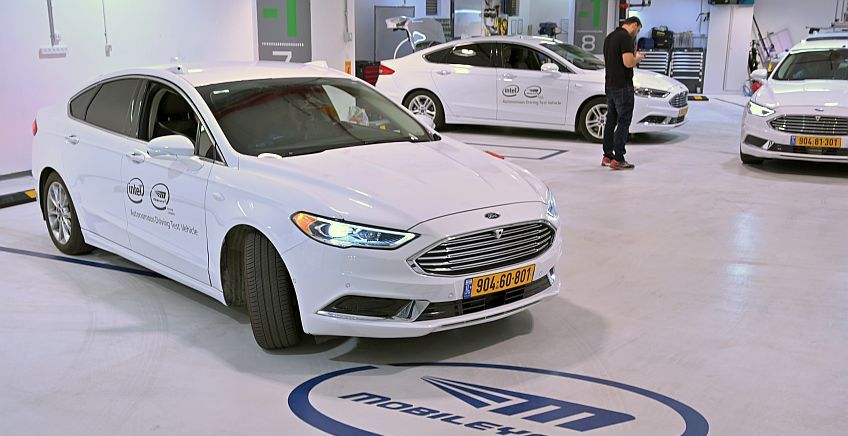
Mobileye revenue decreased 23%

Mobileye announced that its revenue decreased 23% year over year to $490 million in the fourth quarter, as compared to the fourth quarter of 2023. The main reason the this weak quarter is a 20% reduction in EyeQ SoC volumes. This was primarily related to the previously disclosed meaningful build-up of inventory at our Tier 1 customers, including in the fourth quarter of 2023. Average System Price was $50.0 in fourth quarter 2024, compared to $52.7 in the prior year period primarily due to lower percentage of SuperVision related revenue as compared to the fourth quarter of 2023.

Operating Margin of (18%) decreased by 29 percentage points in the fourth quarter of 2024 as compared to the prior year period, due to higher operating expenses than the prior year period on a lower revenue base, as well as the gross margin. Mobileye annual 2024 sales totaled $1.65 billion, compared with $2.08 in 2023. The company generated net cash of $400 million in 2024. Its balance sheet is strong with $1.4 billion of cash and cash equivalents and zero debt. Mobileye expects to return to growth this year. Its financial guidance is $1.69-1.81 billion sales in 2025.

Mobileye President and CEO Prof. Amnon Shashua, said the company achieved major technological milestones: “EyeQ6 High System-on-Chip (SoC) is on-track for series production launch and achieves 10x the frame-per-second processing in comparison to EyeQ5 High. We look forward to a robust cadence of EyeQ6 High-based product launches beginning in 2026”.

He revealed that Mobileye imaging radar B-samples achieved outstanding performance across hundreds of OEM tests. “Most importantly, we progressed significantly on the SuperVision, Chauffeur, and Drive projects for VW Group, achieving milestones on the path to start-of-production.”