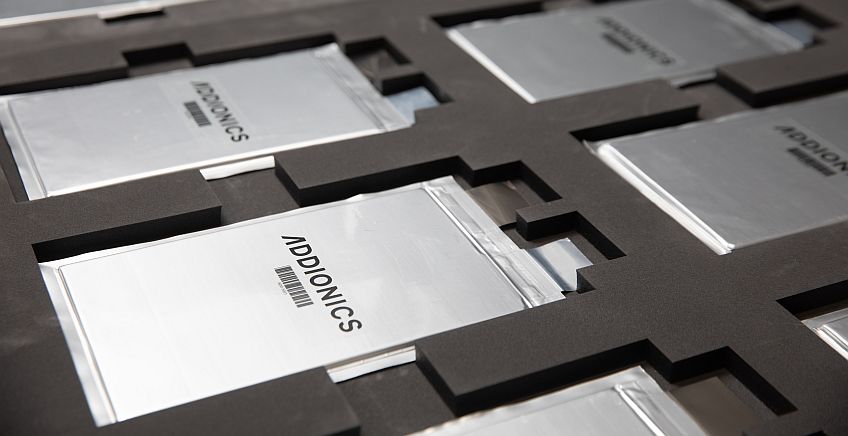

Elron Ventures has entered Addionics as a strategic investor as part of a pre-Series C round, in a move aimed at supporting the company’s preparations for a larger financing round ahead. The size of the investment was not disclosed. The transaction is intended to accelerate Addionics’ operations and sharpen its focus on strategic markets, particularly defense and space, where advanced batteries are considered mission-critical components.
The round is defined as a pre-Series C—an interim stage typical of deep-tech companies that have already achieved initial market adoption and are preparing for a significant capital raise to support global expansion, increased manufacturing capacity, and deeper penetration into strategic markets. For Addionics, this phase represents a shift from a primary focus on civilian and infrastructure applications toward domains in which energy performance directly impacts operational capability, most notably defense and space.
To date, Addionics has raised approximately $80 million from strategic and industrial investors, including GM Ventures and Deep Insight, alongside global partners from the automotive, materials, and industrial sectors such as Avery Dennison, Scania, Magna, Novelis, and JX Nippon. Elron’s entry is expected to enhance Addionics’ access to investors and strategic partners from the defense ecosystem.
At the core of Addionics’ technology is the development of smart metals and three-dimensional current collectors for lithium-ion batteries, replacing flat metal foils with an advanced porous architecture. This structural redesign improves electrical conductivity within the cell, enables more efficient heat dissipation, extends battery lifespan, and supports high-power charging and discharging—without altering battery chemistry or requiring changes to existing manufacturing lines. This chemistry-agnostic approach is considered a significant advantage in conservative markets such as defense and space, where lengthy qualification cycles often slow the adoption of new technologies.
In defense applications, battery requirements extend far beyond those of the civilian market. Unmanned systems and military drones demand extreme energy-to-weight ratios, the ability to handle high-power discharge, and reliable operation under heat, cold, vibration, and fluctuating loads. In these environments, batteries are not merely power sources but determinants of range, loiter time, sensing capability, and operational survivability. Addionics’ ability to deliver high power without compromising stability or cycle life positions its technology as a relevant solution for next-generation electric and hybrid military platforms.
The demands in the space sector are no less stringent. Satellites, particularly those in low Earth orbit, operate through sharp charge-discharge cycles over many years, under constant radiation exposure and without the possibility of maintenance. Any battery failure can result in complete mission loss. The combination of thermal stability, mechanical robustness, and predictable long-term behavior makes Addionics’ structural approach attractive for space applications, where reliability takes precedence over all other considerations.
The move into defense and space complements Addionics’ broader growth strategy. Only recently, the company announced a collaboration with South Korea’s PNT Materials to develop prismatic LFP battery cells for data centers and large-scale energy storage systems—a partnership that underscores the flexibility of its technology across energy-intensive markets, from AI infrastructure to mission-critical systems.
Elron Ventures views Addionics as part of a broader strategic push toward deep-tech and technologies of long-term industrial and security relevance. As part of the investment, Lisya Bahar Manoah, Chairperson of Elron Ventures and MP of Arieli Group, has joined Addionics’ board of directors, strengthening the company’s strategic guidance at a pivotal stage and reinforcing the link between its technology platform and highly regulated, performance-driven markets such as defense and space.
According to Bahar Manoah, the investment reflects Elron’s focus on deep-tech companies with a clear path to growth and scale. “Addionics’ solution is based on a physics-driven, chemistry-agnostic approach that does not require changes to existing manufacturing processes,” she said, adding that this combination enables improved power and energy density while positioning the technology for rapid adoption in markets such as space and defense.
Dr. Mosheial Biton noted that Addionics is now entering its next growth phase and expressed confidence in the company’s ability to lead the field and set a new standard for high-performance batteries for defense and space applications.