The BIRD Foundation — the binational U.S.–Israel foundation for industrial R&D cooperation — is expanding its scope to include mining technologies, one of the least discussed yet fastest-growing segments of the global energy and industrial landscape. As part of this effort, the foundation recently hosted Mark Freeman, Managing Partner at the technology investment arm of Orion Resource Partners, for meetings in Israel with local entrepreneurs and startups.
The gathering, held at the foundation’s offices in Tel Aviv, was designed to expose Israeli startups to commercial and investment opportunities in the global mining industry, while exploring potential collaborations in advanced technologies for the extraction of critical minerals and metals. Representatives from venture capital funds and other players in Israel’s innovation ecosystem also took part.
Orion Resource Partners is among the world’s largest private investors in metals, mining, and raw materials. The group manages approximately $8.6 billion in assets and focuses on investments in critical minerals, industrial technologies, energy, and supply-chain innovation. Over the years, Orion has been involved in more than 80 mining operations worldwide, acting both as a financial investor and a strategic partner in large-scale industrial projects.
According to Limor Nakar-Vincent, Director of the BIRD Energy Program, the meeting reflects a broader structural shift. “The transition to clean energy, electric mobility, and advanced manufacturing depends on the availability of critical minerals — an issue that often remains outside the public conversation,” she said. “Without metals such as copper, cobalt, and graphite, the green transition simply cannot happen.”
The scale of the challenge facing the global mining industry continues to grow. Industry forecasts suggest that over the next three decades, the world will need to mine twice as much copper as has been extracted throughout all of human history to date. Demand for other minerals, including graphite and cobalt, is expected to rise between six-fold and thirty-fold, driven by battery technologies and energy storage systems. To keep pace, annual global investment in mining is projected to increase from roughly $45 billion today to about $75 billion by 2030.
At the same time, supply is struggling to catch up with demand. Success rates in mineral exploration using traditional methods are below one percent, while the average development timeline for a mine — from discovery to commercial production — stands at around 16 years. In parallel, ore quality is declining, and many countries are grappling with a shrinking number of active mines and increasingly stringent environmental regulations.
This reality underscores the need for technological innovation across the entire mining value chain — from subsurface exploration and characterization, through drilling and operations, to processing, refining, environmental management, and recycling. “This is a capital-intensive industry where mistakes can cost billions,” Nakar-Vincent noted. “Advanced technologies enable greater precision, shorter timelines, and reduced risk.”
In recent years, a dedicated entrepreneurial sector focused on advanced mining technologies has begun to take shape. It includes AI and deep-learning solutions for subsurface analysis, chemical and electrochemical processes for extracting metals from low-grade ores, direct lithium extraction technologies, and sensor systems that provide real-time operational data. Funding rounds totaling hundreds of millions of dollars signal that this is an emerging industry with significant long-term potential.
According to the foundation, Israel holds a clear comparative advantage in this arena. “Israel excels in platform technologies that are critical to modern mining — artificial intelligence, robotics, autonomy, cybersecurity, electrochemistry, and synthetic biology,” said Nakar-Vincent. “These capabilities can be directly applied to mineral exploration, operational optimization, ore processing, water treatment, and metal recycling.”
BIRD emphasizes that realizing this potential requires proactive connections between global mining corporations and the Israeli innovation ecosystem, exposure of entrepreneurs to real industrial needs, on-site pilot projects, and access to active mining facilities. “Innovation in mining is not only an industrial necessity — it is also an economic and national interest,” Nakar-Vincent concluded. “Countries and companies that develop advanced technological capabilities in critical minerals will strengthen their energy independence and their position in the global economy.”
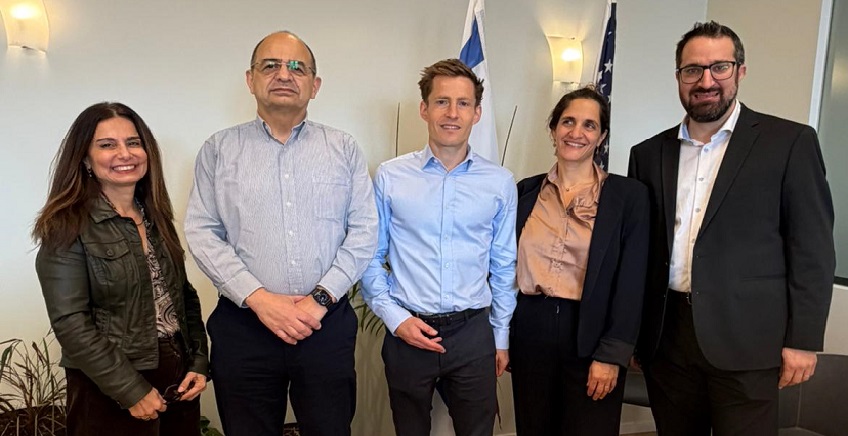
[Ib the photo above: From right to left: Brian Rosen, Chief Scientist at Israel’s Ministry of Energy, Yael Herman (Ministry of Energy), Mark Freeman, Yaron Lotan, CEO of the BIRD Foundation, and Limor Nakar-Vincent, Director of the BIRD Energy Program]