

Has Nano Dimension Been Swallowed by the Company It Acquired?

[Photo: A Markforged printer. Source: Markforged]

By Yochai Schweiger

During Nano Dimension’s earnings call last Thursday, following the publication of its Q3 2025 results, the company’s new CEO, David Stehlin, mentioned the name Nano Dimension exactly once — in the formal opening line. From that moment on, the discussion revolved almost exclusively around the commercial activity and product lines of Markforged, the U.S. 3D-printer manufacturer Nano Dimension acquired and finalized the merger with a few months ago. Flagship FX10 and FX20 printers, the Digital Forge platform, use cases in defense, aerospace, automotive and industrial sectors — these dominated the call, while Nano’s original business disappeared almost entirely from the agenda.

The absence of any reference to Nano’s historical core operations stood out sharply. Its 3D printed-electronics technology, the DragonFly printer, and the broader focus on additive electronics — all central to the company’s identity for years — were not mentioned once.

In its early years, Nano Dimension issued press releases for nearly every DragonFly sale. But for several years now it has not announced any such deals, and the brand that once represented its technological edge has effectively vanished. Sales volumes in that legacy business can now be inferred only indirectly. After the Markforged acquisition, the company even changed its business description from “additive manufacturing of advanced electronics” to “digital manufacturing solutions.” Earlier in 2024, Nano Dimension also carried out a substantial workforce reduction in Israel.

Control Shifts From Nano Dimension to Markforged

This transition is visible not only in the narrative but also in senior leadership. Management gravity has shifted outward from Israel, and control appears to have moved from Nano’s leadership to Markforged’s.

Stehlin, the new CEO, comes from the telecom sector rather than the 3D-printing industry. His appointment surprised investors, as he replaced Ofir Baharav — a veteran of Israel’s additive-manufacturing sector via XJet — who was dismissed after just a few months in the role. Financial leadership has similarly shifted: Nano’s CFO, Assaf Zipori, has departed and was replaced by Markforged’s CFO, John Brenton.

A Loss-Making Company Taps Into Nano Dimension’s Cash Pile

Nano Dimension acquired Markforged in April 2025 for approximately $116 million. Founded in 2013 and based in Waltham, Massachusetts, Markforged employs several hundred people and specializes in industrial 3D printing of metals and composites for aerospace, automotive and industrial equipment sectors. In 2024 it generated $85.1 million in revenue but posted a net loss of $85.6 million, weighed down by $127.7 million in operating expenses.

The merger — combining a larger, higher-revenue but deeply loss-making Markforged with the smaller but cash-rich Nano Dimension — has effectively created a new company. This is clearly reflected in the financial structure shown in the first report of the combined entity: revenues surged, but profitability deteriorated sharply.

The numbers are stark. Q3 revenue jumped to $26.9 million — up 81% year-over-year — but $17.5 million of that came from Markforged. Without the acquisition, Nano’s legacy revenue dropped to just $9.4 million, a 37% decline. The message is clear: nearly all growth is coming from the acquired business, while printed-electronics revenues have shrunk to a secondary segment.

As a consequence, adjusted gross margin eroded from 50.5% to 47.4%. Unadjusted gross margin — which includes inventory charges, integration costs and accounting impacts related to the Markforged deal — fell far more sharply, from 48% to around 30%, signaling heavy one-time (and likely multiquarter) burdens.

Bottom line: if Nano Dimension lost $9.9 million in Q3 2024, the latest quarter ended with a net loss of $29.5 million. With Markforged now consolidated, Nano has also added more than $100 million in annual fixed operating expenses. Quarterly operating costs surged to roughly $29.2 million, an increase of $8–10 million per quarter versus Nano’s pre-merger expense profile.

From Markforged’s perspective, the deal is close to ideal. The company is now housed inside a cash-rich entity holding more than half a billion dollars — financial oxygen it lacked as a standalone business. Markforged has effectively joined a firm capable of funding its loss trajectory and long investment cycles, giving its product roadmap a significantly more stable foundation.

The 3D-Printing Industry’s Vicious Circle

Viewed in a broader context, the Nano–Markforged merger mirrors a familiar pattern in the 3D-printing sector. For more than a decade, the industry has oscillated between sky-high expectations and slow-moving commercial reality: expensive R&D, long sales cycles for industrial customers, and the need for heavy service and sales infrastructures. Many companies attempted to solve the problem through acquisitions — stitching together broader “platforms” in hopes of achieving operational scale and technological synergy. In practice, these moves often produced integration challenges, cost inflation and financial structures mismatched to market size.

Nano Dimension launched its acquisition strategy in 2022 after raising roughly $1 billion in cash, becoming one of the most capital-rich players in the space. Over the next two years it acquired five to six companies in 3D printing and electronic manufacturing. Most of these efforts ultimately failed: in recent quarters, Nano has shut down or significantly downsized most of the acquired operations. The clearest example is Desktop Metal — a deal in which Nano bore part of the cost burden — which ended in bankruptcy and was classified as a discontinued operation. Against this backdrop, Markforged seemed like the more sensible acquisition: a larger company with meaningful revenue and a global customer base. Yet the latest results show that Markforged also brings with it the industry’s characteristic traits: chronic unprofitability and heavy cost structures.

Nano Dimension had hoped to be the company that breaks this cycle — leveraging its cash reserves and its unique printed-electronics technology to reach profitability where many competitors failed. But judging from the latest report and the accompanying earnings call, the company is now in a transition period in which its historical core is shrinking, the acquired business dominates, and the organizational identity is shifting.

The process is still unfolding — but the question already hangs in the air:
Did Nano Dimension acquire Markforged, or has the acquired company become so dominant that it’s no longer clear who actually absorbed whom?

Nano Dimension May Let Desktop Metal Default on Its Debt

[In the photo above: Desktop Metal employees on the industrial printer production line in Massachusetts, USA. Source: Desktop Metal]

Will Nano Dimension allow Desktop Metal, the company it acquired just weeks ago, to fall into bankruptcy? That scenario now seems very much on the table, judging by statements made by Nano Dimension’s executives during their recent earnings call following the release of their 2024 financial results. During the call, company leaders hinted that Nano Dimension may not provide Desktop Metal with the financial support needed to meet its debt obligations—potentially sealing its fate.

As a reminder, Nano Dimension completed the acquisition of Desktop Metal last month—grudgingly and under court order from a Delaware court—for $180 million. But Desktop Metal joins the company with considerable financial baggage. Alongside ongoing operating losses, it carries a burden of approximately $150 million in convertible notes, due to be repaid to bondholders by June 11, 2025, along with interest. As of September 2024, Desktop Metal had just $30 million in cash.

Distancing from Desktop Metal, Embracing Markforged

Nano Dimension’s newly appointed CFO, Assaf Zipori, addressed the issue directly in the earnings call: “Let’s talk about the elephant in the room. It’s clear to anyone analyzing Desktop Metal that it’s a company with limited liquidity and substantial debt. It lacks the liquidity to repay these notes or meet other material obligations—obligations of Desktop Metal, not of Nano Dimension. While we’ve provided limited short-term funding, we cannot commit to further financial support.”

This statement suggests that Nano Dimension is actively distancing itself from Desktop Metal. The latter is now independently working with two consulting firms to explore potential solutions for its financial crisis. Another clear sign of Nano’s hands-off stance came from Zipori’s additional comment: “We will act consistently with our guiding principles—preserving financial strength and investing only in growth- and profit-oriented opportunities.”

If Desktop Metal does default, key questions remain: what legal and financial ramifications might Nano Dimension face, and how will investors and markets react? After all, this might be perceived as a walk-away from a corporate commitment—albeit one made by a previous management team.

In stark contrast, Nano Dimension’s recent $115 million acquisition of U.S.-based Markforged appears to be welcomed by the new leadership. CFO Assaf Zipori, formerly of Markforged, has taken over as Nano’s global CFO. The Markforged technology fits more squarely into Nano Dimension’s software-driven vision. “Markforged has an excellent software platform—we knew it before the deal, and we know it even better now,” said interim CEO Julian Lederman during the call, following the ousting of former CEO Yoav Stern.

Cleaning Up a Legacy of Unfocused Acquisitions

Desktop Metal isn’t the only problematic asset from the acquisition spree led by Stern, Nano Dimension’s previous CEO. Under his leadership, the company made no fewer than 10 acquisitions totaling nearly $450 million—resulting in a fragmented group of 3D printing and PCB companies, often lacking clear business or technological synergy.

The new leadership seems determined to refocus. Plans are underway to exit less profitable product lines and zero in on advanced additive manufacturing solutions for high-performance, high-value parts—returning to Nano Dimension’s original mission of 3D-printed PCBs and electronic components. “Shareholders demanded change, and we’re delivering it,” said Zipori. “We’re applying a disciplined strategy focused on synergy. No more random acquisitions—every business line must offer a defensible technological edge against low-cost Far East competition.”

During their first quarter in office, the new leadership divested from Admatec, DeepCube, NanoFabrica, and Formatec. Two of these—NanoFabrica and DeepCube—are Israeli firms. NanoFabrica, acquired in 2021 for $55 million, developed 3D printers for micro-scale parts. DeepCube, acquired around the same time for $70 million, specialized in AI algorithms. This deal raised eyebrows both for its high price and questionable strategic fit—especially since DeepCube’s founder was a board member at Nano Dimension, sparking concerns of conflict of interest.

Though the CFO didn’t elaborate on what “divestment” entails, Nano Dimension confirmed to Techtime that these four companies have ceased operations, and full details will be included in the upcoming annual report to the SEC.

Trade War Tailwinds?

In 2024, Nano Dimension reported revenue of $57.8 million, a 2.6% increase over 2023. EBITDA-adjusted net loss was $65.3 million, a 35% improvement from the previous year. Preliminary results for Q1 2025 show revenue of $14.4 million—an 8% year-over-year rise. The company believes that U.S. President Trump’s tariff and trade policies may play to its advantage. “Global trade dynamics are forcing companies to reevaluate supply chains, and we aim to help them do just that,” said CEO Ofir Baharav.

It’s worth noting that a similar hope surrounded the COVID-19 crisis, when companies were expected to localize supply chains—yet that business boom never materialized.

Nano Dimension Acquires NanoFabrica for $55 million

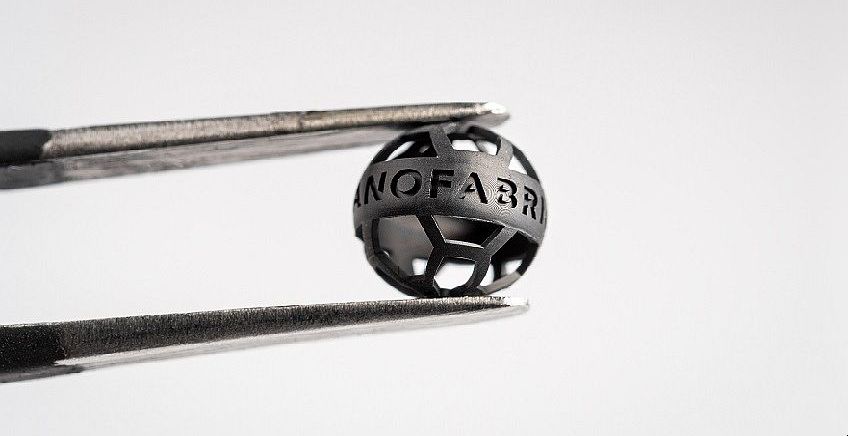
Above: Miniature structure created by NanoFabrica’s Tera 250 machine

In a surprising  move to expand its footprint in the market of additive manufaturing for the Electronics industry, Nano Dimension announced that it has signed and closed a definitive agreement to acquire NanoFabrica for $54.9-$59.4 million. Out of that, between $23 million to $27.5 million will be paid in cash (depending upon certain milestones), and approximately $32 million was paid in American Depositary Shares (ADSs) of Nano Dimension.

The Tel aviv based NanoFabrica has developed a 3D Printing technology for miniature parts. Its Tera 250 machine is capable of producing thousands mm-size parts in a single run and in a resolution of down to 1 micron. Nano Dimension’s produce a PCB printer for the Electronics industry. It uses nanoparticle ink to enable in-house rapid prototyping of professional, multi-layer printed circuit boards (PCBs) and passive devices such as resistors, capcitors, inductors and antennas.

High-end components in a digital format

NanoFabrica’s scientists and engineers are expected to now join Nano Dimension and continue to be led by NanoFabrica’s two founders: Dr. Jon Donner and Eyal Shelef. Yoav Stern, Chief Executive Officer of Nano Dimension, stated, “Our mutual vision is to merge the technologies of our micro-electronic 3D-fabrications machines for Hi-PEDs (Hi-Performance Electronic Devices) with NanoFabrica’s micro-mechanic 3D printing.

“The future of Hi-PEDs and miniaturized high-performance printed circuit boards (PCBs) is interlaced with micro-mechanical printing applications. Eventually, the end goal is to reach a capability for maintaining an inventory of high-end PCB devices, micro-mechanical parts and Hi-PEDs in digital form: print them as you need them, where you need them, only the quantity you need, in the best quality at competitive prices.”