Quantum X Labs Files Patent for Quantum-Accelerated Clinical Trial Analytics

By Yohai Schweiger

Israeli company Quantum X Labs has filed a U.S. patent application for a technology designed to accelerate and improve the analysis of clinical-trial data by integrating quantum computing. According to the disclosure, the invention centers on a computational algorithm built to handle large volumes of complex biological and clinical data, enabling more efficient inference about treatment responses, patient sub-populations, and probabilistic patterns using quantum capabilities.

The patent filing was reported on Wednesday by Geeks Internet, a publicly traded company on the Tel Aviv Stock Exchange. Geeks Internet holds approximately 26.42% of Viewbix, which is currently in the process of acquiring Quantum X Labs. Viewbix stated that Quantum X Labs—the acquisition target—submitted the U.S. patent application, and that development was carried out in collaboration with CliniQuantum, a portfolio company of Quantum X Labs focused on applying quantum computing to clinical-trial analysis.

The patent application is titled “Generating Quantum Markov Chain Monte Carlo Sampling Points for Continuous Distribution Functions.” The title offers a clear window into the technology’s core. At its heart lies a well-established statistical and AI framework known as Markov Chain Monte Carlo (MCMC)—a family of algorithms used for probabilistic sampling and inference when systems are too complex for direct calculation, such as those involving many variables and high uncertainty. In clinical trials, MCMC methods help model treatment responses, estimate probabilities, and uncover hidden patterns within noisy or incomplete datasets.

According to the public description, the innovation Quantum X Labs seeks to protect does not alter clinical protocols themselves, but rather the algorithmic sampling methodology. In a clinical-trial context, “samples” are not only lab measurements but computational representations of possible scenarios—different combinations of patient characteristics, treatment responses, dosages, and outcomes over time. MCMC algorithms rely on such samples to construct a probabilistic picture of how a therapy performs, even when data are partial or imperfect. The disclosed algorithm introduces a quantum component to generate these sampling points more efficiently and accurately from complex, continuous distributions. This approach could shorten computation times, improve statistical precision, and potentially enable comparable conclusions with fewer patients or fewer real-world measurements. In that sense, the patent targets the algorithmic and methodological layer, with a clear application to medical research.

Importantly, the algorithm is not intended to run entirely on a standalone quantum computer. Instead, it follows a hybrid architecture: the overall statistical computation runs on classical computers, while a quantum processor is integrated as an accelerator for specific stages—primarily the generation of complex sampling points. This design aims to leverage today’s available quantum advantages without depending on fully mature, large-scale quantum hardware.

Development was carried out in collaboration with CliniQuantum, which focuses on applying advanced computing—including quantum methods—to clinical-trial analytics. CliniQuantum positions itself as a platform for identifying patient sub-populations, response patterns, and biological signatures within complex datasets, supporting probabilistic decision-making throughout clinical studies. Quantum X Labs develops quantum technologies across multiple domains, centralizes the intellectual property, and leads the core algorithmic work, while CliniQuantum serves as the applied arm for clinical use cases.

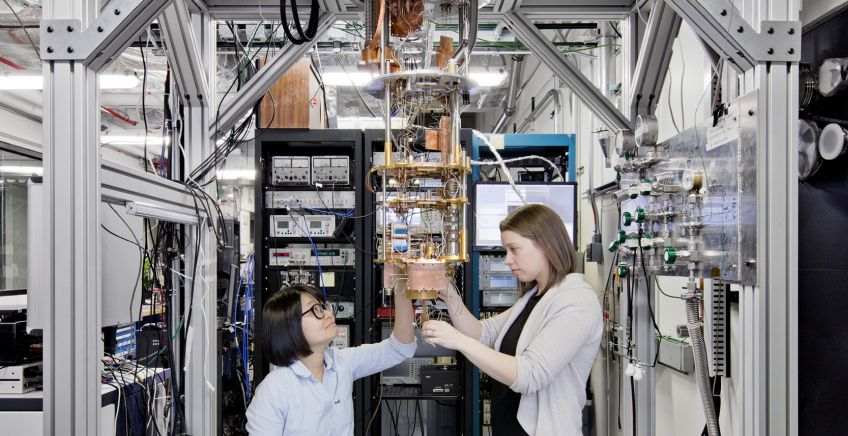
[Image above: Construction of a commercial-grade quantum computer at IBM. Photo: IBM]

Quantum Transistors Achieves 99.9988% Fidelity in Diamond-Based Qubits

[Pictured above: The Quantum Transistors team. Source: Company website]

Israeli startup Quantum Transistors has announced what it describes as a major breakthrough in quantum computing: its diamond-based processors have reached a quantum gate fidelity of 99.9988%. In an industry where differences of mere thousandths of a percent can determine whether a system will ever scale into a practical quantum computer, the achievement represents a significant leap—one that positions the company at the forefront of the global race toward scalable quantum hardware.

The result is based on a proprietary technique developed by the company known as PUDDINGs, which dramatically reduces the impact of environmental noise on qubit operations. The approach enables highly stable quantum gates without relying on complex or extreme cooling systems. In quantum computing, fidelity measures how closely a performed quantum operation matches its ideal theoretical outcome—making it one of the most critical benchmarks in the field.

Quantum Transistors’ technology is built around ultra-pure synthetic diamonds, in which the company deliberately creates minute atomic defects known as color centers. These are locations in the crystal lattice where a carbon atom is missing or replaced by another atom, producing unique energy states. In such configurations, the spin of a single electron can be precisely controlled using light and electromagnetic fields, allowing it to function as a qubit—the fundamental unit of quantum information.

A key advantage of diamond-based qubits lies in their solid-state nature: unlike superconducting approaches, they do not require temperatures close to absolute zero. Quantum Transistors aims to turn this inherent advantage into an industrially scalable capability. To that end, the company already operates independent fabrication processes in Israel and is among the very few players worldwide capable of building a full quantum chip on diamond—from material production through to the integration of photonic connectivity between qubits.

Beyond the material advantages of diamond, the company has developed its proprietary PUDDINGs quantum control system—short for Power-Unaffected, Double-Detuning-Insensitive Gates. The system is designed to mitigate environmental noise by using advanced control-pulse engineering that makes quantum operations resilient to fluctuations in power and frequency, two of the dominant sources of error in quantum systems. According to the company, this approach significantly reduces gate error rates and underpins the newly reported fidelity record.

While still relatively young, Quantum Transistors has already reached several commercial milestones. In recent years, it secured funding from the European Union under one of the bloc’s largest quantum research programs, enabling the expansion of its R&D efforts and the establishment of a dedicated manufacturing facility. The company’s long-term ambition is to deliver quantum processors that can be directly deployed in data centers—without massive cryogenic infrastructure or prohibitively expensive equipment.

Such a shift could transform quantum computing from cumbersome experimental systems into an integral component of advanced computing infrastructure, opening the door to far broader industrial adoption.

The Promise of Diamond Qubits

Diamond-based qubits have emerged in recent years as one of the most promising directions in quantum hardware. While companies such as IBM and Google lead the superconducting approach, and ion-trap systems demonstrate exceptional accuracy but face challenges in scaling, diamond defects offer a unique combination: high quantum stability within a robust, heat-tolerant solid-state environment, along with natural photonic connectivity between qubits. These properties make diamond an attractive candidate for distributed quantum architectures.

Until now, the central challenge has been maintaining very high fidelity in environments that are not tightly controlled. It is precisely in this area that Quantum Transistors’ latest results represent a meaningful breakthrough.

The company’s achievement signals growing technological maturity and addresses one of quantum computing’s most persistent obstacles: error rates. If these fidelity levels can be preserved in multi-qubit systems and supported by stable manufacturing processes, the technology could help move the field closer to a point where quantum computing becomes a practical tool rather than a long-term promise.

Quantum Transistors has set itself an ambitious goal—not another experimental quantum machine confined to the lab, but a quantum processor designed for integration into server farms and cloud environments. The road ahead remains long, but the latest announcement places the company on that path with a technological milestone few have reached to date.

Quantum Transistors was founded in 2022 by Shmuel Bakhinski, who also serves as the company’s CEO. The company operates from Israel and employs several dozen people across research, development, and manufacturing.

Nobel Prize in Physics 2025: The 1985 Experiment That Paved the Way for Quantum Computing

[Image: A chip built by NIST demonstrating the Josephson effect. Source: Wikipedia]

The Royal Swedish Academy of Sciences announced on Tuesday that the 2025 Nobel Prize in Physics has been awarded to John Clarke of the University of California, Berkeley, Michel Devoret of Yale University, and John Martinis of the University of California, Santa Barbara. The trio was recognized for groundbreaking experiments conducted in 1984–1985 that proved quantum phenomena can exist in large, measurable systems.

Their experiments showed for the first time that entire electrical circuits can obey the rules of quantum mechanics — a discovery that opened the door to quantum computers, quantum sensors, and the next generation of physics-based technology.

At the core of their work lies a phenomenon known as quantum tunneling — a process in which a system can “tunnel” through an energy barrier that, classically, it should not be able to cross. To demonstrate this, the researchers built circuits containing a tiny component called a Josephson junction, in which two superconductors are separated by a thin insulating layer. When cooled to near absolute zero, the electrons in the circuit act as a single quantum entity, allowing the entire system to “jump” between energy states without crossing the barrier in the classical sense — a behavior previously observed only in subatomic particles. Their results also showed that these circuits absorb and emit energy in discrete packets, or quanta, following the same fundamental rules that govern atoms and photons.

This breakthrough bridged the gap between the microscopic and macroscopic worlds. It proved that quantum effects aren’t confined to the atomic realm and that devices visible to the naked eye can be engineered to behave according to quantum laws.

From Quantum Circuits to Quantum Computers

The circuits built by Clarke, Devoret, and Martinis became the foundation for what, decades later, would form the core of the quantum computer: the superconducting qubit. The revolutionary idea was to turn a quantum electrical circuit into a unit of computation in which current could flow in two directions simultaneously — just as a particle can exist in two states at once. Unlike a classical bit that represents 0 or 1, a qubit can represent both at the same time, allowing quantum computers to perform many calculations in parallel.

John Martinis went on to lead Google’s quantum hardware team, which built the Sycamore processor — the first machine to demonstrate quantum supremacy by performing a computation that would have been practically impossible for a classical supercomputer. Michel Devoret, at Yale, pioneered the field of Circuit QED, which couples superconducting qubits to microwave fields for precise control and measurement. John Clarke, at Berkeley, was among the first to show that minuscule magnetic signals could be detected using SQUID sensors — devices so sensitive that their technology still underpins MRI scanners and nuclear medicine today.

The Engineering Leap

Beyond its scientific brilliance, the trio’s work was also an engineering triumph. Observing such delicate phenomena required cooling systems that brought temperatures down to mere thousandths of a degree above absolute zero, near-perfect electromagnetic shielding, and measurement devices of unprecedented sensitivity. These innovations have since become standard tools in the quantum computing industry.

This year’s Nobel Prize thus recognizes more than a discovery — it marks a transformation. Quantum physics has evolved from a theoretical curiosity into a technological foundation that can be built, controlled, and scaled. Thanks to Clarke, Devoret, and Martinis, the journey from abstract theory to practical quantum systems is complete — and the age of quantum computing has truly begun.

QEDMA raised $26M with participation from IBM

The developer of noise reduction solutions for quantum computers, QEDMA from Tel aviv, announced a $26 million in Series A funding. The round was led by Glilot Capital Partners through its early growth fund, Glilot+, with new participation from IBM, Korean Investment Partners, and others, alongside existing investors including TPY Capital. QEDMA’s software solution, addresses the critical challenge of reducing errors in quantum computing. QEDMA expects to demonstrate quantum advantage in the coming months through partnerships with multiple quantum computing companies and research institutions.

Errors are a fundamental obstacle on the path to large-scale, practical quantum computing. As the size of quantum computers grows and the complexity of computations increases, errors can compound and the signal gets overwhelmed by noise. While error correction schemes exist that could in theory strongly suppress errors, error-correcting codes require significant overhead: as many as 1,000 qubits (quantum bits) to correct errors for just a single qubit.

QEDMA’s software is being engineered to accelerate the timeline to practical quantum computing by reducing, mitigating, and correcting errors. When a user requests to run a quantum algorithm, QEDMA’s solution executes a protocol to learn the noise characteristics of the specific device. It then adjusts the quantum algorithm to reduce some classes of errors from occurring (suppression) and uses post-processing to address the impact of remaining errors on the final calculation (mitigation).

QEDMA’s solution has support from major industry leaders, including its launch as one of the first IBM Qiskit Functions. “While the industry is making massive investments in quantum computing infrastructure and scaling the number of qubits, our platform-agnostic approach allows us to extract maximum value from existing hardware across all quantum computing architectures,” said Dr. Asif Sinay, CEO and co-founder of QEDMA. “By accelerating the timeline to practical quantum computing, we’re establishing a fundamental foundation that will become even more crucial as quantum systems scale.”

Quantum computing collaboration between Nvidia and the Israeli Classiq

Nvidia Company revealed last week in its annual developer conference (GTC) a new collaboration with another Israeli Company, Classiq from Tel-Aviv, who provides a platform for creating quantum software algorithms. Within this cooperation, Classiq’s platform integrates with Nvidia’s quantum simulator. This integration will allow Classiq’s customers to run their quantum application on the simulator, perform stress-tests, debugging and optimization – without the need to use real quantum machine.

At this time Nvidia doesn’t develop quantum hardware, but it developed the cuQuantum simulator, which simulate quantum computer processing capabilities of dozens of qubits. This simulator is based in its operations on a supercomputer composed of hundreds of GTX A100 processors and Tensor Core GPUs. This simulator is capable of performing billions of parallel computations and simulates quantum computing processes such as superposition and entanglement. It provides the capability of running, on a classic machine, quantum algorithms and is used by researchers and developers in developing and verifying quantum applications.

In last December, Nvidia launched its Software Development Kit (SDK), based on the company’s Selene supercomputer which is capable of running (for particular type algorithms) simulations with a scale of thousands of qubits. Nvidia reported lately that it successfully ran the optimization problem MaxCut, which is considered impossible to solve using a classical computer, but only using a quantum computer. In order to solve the problem, Nvidia used 896 GPUs that simulated 1,688 qubits. 

Verify algorithms without any noise

In a conversation with Techtime says Amir Naveh, Classiq’s co-founder and Head of Algorithms that “this collaboration was born earlier in the simulator development phase. Our platform allows for the creation large-scale quantum circuits, which the customers may test directly through the simulator. The existing intermediate-scale quantum computers are still noisy, and this simulator is currently the only way a developer can test its algorithms in a cost effective, clean method”.

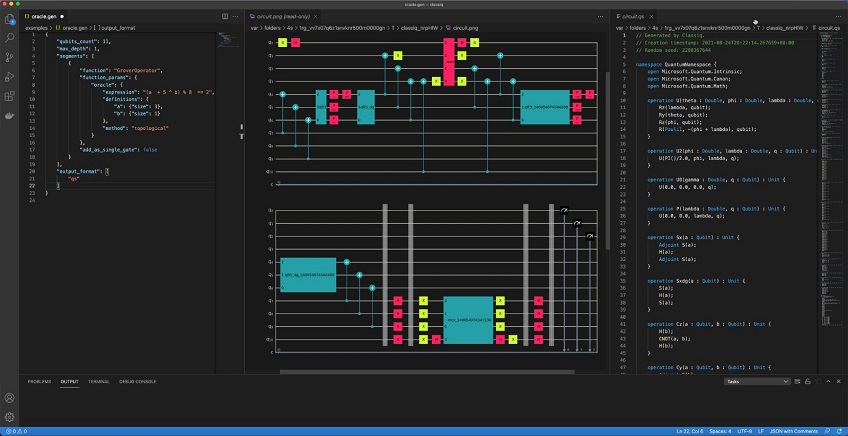
Classiq developing CAD solutions that will make it possible to write applications for quantum computers. Nir Minerbi, Classiq co-founder and CEO, told Techtime in an earlier interview: “The quantum revolution consists of two things: hardware and software. Nowadays it is almost impossible to develop applications for a quantum computer, since you have to program at the logic gate level. It’s like designing a chip at the transistor level. We build the tools that allow developing applications at a higher level of abstraction. The next layer in the quantum stack.”

Recently, Classiq launched its proprietary platform’s Beta version which allows, for the first time in the industry, to compose functional algorithms for Quantum computers. The company made the new platform available to several customers, and intends to expand the beta version access to several dozen customers in the next few months.

Classiq launched its beta version for the quantum software platform

Israeli quantum software start-up Classiq launched lately its proprietary platform’s Beta version which allows, for the first time in the industry, to compose functional algorithms for Quantum computers. The company made the new platform available to several customers, among them a Telecom company, Aerospace Company, financial firm, consulting agency and several academic bodies.

In the next few months, the company plans to expand the beta version access to several dozen customers.  In addition, the company had filed 9 patent applications to the USPTO (United States Patent and Trademark Office) for its IP relating quantum computing software. The applications relate to writing, compiling, debugging and optimizing functional algorithms designed for Quantum machines. Classiq Company was founded in May 2020 by CEO Nir Minerbi, Head of Algorithms Amir Naveh and CTO Yehuda Naveh. The R&D team currently includes 25 people.  

In recent years, there has been a significant breakthrough in quantum computing, and many technology giants are building powerful quantum computers that are capable, at the level of hardware, of performing considerable tasks. IBM, a pioneer at this field, has launched last year a 65-qubits quantum computer, and set a goal of developing a 1000-qubits processor by 2023.

Building the first layer of the quantum programming stack

However – implementing the quantum computer’s capabilities depends on the software level as well. In the classics bit-oriented computing world, development tools are highly sophisticated, allowing writing complex application with very high abstraction level. This is the result of evolution going on for many years and building a layer upon layer. This is the stack. Since quantum making is qubits-based, the whole stack has to be build from scratch. In fact, a programmer writing code for a quantum machine, have to tailor an algorithm at the logical gates level.

This process might be viable for simple applications with single amount of qubits, but as the application gets more complex and the number of qubits is growing – this mission becomes almost impossible, due to the astronomic number of possible arrangements of the quantum circuit. Classiq has set itself a target to write the first stack layer in the field of quantum computing, and is one of the first start-up companies to develop solutions that will make it possible to write applications for quantum computers. 

One of the co-founders and the Head of Algorithms, Amir Naveh, explained to Techtime that his company’s platform simplifies the method of writing algorithms for quantum software. “Practically, it is impossible to write quantum algorithms at the logical gates level, certainly when the number of qubits is growing. Our platform allows for writing the algorithms at the functional level. The programmer is required to describe the algorithm’s functional logic, and our software translates it to the quantum circuit’s level, at the most optimal manner in terms of resource utilization and memory management”.

From cracking molecules to writing financial options

Quantum computer is not intended to replace the classical one, rather it is planned to solve certain types of problems that regular computer, whatever is its strength, is not capable of solving. Mainly, these are problems require computing an astronomical number of scenarios and combinations, such as simulating molecules behavior during drug development, or rapid pricing of financial options that depend on the correlation between a huge number of other financial assets.

Problems of this kind of are often impossible to solve within a reasonable period, even by the most powerful supercomputers, but they are quite easy solvable with quantum computer, which is capable of performing huge amount of calculations simultaneously. Naveh says: “Main usages of quantum computing are in the financial, chemical and optimization worlds. Almost every area of activity has issues related to optimization. By using our platform, the customers are trying to figure out the way quantum computer may contribute to solve the relevant problems regarding their business”.