SolarEdge Rebounds: “We are shifting to offense”

photo above: The new SolarEdge Nexis platform for the residential market. Sales will begin in 2026.

By Roni Lifshitz

The sales of SolarEdge grew in Q4 2025 by 70% compared with the corresponding quarter of 2024, reaching approximately $335.4 million. This marked the fourth consecutive quarter of year-over-year revenue growth and the fifth consecutive quarter of improvement in profitability. “In 2025 we restored discipline, generated strong free cash flow, and rebuilt margins,” said Shuki Nir, CEO of SolarEdge.

“In 2026 we are shifting decisively to offense, focused on moving toward profitable growth and capturing global market share through the rollout of the SolarEdge Nexis platform. By leveraging our DC expertise, investing in high-growth adjacencies like AI data center power, and maintaining our rigorous cost discipline, we believe we are positioning 2026 to be a transformational year for SolarEdge.”

The new SolarEdge Nexis was first unveiled in September 2025. It is a residential platform for solar energy generation and storage with a capacity of up to 20 kilowatts, suitable for backing up all household needs for several days. The platform is based on a modular design using lithium iron phosphate (LFP) batteries with a lifespan of 10-15 years, an enhanced DC architecture to increases backup capacity, and an installation process that can be completed in less than 15 minutes. The company announced that the new systems would reach the market later in 2026.

The stock surged — and then plunged sharply

During the last quarter, the company delivered 98.8 thousand inverters, 2.87 million power optimizers, and solar energy storage batteries with a total capacity of 280 MWh. Total sales in 2025 grew by 31% compared with 2024, reaching approximately $1.18 billion. The most notable development was the turnaround in profitability: gross margin in 2025 stood at about 16.6%, compared with a negative gross margin of 97.3% in 2024.

The company’s Nasdaq-listed stock reacted unusually to the report: within just one hour, it surged from $38 per share to more than $42, and then quickly fell to just under $35. The company is now valued at a market capitalization of about $2.1 billion.

What happened during the call? It is possible that analysts were disappointed that the new growth engines would take longer than expected to materialize. In response to requests for further details on entry into the AI market, CEO Nir explained that this market has multi-billion-dollar potential for the company.

“The new GPUs from NVIDIA, expected to reach the market in 2027, require an 800-volt DC power architecture. We are in discussions with companies in the AI sector and are receiving positive feedback on our technology. We expect to conduct initial trials of new products for this field soon, but no revenues are expected before 2027. In our assessment, mass production will begin in 2028.”

Manufacturing shifted to the United States

Revenue from the new residential system will also not be felt immediately. During the earnings call, Nir explained that the Nexis platform would be launched only in March 2026, with large-scale shipments expected to begin in the third quarter of the year. This means that the new growth engine will be felt only in the second half of 2026, or later.

It is worth noting that during 2026, SolarEdge completed a major transformation of its manufacturing infrastructure, shifting most of its production to the United States. The company closed its manufacturing plants in China, Mexico, and Hungary. It still maintains some manufacturing capacity in Asia, mainly through a contractor in Vietnam. In Israel, the Sela-1 manufacturing facility (in the Tziporit industrial zone) produces short production runs and performs manufacturing optimization due to its proximity to the company’s R&D center.

The Texas plant manufactures single-phase inverters, the Utah plant focuses on residential batteries, and the Florida plant produces three-phase inverters and solar panel optimizers. The scope of this move was revealed during the investor conference call in September 2025, immediately after the quarterly report was released.

Shuki Nir disclosed during the call that the company intends to base most of its production in the United States—not only for the domestic market, but also for customers worldwide. “We intend to manufacture in the United States and distribute U.S.-made products both domestically and globally for many years to come.”
SolarEdge Ships US.-Made Inverters to Europe

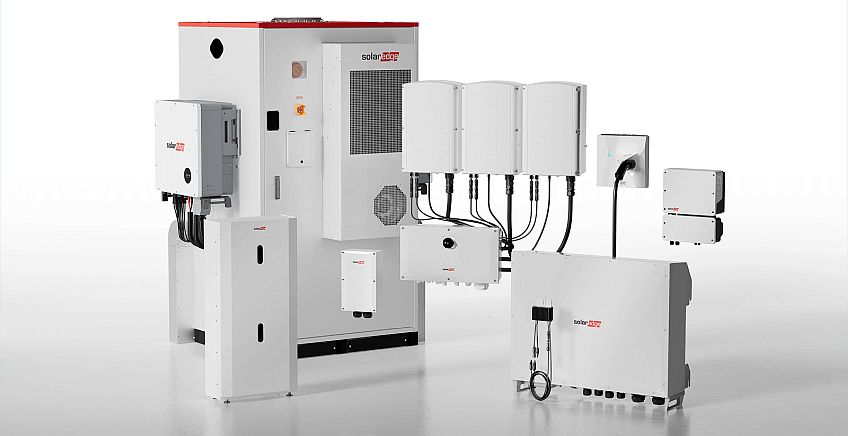
photo above: SolarEdge’s solutions portfolio

SolarEdge has ramped up production at its three manufacturing facilities in the United States and has begun shipping U.S.-made products to Europe. This move marks the culmination of a process that has been unfolding gradually for more than a year and now appears to be complete. The company has shut down manufacturing operations in China, Mexico, and Hungary, while retaining a limited production footprint in Asia, primarily through a contract manufacturer in Vietnam.

In Israel, SolarEdge continues to operate the Sela-1 manufacturing facility, located in the Ziporit industrial zone. This site is dedicated to short production runs and manufacturing optimization, leveraging its proximity to the company’s R&D center in Israel.

The Texas facility focuses on single-phase inverter production, the Utah plant specializes in residential battery systems, and the Florida site manufactures three-phase inverters and solar panel power optimizers. The scope of this transformation was disclosed during the company’s earnings call in September 2025. The CEO, Shuki Nir, stated that SolarEdge intends to anchor the majority of its manufacturing in the United States. “We plan to manufacture in the U.S. and distribute U.S.-made products both locally and globally for many years to come.”

Today, SolarEdge employs approximately 3,400 people worldwide. While the company does not provide a geographic breakdown, it reported in June 2025 that its three U.S. manufacturing plants employ around 2,000 workers. This week, SolarEdge announced a key milestone in executing its new manufacturing strategy: the shipment of its first U.S.-made residential inverters to Europe, with initial deliveries to Italy, France, and the Netherlands. The company is now preparing for the first European shipments of its commercial and industrial systems, scheduled to leave the Florida plant in early 2026.

The Generic Solution Strategy

Alongside the reconfiguration of its global manufacturing footprint, SolarEdge is redefining its portfolio to improve marketability while streamlining manufacturing, logistics, and the supply chain. Under this new approach, the company is consolidating product lines to reduce the number of SKUs, with each SKU designed to serve multiple applications or markets. SolarEdge refers to this strategy as Single SKU—an ambition to deliver a unified model, or a very small set of models, capable of addressing a broad range of use cases and geographies, instead of maintaining a large portfolio of distinct variants. In Europe, this concept is marketed under the name MultiRange.

For example, rather than producing separate inverters for Europe and the U.S., SolarEdge aims to manufacture a single inverter platform, with market- or application-specific customization handled through software, configuration settings, or auxiliary components. The company has indicated that this approach will be implemented in upcoming products, including the SolarEdge Nexis Solution, an integrated residential system combining solar energy generation and storage.

The goal is to deliver a unified platform that supports solar production, energy storage, self-consumption, and backup power during grid outages. SolarEdge is now applying the same design philosophy to its commercial and industrial product lines, with the objective of aligning them as well with the Single SKU strategy.

SolarEdge Closes the Energy Storage Division

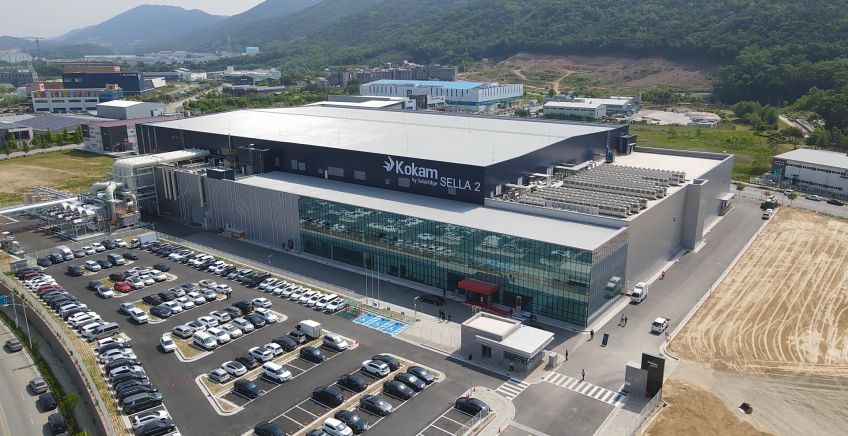
Photo above: SolarEdge’s “Sella 2” plant, a two gigawatt-hour (2GWh) battery cell manufacturing facility in Korea

SolarEdge Technologies announced today that as part of its focus on its core solar activities, it will cease all activities of its Energy Storage division. This decision will result in a workforce reduction of approximately 500 employees, most of whom are in South Korea. The expected quarterly operating expenses savings due to the closure are approximately $7.5 million with the full run rate expected to be achieved by the second half of 2025.

The Company intends to sell the assets related to the storage division activities including its manufacturing facilities for battery cells and packs. This does not impact the solar business sale of batteries for residential and C&I markets. Ronen Faier, Interim Chief Executive Officer of SolarEdge, said: “The decision to close our Energy Storage division represent continued execution of two of our main priorities: financial stability  and profitability; and focus on our core business lines of solar, PV-attached storage and energy management capabilities.”

The activity in Korea is based on Kokam, a local producer of Lithium-ion battery cells, batteries and energy storage solutions, which was acquired by SolarEdge  in 2018 for approximately $105 millions. Following the acquisition, SolarEdge opened in May 2022 Kokam’s second plant, “Sella 2”, a two gigawatt-hour (2GWh) battery cell manufacturing facility. The manufactured battery cells for SolarEdge’s residential solar-attached batteries as well as battery cells for a variety of industries, including mobile, energy stationary storage solutions and UPS.

Ending all Non-solar activities

During 2023 , SolarEdge continued to ramp up the manufacturing capabilities in Sella 2, and planned to gradually increase its manufacturing capabilities during 2024. The current descision marks an historic moment for the company: the completion of the exit from all the non-solar activities, such as UPS, e-Mobility and battery cell productions. The non-solar activity never took off and had remained bewlow 10% of total revenues.

At its peak, in 2023, it had reached $200 million sales, when total sales surepassed $3 billions. During the first nine months of 2023, Kokam’s sales totaled $51.9 million, out of  SolarEdge’s $730.7 millions sales. The market reacted to the news by sending SolarEdge stock price on NASDAQ 8.5% up, giving the company a market cap of approximately $861 millions.

Ecoppia raised NIS 440 million on its Tel Aviv Stock Exchange IPO

The Israeli Ecoppia, which manufactures autonomous robots designed to clean solar panels, announced Tuesday morning that the Israel Securities Authority has approved the listing of the company’s share for trade on the Tel Aviv Stock Exchange. According to the company’s announcement, the proceeds from the IPO is expected to amount to NIS 282 million, along with another NIS 157 million following the exercising of options. According to a prospectus recently submitted by the company, its backlog now stands at $ 42 million.

Ecoppia has developed a family of robots that clean solar panels automatically using microfiber and without the use of water. Regular cleaning of the panels is important for generating high output, as dust and dirt accumulation may reduce their power output by dozens of percent. Ecoppia’s robots operate autonomously and clean the panels at night, removing about 99% of the dust that has accumulated on them during the day. One robot is capable of cleaning about 1,200 panels a night.

To date, Ecoppia’s robots have cleaned more than 2 billion solar panels. The company collaborates with leading companies in the solar sector, including the French Engie Group and EDF, the Indian NTPC and Adani Power, Actis Group from the UK, unEdisson/TerraForm from the United States, and the Finnish Fortum.

The hottest sector in the stock market

In a presentation to its investors, Ecoppia reported that it experienced an average annual increase of 248% between 2014-2020, and that its robots are currently cleaning panels at a total capacity of 5,200 megawatts. The company estimates that the solar panel maintenance market is valued at about $4-5 billion, and is expected to grow in the coming years along with the growth of the entire solar market.

In 2018, the company’s revenues totaled at $4.9 million, and in 2019 they spiked to $8 million. However, Ecoppia’s revenues so far during the first half of 2020 totaled only at $673,000, partly due to a stagnation in the Indian market, which is the company’s main market and is responsible for more than half of its revenues.

Solar stocks have seen significant momentum in world markets over the past year, against the backdrop of the global solar market’s growth, and as many countries adhere to multi-year plans meant to reduce greenhouse gas emissions and dependence on electricity generated from polluting sources. Joe Biden’s election to the presidency of the United States has also added to the momentum of the solar sector, given the president-elect’s commitment to combat the climate crisis and promote renewable energies. For example, the TAN ETF, which contains shares of leading solar companies, including the Israeli Solar Edge, has risen by about 150% since the beginning of the year.

Ecoppia received $40 million investment for Solar Panels Cleaning Robots

CIM Group has made a $40 million investment in Herzliya-based Ecoppia, a provider of robots for automatic cleaning of solar panels, and became the largest shareholder in the company. Ecoppia’s VP of marketing, Anat Cohen-Segev, told Techtime that CIM’s evolving ecosystem in the solar market will drive business expantion. “They have established extensive activity in the solar market.”

Ecoppia’s robots clean the solar panels automatically using only microfiber and without the use of water. Regular cleaning is vital, as dust and dirt may dramatically reduce their power output. These autonomous robots clean the panels every night, removing about 99% of the dust that has accumulated during the day. One robot is capable of cleaning 1,200 panels a night.

Ecoppia robots have their own on-board dedicated solar module, allowing batteries to quickly charge in between operations. A cloud-based platform enables remote management via any connected device, while data arriving from smart sensors and AI platform can independently initiate cleanings, based on weather conditions and other parameters.

Founded in the early 1990s by the two Israelis, Avi Shemesh and Shaul Kuba, CIM Group currently manages assets worth of $60 billion. Its portfolio company, Sky Power from Canada, manages solar projects with a total capacity of 2,500 megawatts worldwide. Earlier this year CIM has begun developing the Westlands Solar Park, a 20,000 acres solar park in California, planned to produce 2,700 megawatts.

COVID-19 had a Positive Impact

Ecoppia collaborates with leading Energy companies such as the French Engie Group and EDF, the Indian NTPC and Adani Power, Actis Group from the UK, unEdisson/TerraForm from the US. It says that its activities have grown annually by 200% in the last 6 years. Big financial backer is crucial in the energy market: agreements demand long-term commitment, sometimes for decades, and the ecosystem prefer a strong financial soundness. Thus, CIM Group’s investment helps Ecoppia to meet the financial standards needed in the market.

Unlike many technology companies, the COVID-19 crisis had a positive impact on Ecoppia’s businesses. Cohen-Segev: “It made our advantage clearer. Due to the quarantine and social distancing, maintenance works were stopped at many solar sites, and the panels accumulated dust and dirt that damaged performance. However, in the case of our customers, cleaning works continued as usual, since the cleaning is performed by automatic robots. We have always believed in automation, and COVID-19 has accelerated this understanding among energy companies as well.”

Audi to explore Apollo Power On-vehicle Solar Sheets

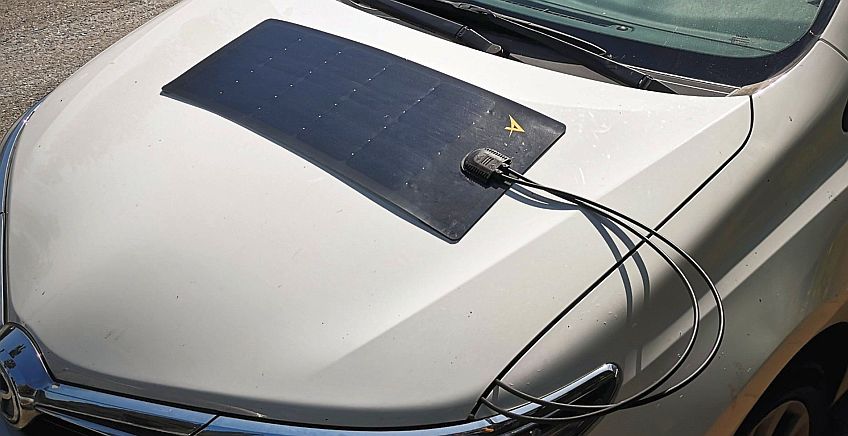
Yokneam-based (north of Israel) Apollo Power has signed an MoU with Audi AG to examine the integration of Apollo’s flexible solar sheets technology into cars made by Audi or another brand of Volkswagen Group. During the first 12 months of the agreement, the technology will be evaluated and tested. Following this, the parties will develop relevant products for Hybrid/Electrical vehicles, and after achieving certain milestones, they will introduce products to be integrated in future vehicle models. Apollo Power’s stock rose by about 30% on the Tel Aviv Stock Exchange.

Apollo Power has developed flexible solar sheet technology that can be adapted to the needs of the Automotive industry. Last year it conducted a series of experiments in collaboration with BWR, in which a 1.2-square-meter solar sheet was installed on the roof of a Kia Niro family car. According to the research company Market Study Report, the market for flexible solar sheets will grow at an annual rate of 8.7% in the next 5 years, reaching $610 million in 2024.

A solar solution for non-flat surfaces

Founded in 2014, Apollo Power is controlled by Westar Holdings (61%) and its operations are carried out through its wholly-owned subsidiary SolarPaint. Its main target markets are floating solar, automotive, and off grid applications. Thanks to their elasticity and low weight, the solar sheets can be easily deployed on top of uneven surfaces, and thus utilize structures and areas where hard and heavy panels cannot be installed. The main disadvantage of flexible solar sheets lies in their lower energy conversion efficiency compared to rigid solar panels.

Apollo Power’s technology and composition of materials are protected by undisclosed registered patents. According to the company, it has achieved 13.6% conversion efficiency – relatively high compared to competing solutions. The sheets weight 1 kg per square meter. The use of flexible sheets is particularly suitable for the electric and hybrid vehicle industry, as their light weight allows them to be positioned over the entire surface of the vehicle, including the roof and hood, and thus attain an additional energy source to increase the vehicle’s range, or to reduce the batteries’ capacity.

The company is building a semi-automatic production line commissioned from a European manufacturer specializing in machines for the solar industry has recently arrived in Israel. It is considered the first production line of its kind in Israel, and it is planned to start operating as early as in 2020. Its production output is expected to reach up to 6 MWp per year.