
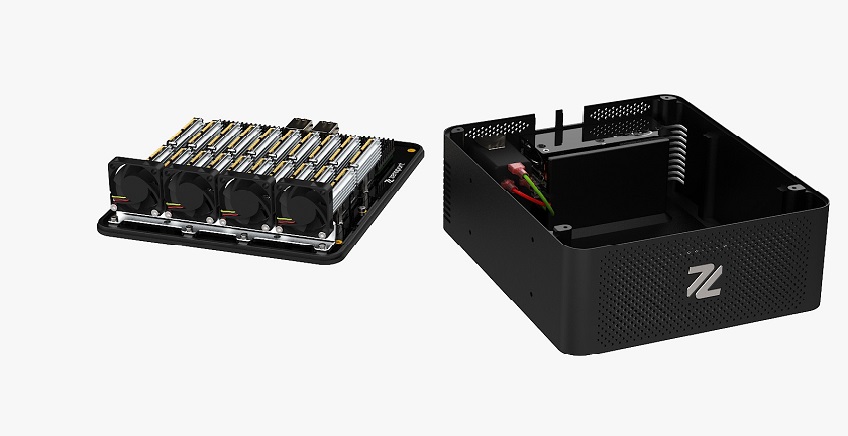
[Image: Zeroport’s hardware-based access solution. Credit: Zeroport]
Israeli industrial cybersecurity company Zeroport has emerged from stealth today, announcing a $10 million Seed funding round. The round was led by lool ventures, with participation from Clarim Ventures, Elron Ventures’ micro-fund, CyberFuture, and Fusion Fund. The company plans to use the funding to support global expansion, grow its workforce, and continue developing its core platform.
Zeroport operates in the secure remote access space, addressing one of the most sensitive challenges in modern cybersecurity: enabling remote connectivity to critical and highly sensitive systems without exposing them to the internet or to IP-based communication. Since its founding, the company has already deployed its technology among large organizations in Israel and internationally, including operators of critical infrastructure, energy companies, financial institutions, as well as government and defense entities.
In recent years, remote access to operational and critical systems has become unavoidable. Organizations now manage geographically distributed facilities, rely heavily on external vendors and contractors, require real-time monitoring and maintenance, and must operate under emergency conditions where physical access to sites is impractical or impossible. Despite this reality, most organizations still depend on software-based solutions, primarily VPNs and various Zero Trust platforms—a security model that removes implicit trust and requires continuous authentication and authorization for every access attempt.
These solutions are built on IP communication and, by design, introduce an attack surface that can be exploited through malware, credential theft, or network intrusion.
This challenge is far from theoretical. Even organizations with advanced security postures continue to suffer breaches originating from remote access infrastructures. As a result, many are forced to choose between completely isolating sensitive systems from connectivity or relying on complex, costly, and inherently vulnerable remote access solutions. This dilemma is particularly acute in critical infrastructure and operational technology environments, where any network connection can become a single point of failure.
Zeroport’s technology takes a fundamentally different approach. Instead of relying on standard networking protocols or IP-based communication, user input and display output are converted into analog signals and transmitted via a dedicated hardware component. This architecture eliminates any direct IP communication between the remote user and the organization’s internal network.
According to the company, the complete absence of IP connectivity inherently prevents intrusion, interception, or malicious code injection, enabling secure remote access even to systems that were previously considered too sensitive to connect externally. The patented hardware component, installed at the organization’s perimeter, functions as a physical isolation layer between external users and critical internal systems, without relying on software-based security mechanisms.

Zeroport was founded in mid-2024 in Herzliya by CEO and co-founder Yosef “Sefi” Gertz, who brings over 15 years of experience in leading technology companies, and co-founder and CTO Lavi Friedman, a graduate of Israel Defense Forces Unit 81. The idea for the company emerged during reserve military service in the “Iron Swords” war, where the founders identified deep structural gaps in existing secure remote access solutions.
Today, Zeroport employs approximately 25 people, with offices in Israel and additional locations in New York and Singapore. Following the funding round, the company plans to grow its workforce to around 40 employees within a year and expand into markets across North America, Europe, and the Asia-Pacific region.
Zeroport currently offers three core products, each designed to address different secure remote access needs while maintaining strict isolation from IP communication. Fantom is the company’s flagship, enterprise-scale solution, supporting large networks with multiple users—including employees, contractors, and third-party vendors—through dedicated hardware devices that create one-way isolation with no digital attack surface. Polter is designed for highly sensitive, one-to-one access scenarios, enabling secure, isolated connectivity to a single system or workstation. Roamer is a zero-client endpoint with no operating system, providing a hardened remote workspace that connects to Fantom or Polter without leaving data, memory, or attack vectors on the user’s device.
Zeroport is primarily targeting organizations that operate critical systems, including operational technology environments, industrial control systems, energy infrastructure, sensitive financial facilities, and government and defense bodies. In these environments, the technology enables secure remote maintenance, monitoring, and operation of sites and systems without requiring on-site personnel or exposing internal networks to the internet.
Beyond OT environments, the platform can also serve IT organizations that demand extreme levels of security and seek to replace layered, legacy remote access architectures accumulated over years.
According to the company, its solution is already in use among large organizations in Israel and abroad across critical infrastructure, energy, finance, and public sector segments. Early adoption has been driven by organizations with near-zero tolerance for error, where any remote access breach could result in severe operational, regulatory, or security consequences.