Eco Wave Power Raises Capital at a Premium, but the Road from Pilot Projects to the Energy Industry Remains Long
3 July, 2026
Despite a 54% share price surge, annual results show minimal revenue, while most projects remain in development and the flagship Portuguese project has yet to reach commercialization
By Yohai Schwiger
Eco Wave Power, the Israeli company developing wave energy technology, this week announced a $4 million private placement with an institutional investor. In an unusual move, the offering was priced at $10 per ADS, representing a 10.7% premium to the Nasdaq closing price. The investor also received warrants exercisable at $12 per ADS, approximately 33% above the market price.
The timing is no coincidence. Eco Wave Power’s shares have gained roughly 54% since the beginning of the year, giving the company a market capitalization of approximately $53 million. In effect, the company took advantage of the strong share performance to strengthen its balance sheet under relatively favorable terms, avoiding the discounts that typically accompany capital raises by small public companies.
According to the company, the proceeds will be used to expand commercial operations and advance a broader strategic vision: positioning wave energy as an “energy layer” for AI infrastructure and data centers. However, a closer look at the company’s 2025 annual report paints a more nuanced picture, illustrating how far it still has to go before translating technological promise into meaningful commercial business.
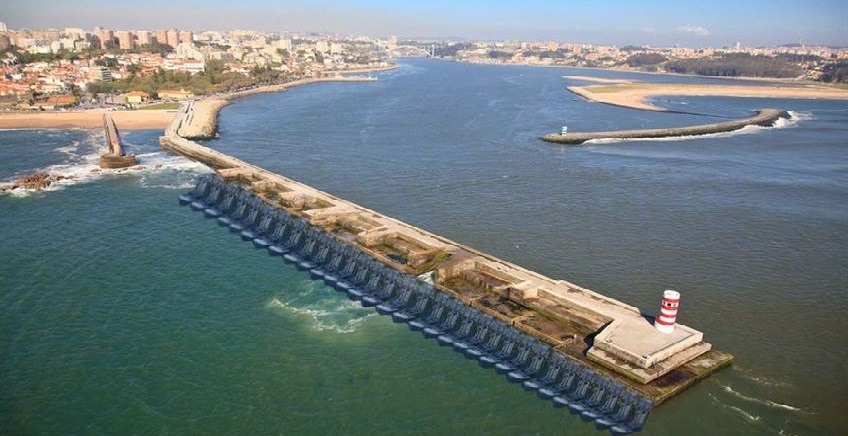
Eco Wave Power has developed a system that installs floating devices on existing breakwaters, piers, and coastal structures. The movement of ocean waves drives a hydraulic mechanism connected to a generator, producing electricity without the need for large offshore installations. According to the company, leveraging existing coastal infrastructure significantly reduces both construction and maintenance costs compared with conventional offshore wave-energy systems.
Commercially, however, the gap between vision and reality remains substantial. The company’s annual report shows 2025 revenue of just $38,000, down from $168,000 in the previous year. Net loss totaled approximately $3.7 million, while operating cash flow was negative by roughly $3 million. At year-end, Eco Wave Power held approximately $6 million in cash, meaning the latest financing adds another $4 million to its balance sheet—improving its financial position, but falling well short of funding large-scale commercial deployment.
The financial figures also raise an interesting question about the company’s pace of progress. On one hand, annual cash burn of roughly $3 million is relatively modest for an energy infrastructure company, suggesting a lean operating model focused on technology development and partnerships, while major capital investments are expected to come later or be financed by project partners. On the other hand, it may also indicate that the company has yet to reach the stage where significant investments are required to build commercial power facilities. After nearly two decades of development, this remains one of the key questions raised by the annual report: do the relatively low expenditures reflect operational efficiency, or simply the fact that commercialization is still advancing slowly?
A similar gap is evident in the company’s project pipeline. Eco Wave Power reports a portfolio totaling 404.7 megawatts, yet the annual report makes clear that most of these projects consist of preliminary agreements, memoranda of understanding, and development initiatives rather than binding customer orders or revenue-generating facilities.
In practice, the number of active projects is far smaller. The demonstration plant in Jaffa, connected to Israel’s power grid since 2023, continues to serve primarily as a testing and development platform. In the United States, the company launched a pilot project at the Port of Los Angeles in 2025 together with AltaSea and Shell Marine Renewable Energy, but this, too, remains a demonstration site intended to validate the technology rather than a commercial-scale power plant.
The company’s most significant milestone lies in Portugal, where its first commercial project is planned. Yet the timeline itself illustrates the challenges of moving from pilot projects to commercialization. The original concession agreement was signed in 2020, grid connection approval was received in 2021, and only in March 2024 did the company obtain the regulatory license allowing the project to move forward. Even today, the facility has yet to begin generating electricity, while the annual report notes that damage to the site’s breakwater could further delay progress.
Over the past year, Eco Wave Power has also sought to align itself with the artificial intelligence boom. The company introduced its WaveGPT initiative, partnered with researchers at U.S. universities, joined the NVIDIA Inception program, and was featured on NVIDIA’s official blog for its use of digital twins and AI tools to optimize energy facility management.
Here, too, however, it is important to distinguish between technological capability and marketing narrative. WaveGPT does not alter the company’s method of electricity generation. Instead, it is designed to improve plant operations through data analytics, predictive maintenance, simulation, and performance optimization. These capabilities could become valuable once dozens or hundreds of facilities are in operation, but they do not address the company’s primary challenge: deploying commercial-scale power plants.
Eco Wave Power has also positioned itself as a potential energy supplier for data centers—one of today’s fastest-growing infrastructure markets due to the rapid expansion of AI. Yet a fundamental question remains. The company’s existing installations operate at capacities ranging from several hundred kilowatts to only a few megawatts, while modern data centers typically require tens or even hundreds of megawatts. Even if the technology proves commercially viable, it is therefore likely to serve as a complementary energy source alongside the electrical grid, natural gas, solar, or wind power, rather than as a primary power solution for AI infrastructure.
Ultimately, Eco Wave Power’s annual report presents a company with an intriguing engineering concept, growing international recognition, and genuine technological potential—but one that is still searching for its commercial breakthrough. After more than a decade of development, the central question is no longer whether electricity can be generated from ocean waves, but whether it can be produced at commercial scale, at competitive cost, and at the speed required by a rapidly evolving global energy market. For now, the company’s financial results suggest that answer has yet to emerge.
Posted in: News