Israel’s Desert Tech Ecosystem Takes Shape
23 September, 2026
A new Israel Innovation Authority report maps the local ecosystem across five areas, from AI and sensing to water and agriculture, and highlights the challenge of scaling deployment
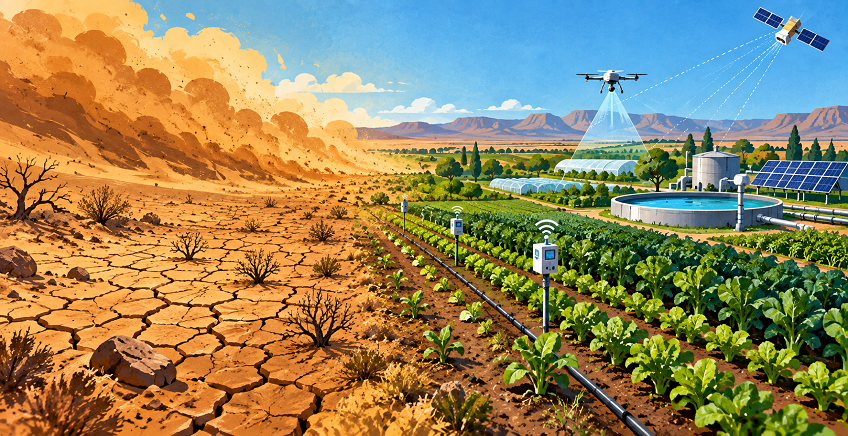
Around 100 Israeli companies are developing technologies that could help address desertification and the effects of climate change, including sensing systems, artificial intelligence, environmental data analytics, water technologies and precision agriculture. The figure comes from a new report by the Israel Innovation Authority and Israel C4IR, the Israeli Center for the Fourth Industrial Revolution, examining how advanced technologies can be deployed to tackle land degradation and water scarcity in arid regions.
The Climate Resilience, Desertification and Applied Innovation Report defines desertification not as the expansion of existing deserts, but as the degradation of land in arid and semi-arid regions caused by a combination of climate change and human activity. According to figures cited in the report, desertification directly affects around 250 million people and roughly one-third of the world’s land surface, while threatening the livelihoods of approximately one billion people. More than 170 countries are affected by desertification.
Water scarcity is expected to intensify the problem. According to the report, between 1.7 billion and 2.4 billion people are projected to live in urban areas facing water scarcity by 2050. Agriculture alone currently accounts for more than 70% of global freshwater withdrawals, with the share potentially even higher in arid countries.
From Sensors and Satellites to Drought-Resistant Seeds
The report identifies five key technology areas for addressing desertification: water systems for arid environments, climate-resilient agriculture, soil monitoring and restoration, environmental intelligence, and renewable and distributed energy.
One of its central arguments is that these should not be treated as separate technology markets, but rather integrated into broader resilience systems. Reclaimed water, for example, can support agriculture; solar power can operate water treatment and irrigation systems; and sensors and AI can detect soil degradation before significant damage occurs.
The mapping conducted for the report identified a significant concentration of Israeli companies operating in these fields. Examples include TaKaDu, which uses data analytics to detect leaks and failures in water networks; CropX, which combines soil sensor, weather and satellite data to optimize irrigation and agricultural inputs; SupPlant, which monitors plant conditions to support irrigation decisions; and Netafim and N-Drip, both active in precision and water-efficient irrigation.
Another example is Israeli company SaliCrop, which has developed a non-GMO seed enhancement platform designed to activate plants’ natural stress-response mechanisms before planting. According to the report, the technology has been tested in more than 250 field and commercial projects across 12 countries. The company has reported typical yield improvements of 10% to 25% under stress conditions, with higher gains recorded under severe stress.
In the water sector, the report also highlights Laguna Innovation, which develops a modular, solar-powered system that treats wastewater onsite so it can be reused for irrigation. EZPack develops modular systems for water purification, storage and distribution in areas without permanent infrastructure, including reverse-osmosis and irrigation-water salinity treatment solutions.
Using AI to Manage Soil
One of the technological shifts identified in the report is a move from treating soil after degradation has already occurred toward data-driven management aimed at detecting deterioration earlier.
Combining satellite observations, soil and water sensors, IoT systems and artificial intelligence makes it possible to monitor moisture, salinity, vegetation health and other environmental variables, and to use that information to guide irrigation and land-restoration efforts.
AI, sensing and robotics are also becoming part of the broader response in agriculture. The report divides these applications into three categories: systems that monitor and forecast drought, heat and land degradation; technologies that help farmers adapt production to changing water and soil conditions; and technologies designed to restore soil and ecosystems that have already been damaged.
Israel as a Living Lab
The report presents Israel as a case study in how resource scarcity can drive technological development. In the water sector, for example, approximately 90% of Israel’s treated wastewater is reused for agriculture, alongside extensive use of desalination and precision irrigation. According to the report’s authors, this combination of technologies and infrastructure has largely decoupled Israel’s water supply from fluctuations in natural freshwater availability.
The Negev is presented as a “living lab” for testing technologies under conditions of extreme heat, low rainfall, salinity and water scarcity. Research institutions, companies, farmers, and pilot and demonstration sites operate across the region, allowing solutions to be tested under conditions similar to those that other parts of the world may increasingly face as climate change intensifies.
The Challenge: Moving Technology From Pilots to the Field
Alongside technological advances, the report identifies several barriers preventing some solutions from reaching widespread adoption. In agriculture, for example, the authors point to a shortage of high-quality data for training and validating AI models, limited access to agricultural testing environments, high development costs and difficulties demonstrating a clear return on investment for farmers.
Smallholder farmers may struggle to finance equipment, software, data services and training, while investors can be reluctant to finance companies operating in markets where the path to large-scale commercial deployment is long.
One of the report’s main recommendations, therefore, is to go beyond funding research and development. The authors call for the expansion of “living labs,” demonstration sites and regulatory sandboxes, as well as a continuous financing framework that supports technologies from the laboratory through field trials and demonstration to their first commercial deployment.
“Climate change and desertification present the world with challenges that cannot be solved by a single technology or a single country,” said Israel Innovation Authority CEO Dror Bin. The challenge now, he added, is to connect existing solutions and enable them to move from research and pilot projects “to implementation at meaningful scale.”
Posted in: News