
The Robots Took Over electronica 2026
19 November, 2026
The trade fair held in Munich broke records for both exhibitors and visitors. The spotlight was on the integration of AI into manufacturing, robotics, and physical edge systems
This year, the electronica 2026 trade fair set new records for exhibitor numbers and international participation, despite the growing importance of online activities in the industry. According to Messe München (the event organizer), this year’s exhibition attracted 3,512 companies from 60 countries, with 74% of exhibitors coming from outside Germany. More than 86,000 industry professionals attended the event, approximately 54% of them from abroad. The five countries with the largest exhibitor presence, in descending order, were Germany, China, Taiwan, the United States, and France.
More than any other topic, artificial intelligence defined the look of electronica 2026. Exhibitors showcased practical AI applications ranging from smart sensors to connected systems and automated manufacturing. Other major themes included cybersecurity resilience and energy-efficient technologies, which are key growth drivers in the transition toward an All Electric Society.
This transformation was clearly reflected on the exhibition floor. In previous years, the largest displays focused on smart homes and, particularly, the automotive industry. Electric vehicles and cars equipped with a wide range of electronic systems could be seen throughout the exhibition halls.
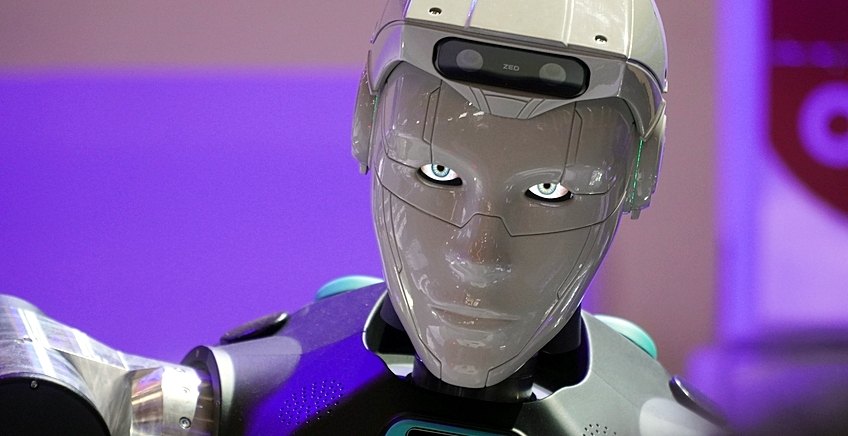
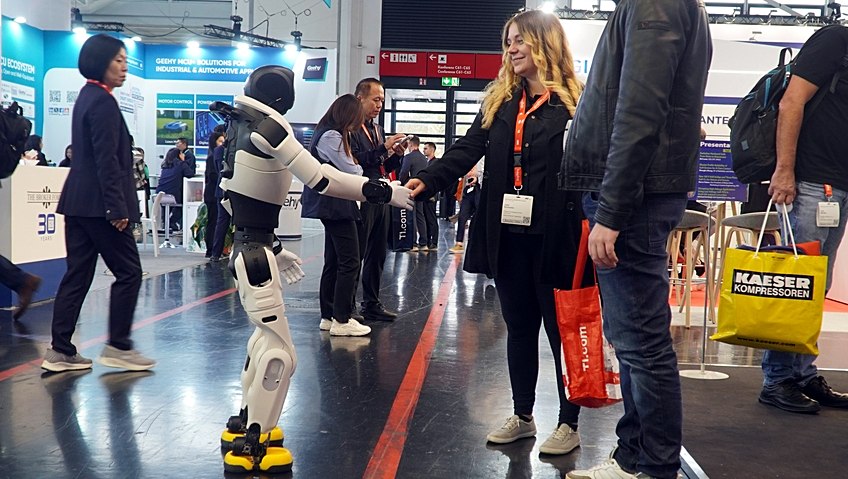
This year, however, robots took center stage. Most major exhibitors showcased industrial and humanoid robots, both as demonstrations of their technologies and as attractions designed to draw visitors to their booths.
This shift reflects two major developments in the electronics industry: the growing focus on artificial intelligence running directly on edge devices (Edge AI), and a fundamental change in development strategies, as companies move beyond designing individual chips toward developing complete platforms for robotics and Physical AI applications.
Artificial Intelligence Enters Physical Systems
MIPS announced updates to its MIPS Actus robotic control platform, aimed at adapting it for mass-produced humanoid and industrial robots. The goal is to translate decisions made by AI systems into precise and secure physical motion. The updates address the “last-mile” challenge of humanoid robotic arms, from the elbow to the fingertips. Every joint in this assembly must deliver smooth, human-like motion while meeting strict constraints on size, weight, power consumption, and heat dissipation.
TDK demonstrated the Nibotics Dexterous Hand, a robotic hand equipped with sensors and AI capabilities to detect pressure, force, slippage, texture, shape, and temperature in real time. Teradyne unveiled its Omnyx Edge platform for testing circuit boards used in Physical AI and Edge AI systems. The platform performs testing across the three main hardware layers of Physical AI systems: the Compute & Control Layer, which includes processing modules, robotic controllers, and dedicated control units; the Sensing Layer, which includes camera, radar, LiDAR, and sensor-fusion boards; and the Motion Layer, which includes power conversion, motor control, joint drives, and mechanical actuation.
A Revolution in Competition Among Chipmakers
An unusual announcement by Texas Instruments demonstrated how artificial intelligence is transforming not only the industry’s target markets, but also the competitive landscape within the semiconductor industry itself. TI unveiled a significant upgrade to its CCStudio development environment, expanding its Agentic AI capabilities for code development in microcontroller-based (MCU) embedded systems.
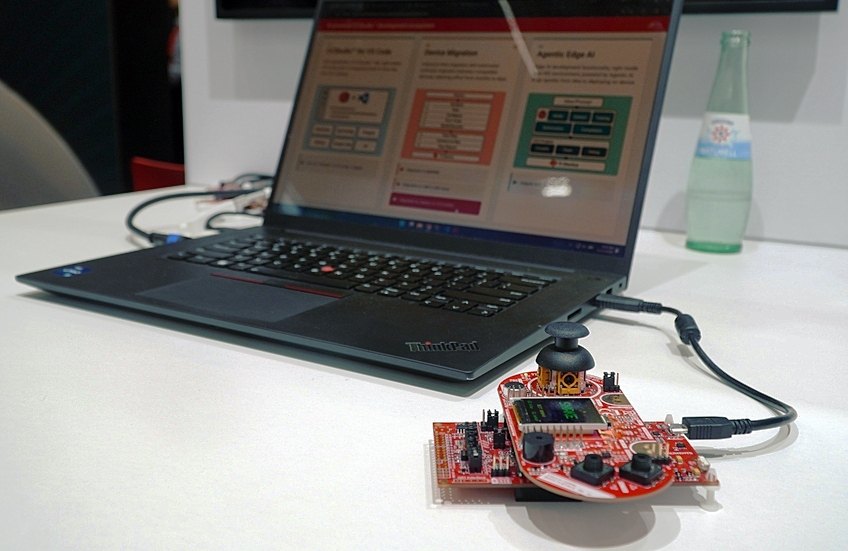
To address this challenge, TI integrated context engineering capabilities into the development environment, giving AI agents access to hardware-specific knowledge, including software development kits (SDKs), pin configurations, and peripheral information. This information enables AI agents to generate code, configure peripherals, build applications, flash them onto the target hardware, and perform autonomous debugging. The immediate result is a dramatic reduction in development time for complex tasks – from months to just a few days.
However, the implications go even further. Vinay Agarwal, vice president of TI’s Microcontrollers Division, told Techtime that the company had trained the system on its own microcontrollers as well as those of its major competitors. Agarwal: “We used publicly available information from competitors to enable the system to migrate applications from one microcontroller to a completely different one. Normally, such a process takes several months. Now it can be completed in just a few hours. We have also integrated testing capabilities that allow the system to inject data, examine the resulting output, and validate the software.”
At TI’s booth, the company demonstrated the migration of a design from an STMicroelectronics microcontroller to a TI MSP-family microcontroller. According to Agarwal, the system is still in its early stages. “We plan to expand its capabilities and eventually make it an open-source platform.”
Posted in: AI , News , Semiconductors
Posted in tags: electronica 2026 , robot