XTEND Advances to Next Stage of Pentagon’s Drone Dominance Initiative
3 July, 2026
The Israeli company is among 19 finalists in the Pentagon’s Drone Dominance program, aimed at accelerating mass production of low-cost autonomous drones while incorporating lessons from recent battlefields

By Yohai Schwiger
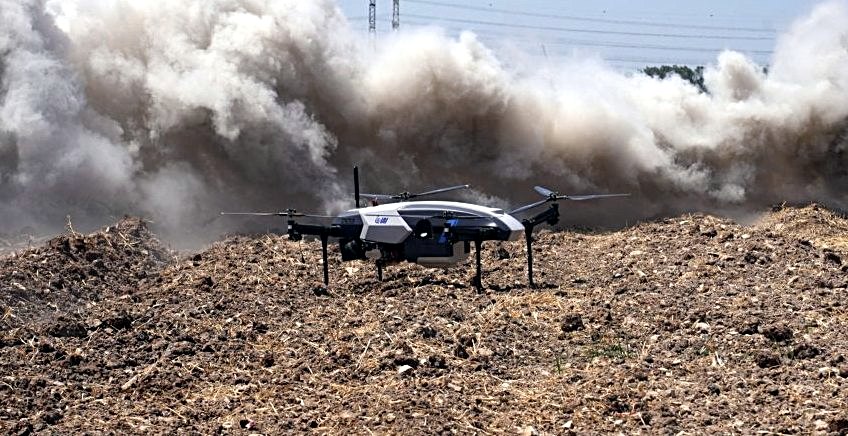
Israeli drone technology company XTEND has advanced to Gauntlet II of the U.S. Department of Defense’s Drone Dominance program after being selected as one of just 19 companies from an initial field of 49 participants. During the next phase, scheduled for August at Fort Carson, Colorado, the company will demonstrate its STRIKER drone system while proving its ability to manufacture and deliver operational systems at industrial scale—a critical milestone toward participating in one of the Pentagon’s most ambitious drone procurement efforts.
The announcement, however, represents more than another achievement for XTEND. Drone Dominance provides a window into how the U.S. military is reshaping its approach to drone acquisition. Drawing lessons from the wars in Ukraine and the Middle East, the Pentagon is rebuilding America’s drone industrial base around a new principle: battlefield advantage depends not only on superior technology, but also on the ability to produce it rapidly and in large quantities.
Not Another Development Program—A Manufacturing Revolution
For years, the United States relied on sophisticated and expensive unmanned systems developed over lengthy, multi-year programs costing hundreds of millions of dollars. Recent conflicts have demonstrated that this model no longer matches the pace of modern warfare.
Small, inexpensive drones have become among the most influential weapons on today’s battlefield. They are affordable, easy to operate, rapidly upgradeable, and can be manufactured in volumes far beyond those of traditional weapon systems.
Against this backdrop, the Department of Defense launched Drone Dominance, an initiative designed to rapidly identify promising companies, evaluate their technologies, and transition them into military suppliers within months rather than years. The program is estimated to be worth roughly $1 billion and is expected to lead to procurement of tens of thousands of drones over the coming years.
Unlike traditional defense competitions, the Pentagon is no longer selecting only the best-performing drone. Participants must also demonstrate rapid manufacturing capability, resilient supply chains, scalable serial production, and the ability to evolve from innovative startups into reliable industrial suppliers.
A Test of Industry, Not Just Technology
The program’s first phase took place at Camp Grayling, Michigan, where the U.S. Army evaluated drone performance across a range of operational scenarios during both day and night.
The 19 companies advancing to Gauntlet II now face a fundamentally different challenge. Rather than showcasing prototypes, they must prove that their systems are ready for mass production, can be delivered quickly and at scale, and meet the demanding standards of the U.S. defense supply chain.
In effect, this is a test of industrial capability as much as technological innovation.
The Finalists Tell the Story
The shortlist combines established defense contractors with a new generation of drone companies. Alongside well-known names such as AeroVironment, Kratos, and Teal Drones are younger firms including Neros, Ascent AeroSystems, Ukraine’s General Cherry, and Israel’s XTEND.
The composition of the finalists reflects a broader shift in Pentagon thinking. Rather than relying primarily on traditional defense primes, the Department of Defense is increasingly looking to companies specializing in tactical drones, autonomy, and technologies developed at the pace demanded by rapidly evolving battlefields.
It is also notable that although the initiative aims to strengthen America’s domestic manufacturing base, several of the selected technologies originate abroad. XTEND is the only Israeli company to reach Gauntlet II, joined by firms with Ukrainian and European roots. The message is clear: the Pentagon wants manufacturing to take place in the United States but is willing to source innovation from anywhere in the world.
Lessons From Recent Battlefields
Russia’s invasion of Ukraine served as the primary catalyst for the Pentagon’s strategic shift. The conflict demonstrated how inexpensive FPV drones, produced in the thousands, could reshape the battlefield and inflict significant damage even on forces equipped with advanced and costly weapons.
More recently, the confrontation with Iran highlighted another critical challenge. Large-scale drone and missile attacks forced the United States and its allies to employ interceptors costing hundreds of thousands—or even millions—of dollars apiece. Beyond their high cost, these conflicts exposed how quickly interceptor inventories can be depleted while replacement production remains comparatively slow.
As a result, the Pentagon is seeking not only more capable drones but also platforms that can be manufactured rapidly, at scale, and at relatively low cost. The emphasis is shifting toward serial production, autonomy, resilience against electronic warfare, and the ability to replenish depleted inventories quickly.
For XTEND, advancing to Gauntlet II represents more than another technological milestone. The company already supplies systems to U.S. defense organizations, but Drone Dominance could position it within a much broader effort to build the next generation of drone suppliers for the U.S. military.
More broadly, the program illustrates a profound shift in American defense strategy: in the age of drones, military superiority is measured not only by the performance of individual systems, but also by the industrial capacity to manufacture thousands of them rapidly, affordably, and at the pace demanded by modern attritional warfare.
Posted in: News