Q-Factor Maps a Path to a Million Qubits
11 October, 2026
The Israeli startup is developing a neutral-atom quantum computer, targeting a million-qubit core while tackling the challenges of scaling control, readout, and error correction
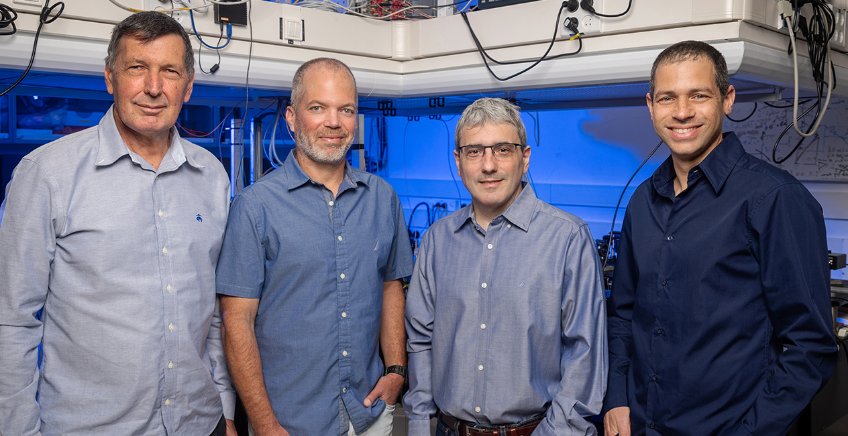
[Pictured, right to left: Prof. Ofer Firstenberg, Prof. Yoav Sagi, Dr. Guy Raz, and Prof. Nir Davidson]
“A quantum computer can work and still be a dead end,” says Dr. Guy Raz, co-founder, CEO, and CTO of Israeli startup Q-Factor. That observation captures the company’s central technological thesis: in the race to build a useful quantum computer, the number of qubits is only part of the problem. The greater challenge is ensuring that every system supporting them can scale at the same pace.
Q-Factor emerged from stealth in April, announcing $24 million in seed funding and plans to develop a neutral-atom quantum computer with more than one million qubits. As TechTime reported at the time, Raz founded the company with Prof. Nir Davidson and Prof. Ofer Firstenberg of the Weizmann Institute of Science, and Prof. Yoav Sagi of the Technion–Israel Institute of Technology. The founders said they had identified an architectural bottleneck that makes it difficult to scale existing neutral-atom computers beyond thousands of qubits.
The company is now beginning to reveal some of the principles behind its proposed solution. In recent months, its researchers have focused on two issues that become increasingly important as a quantum computer grows: the cumulative heating of atoms during quantum operations, and the ability to read their states quickly and accurately.
“A control scheme that looks elegant at 1,000 qubits can become impractical at 100,000; readout can remain accurate but become too slow,” Raz says. “Error correction can suppress noise yet require so many physical qubits and operations that the system never reaches a useful computational capacity.”
Neutral Atoms Move Beyond the Lab
Q-Factor has chosen one of the fastest-growing approaches to quantum computing: neutral atoms. In this architecture, individual atoms serve as qubits. Focused laser beams, known as optical tweezers, trap the atoms and allow them to be moved and arranged in different configurations. To perform operations between qubits, the atoms can be excited into Rydberg states, in which they interact strongly with one another.
Unlike artificial qubits fabricated on chips, atoms of the same isotope are inherently identical. Optical control also allows them to be moved and their connectivity reconfigured without separate electrical wiring for each qubit.
“Atoms are a natural implementation of quantum bits,” Raz says. “They are inherently identical, can be trapped and moved using light, and can be arranged in flexible geometries that allow different qubits to interact. In my view, these properties make neutral atoms the most promising platform for the scaling phase now beginning.”
But this approach does not, by itself, solve the scaling problem. A neutral-atom computer is a large, complex electro-optical system comprising lasers, optical components, control systems, and measurement equipment. As the number of atoms increases, the infrastructure operating them must grow without becoming too slow, complicated, or expensive.
“Most neutral-atom systems are built around a fairly conventional, microscope-like design that naturally limits the size of a single processor,” Raz says. “Q-Factor is developing a different approach, designed from the outset around a much larger atomic core.”
The goal is to scale a single core as far as possible, rather than move early to a system consisting of many smaller, interconnected quantum processors. Modularity also comes at a cost, Raz emphasizes: “Connecting many small quantum cores helps only if the links between them do not become the next bottleneck in performance or system complexity.”
Keeping the Atoms Cool
One example of how the company is approaching the scaling challenge appeared in a study published in August by Q-Factor’s four founders.
When performing quantum gates based on Rydberg states, a common practice is to briefly switch off the optical trap holding an atom, then turn it back on once the operation is complete. Each cycle releases and recaptures the atom, gradually adding motion and heat. Across many gate operations, this effect accumulates and can limit the depth of the quantum circuit—the number of sequential operations the computer can perform.
The researchers developed a technique called motional refocusing, which uses precisely timed changes in trap intensity to reverse the effects of motion and restore the atom’s motional state. According to the study, heating can be canceled in a harmonic model, while simulations of realistic optical traps showed that the technique could suppress the dominant heating mechanism.
For Q-Factor, a key feature is that the solution does not require adding a new hardware component for every qubit. Instead, it uses the trap-intensity control already present in the system—the kind of approach the company is seeking as it designs a machine intended to grow by several orders of magnitude.
For now, however, the study remains theoretical work supported by simulations, rather than a demonstration in a large quantum computer.
Accurate Readout Is Not Enough
Another bottleneck lies in reading the qubits’ states. In a fault-tolerant quantum computer, measurements are not confined to the end of a calculation. Error correction requires repeated cycles of measurement, processing, and feedback, making readout time a critical resource as the system grows.
In another study, Q-Factor researchers and collaborators proposed using auxiliary atoms to amplify the readout signal. Rather than relying solely on the signal from a single atom, the information needed for readout is transferred in a controlled way to several auxiliary atoms, which can then be measured in parallel. Here, too, the proposal has so far been assessed through analysis and simulations, rather than demonstrated in an operating system at scale.
Both studies reflect the same principle: solving each problem individually is not enough. The solution must avoid creating a new scaling bottleneck in place of the one it removes.
“Scaling costs tend to compound,” Raz says. “Faster measurement may require more hardware, additional connectivity makes control harder, and error correction increases the overall resources required. A design that works well at one scale can become impractical when the machine grows tenfold or a hundredfold.”
Q-Factor remains far from demonstrating its ambitious target. The company has not unveiled a system approaching one million qubits, and some of its proposed solutions are still at the research and simulation stage. The central question is whether these elements can be integrated into a single large system while maintaining the accuracy required for fault-tolerant computing.
For Raz, that is precisely where the next phase of the quantum race will be decided. “In the race to a million qubits, the challenge is not just getting there, but making sure the rest of the machine can grow with them.”
Posted in: News