Digi-Key Offers Unlimited Access to EDA/CAD Models

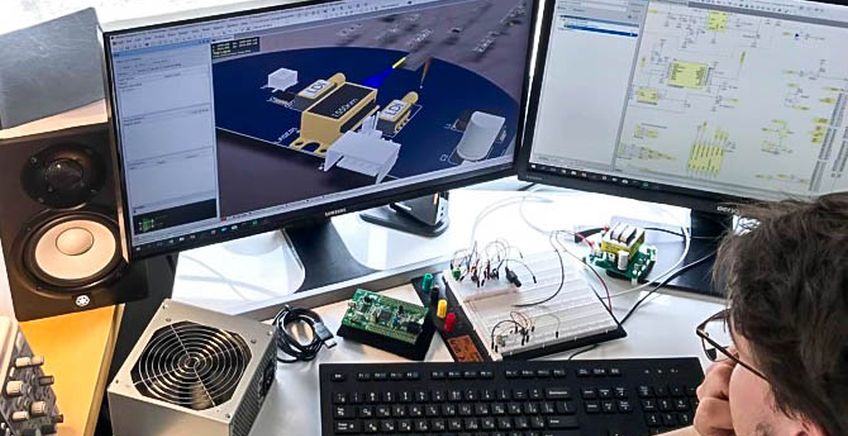
The global electronic components distributor, Digi-Key Electronics, announces unlimited access to Ultra Librarian symbols, footprints, and 3D STEP models from digikey.com. Ultra Librarian offers models in over 20 EDA and CAD formats to cover the vast majority of the PCB design tools in use, including Altium, Eagle, KiCad, OrCAD, and PADS.

Models are created using the Ultra Librarian Desktop software, which uses a combination of templates, pdf extraction, and verification algorithms to quickly capture all important component information required. The company said that in order to ensure the high accuracy, consistency, and adherence to IPC and other standards, models undergo more than 30 different verification checks, and many of the models are also verified by their respective device manufacturer.

“We have worked with EMA to remove the download limits of Ultra Librarian EDA and CAD models,” said Randall Restle, VP, Applications Engineering at Digi-Key.  “We now have model coverage for over 1.25 million parts, meaning our customers will be able to download a very high percentage of the models they need for a design.”

“Providing this improved access through Digi-Key gives our mutual customers an easy way to improve their design process,” said Manny Marcano, president and CEO of EMA Design Automation. Ultra Librarian® is a comprehensive electronic component solution for PCB design. The website www.UltraLibrarian.com allows visitors to search a database of over 40 million components to make part selection and sourcing decisions.

Registered users can download pre-authored and verified components from the world’s largest database of over 14 million CAD neutral library parts. Symbols, footprints, and 3D models from over 400 manufacturers can be exported to over 20 different CAD tools. Library creation software includes templates for over 600 part types and allows easy customization and export to the same 20+ CAD tools.

Digi-Key Electronics, headquartered in Thief River Falls, Minn., USA, is an authorized global, full-service distributor of electronic components, offering more than 6.8 million products, with over 1.4 million in stock and available for immediate shipment, from over 750 quality name-brand manufacturers. Digi-Key also offers a wide variety of online resources such as EDA and design tools, datasheets, reference designs, instructional articles and videos, multimedia libraries, and much more.

For more information: Ultra Librarian, EDA and design tools, Digi-Key website.

Analog Design Tip: High-Side Current Sensing

By: Aaron Schultz, Analog Devices

Question: Is placing a 100Ω resistor in front of a MOSFET gate required for stability?

Answer: Ask any experienced electrical engineer—for example, Gureux, the professor in our story—about what to put in front of a MOSFET gate and you will probably hear “a resistor, approximately 100Ω.” Despite this certainty, one still wonders why and questions the utility and the resistance value. Because of that curiosity, we will examine these questions in the following example. Neubean, a young applications engineer, looks to test if it is actually necessary to place a 100Ω resistor in front of a MOSFET gate for stabilization. Gureux, an applications engineer with 30 years of experience, monitors his experiments and gives his expert opinion along the way.

Introducing the HS Current Sense

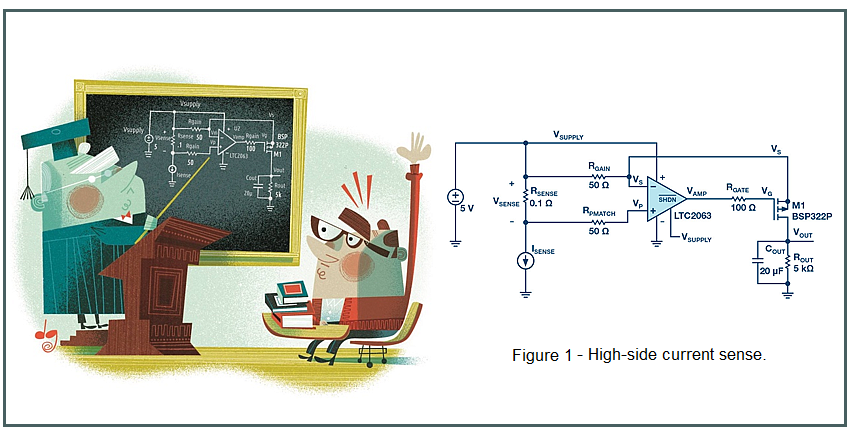
The circuit in Figure 1 shows a typical example of high-side current sense. Negative feedback tries to force the voltage VSENSE upon gain resistor RGAIN. The current through RGAIN flows through P-channel MOSFET (PMOS) to resistor ROUT, which develops a ground referenced output voltage. The overall gain is:

Optional capacitance COUT across the resistor ROUT serves to filter the output voltage. Even if the drain current of the PMOS quickly follows the sensed current, the output voltage will exhibit a single-pole exponential trajectory. The resistor RGATE in the schematic separates the amplifier from the PMOS gate. What is the value? “100Ω, of course!” the experienced fellow Gureux might say.

Trying Out Lots of Ω

We find our friend Neubean, a student of Gureux’s, pondering this gate resistor. Neubean thinks that with enough capacitance from the gate to the source, or with enough gate resistance, he should be able to cause stability problems. Once it is clear that RGATE and CGATE interact detrimentally, then it will be possible to debunk the myth that 100 Ω, or in fact any gate resistance, is automatically appropriate.

Figure 2 shows an example of an LTspice simulation used to highlight the circuit behavior. Neubean runs simulations to show the stability problems that he believes will occur as RGATEincreases. After all, the pole from RGATE and CGATE ought to erode the phase margin associated with the open loop. Yet, to Neubean’s amazement, no value of RGATE shows any sort of problems in the time domain response.

Turns Out, the Circuit Is Not So Simple

In looking at the frequency response, Neubean realizes he needs to take care of identifying what the open loop response is. The forward path that forms the loop, when combining the unity negative feedback, starts from the difference and ends at the resulting negative input terminal. Neubean then simulates and plots VS/( VP – VS), or VS/ VE. Figure 3 shows a plot’s frequency domain plot for this open-loop response. In the Bode plot of Figure 3, there is very little dc gain and no evidence of phase margin problems at the crossover. In fact, the plot overall looks very strange as the crossover frequency is less than 0.001 Hz.
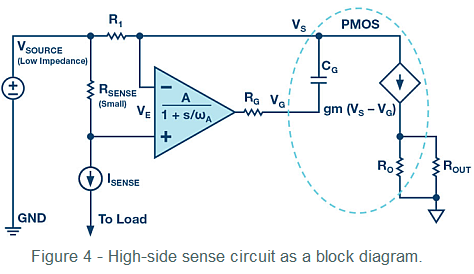
The decomposition of the circuit into a control system appears in Figure 4. The LTC2063, like almost all voltage feedback op amps, starts with high dc gain and a single pole.

The op amp gains the error signal and drives the PMOS gate through the RGATE – CGATE filter. The CGATEand PMOS source connect together to the –IN input of the op amp. RGAIN connects from that node to the low impedance source.

Stability Problems

Even in Figure 4, it might appear that the RGATE – CGATEfilter should cause stability problems, particularly if RGATE is much larger than RGAIN. After all, the CGATE voltage, which directly affects the RGATE current in the system, lags op amp output changes.

Neubean offers one explanation to why perhaps RGATE and CGATE do not cause instability: “Well, the gate source is a fixed voltage, so then the RGATE – CGATE circuit is irrelevant. All you need to do is adjust the gate and the source follows. It’s a source follower.”

His more experienced colleague Gureux says, “Actually, no. This is only valid when the PMOS operates normally as a gain block in the circuit.” Thus prompted, Neubean thinks about the math—what if we could directly model the response of the source of the PMOS to the gate of the PMOS? In other words, what is V(VS)/V(VG)? Neubean runs to the white board and writes the following equations.
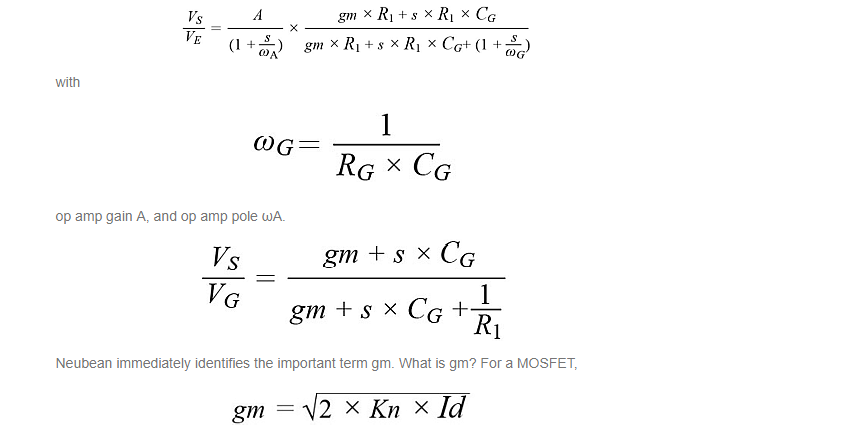
Looking at the circuit back in Figure 1, a light bulb goes off in the Neubean’s head. With zero current through RSENSE, the current through the PMOS ought to be zero. With zero current, gm is zero, because the PMOS is effectively off, not being used, unbiased, and has no gain. When gm = 0, VS/ VE is 0 at 0 Hz and VS/ VG is 0 at 0 Hz, so there is no gain at all and the plots in Figure 3 may be valid after all.

Try to Go Unstable with the LTC2063

Armed with this revelation, Neubean quickly tries a few simulations with non-zero ISENSE. Figure 5 shows what looks like a much more normal gain/phase plot of the response from VE to VS, crossing from >0 dB to <0 dB. Figure 5 should show about 2 kHz, with lots of PM at 100 Ω, a bit less PM at 100 kΩ, and even less with 1 MΩ, but not unstable.

Neubean goes to the lab and dials up a sense current with the high-side sense circuit LTC2063. He inserts a high RGATE value, first 100 kΩ and then 1 MΩ, expecting to see unstable behavior or at least some kind of ringing. Unfortunately, he does not. He tries to increase the drain current in the MOSFET first by using more ISENSE and then by using a smaller RGAIN resistance. Nothing works to destabilize the circuit.

He returns to the simulation and tries to fill a phase margin with non-zero ISENSE. Even in simulation it seems difficult, if not impossible, to find instability or low phase margin.

Neubean asks Gureux why he is failing to destabilize the circuit. Gureux advises him to do the numbers. Neubean is used to riddles from Gureux, so he examines what might be the actual pole associated with RGATE and the total gate capacitance.

With 100Ω and 250 pF, the pole is at 6.4 MHz; with 100 kΩ, the pole is at 6.4 kHz; and with 1 MΩ, the pole is at 640 Hz. The LTC2063 gain bandwidth product (GBP) is 20 kHz. When the LTC2063 takes gain, the closed-loop crossover frequency can easily slide below any effect of the RGATE – CGATE pole.

Yes, You Can Go Unstable

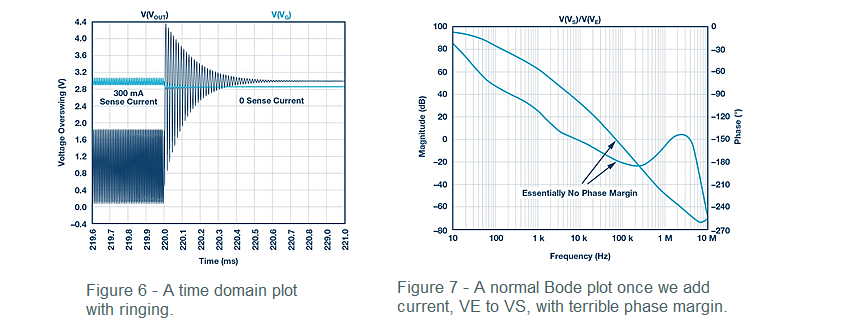
Realizing that the op amp dynamics need to continue up into the range of the RGATE – CGATEpole, Neubean chooses a higher gain bandwidth product. The LTC6255 5 V op amp will directly fit into the circuit with a higher 6.5 MHz GBP. Eagerly, Neubean tried a simulation with current, the LTC6255, 100 kΩ gate resistance, and with 300 mA sense current.

Neubean then proceeds to add RGATE in simulation. With enough RGATE, an extra pole can destabilize a circuit. Figure 6 and Figure 7 show simulation results with high RGATE values. At a constant 300 mA sense current, this simulation shows instability.
Lab Results

Wanting to see if the circuit might act badly while sensing a non-zero current, Neubean tries the LTC6255 with a step changing load current and uses three different RGATE values. ISENSEtransitions from a base of 60 mA to a higher value of 220 mA enabled by a momentary switch that brings in more parallel load resistance. There is no zero ISENSE measurement, because it is already shown that the MOSFET gain is too low in that case.

Indeed, Figure 8 finally shows truly compromised stability with 100 kΩ and 1 MΩ resistors. Because the output voltage is heavily filtered, the gate voltage becomes the detector for ringing. Ringing denotes poor or negative phase margin, and ringing frequency indicates crossover frequency.

A Moment to Brainstorm

Neubean realizes that he has seen many high-side integrated current sense circuits and, unfortunately, there is no chance for an engineer to decide on gate resistance, because everything is inside the part. Examples that came to his mind were AD8212LTC6101LTC6102, and LTC6104 high voltage, high-side current sense devices. In fact, the AD8212 uses a PNP transistor rather than a PMOS FET. He tells Gureux, “Eh, it doesn’t really matter, because modern devices already solve this problem.”

As though expecting this comment, almost cutting off Neubean before his last word, the professor responds: “Let’s say you want a combination of extremely low supply current and zero-drift input offset, such as in a remotely located battery-powered instrument. You might want an LTC2063 or LTC2066 as the primary amplifier. Or, perhaps, you need to measure a low level current level perhaps through a 470 Ω shunt as accurately and noiselessly as possible; in that case you might want to use the ADA4528, which has rail-to-rail input capability. In these cases, you will need to deal with the MOSFET drive circuitry.”

And So …

Clearly, then, it is possible to destabilize the high-side current sense circuit by using too large of a gate resistor. Neubean relates this finding to his willing teacher Gureux. Gureux notes that RGATE can in fact destabilize the circuit, but the initial inability to find this behavior drew from a wrongly formulated problem. There needed to be gain, which in this circuit required there to be non-zero signal being measured.

Gureux replies, “Sure, when a pole erodes the phase margin at a crossover, ringing happens. But your 1 MΩ of added gate resistance is absurd—even 100 kΩ is crazy. Remember, it is always good to try to limit the output current of an op amp in case it tries to swing a gate capacitance from one rail to another rail.”

Neubean agrees. “So what value of resistance do I use?”

Gureux notes confidently, “100Ω.”

About the author:

Aaron Schultz [aaron.schultz@analog.com] is an applications engineering manager in the LPS business unit. His multiple system engineering roles in both design and applications have exposed him to topics ranging across battery management, photovoltaics, dimmable LED drive circuits, low voltage and high current dc-to-dc conversion, high speed fiber optic communication, advanced DDR3 memory R&D, custom tool development, validation, and basic analog circuits, while over half of his career has been spent in power conversion. He graduated from Carnegie Mellon University in 1993 and MIT in 1995. By night he plays jazz piano.

Sckipio Raised $10M for G.fast Rollout

Sckipio Technologies from Ramat Gan, Israel, has raised $10M USD in a round led by MegaChips, with the participation of Intel Capital, Pitango Venture Partners, Genesis Partners, Gemini Israel Ventures, Amiti Ventures, Aviv Ventures, CIRTech Fund and Axess Ventures. The additional investment will be used to support the global rollout of G.fast solution with tier-1 service providers. The recent round brings the total investment in Sckipio to $50 million.

Founded in 2012, Sckipio is the first semiconductor company focused on the new ITU standard, G.Fast. It was founded by a veteran team of communications experts with deep experience in broadband access and home networking solutions and consists of 70-person team. In October 2017, the company demonstrated 3.1Gbps of download and 900Mbps of upload on production silicon using G.fast bonding running at 212Mhz. The demonstration was developed in partnership with software company Civica.

“Sckipio is pushing G.fast to astonishing speeds with production silicon,” said David Baum, Co-founder and CEO of Sckipio. “No other G.fast solution delivers end-to-end 212a profile bonding.” The company said in a press release that it is the only company to demonstrate standards-compliant, commercially available G.fast silicon that runs 4Gbps of aggregate traffic on two bonded pairs of CAT-3 wiring (regular copper telephone wires). The demonstration uses Sckipio’s SCK23000 chipsets, Civica WanStaX software and the Microsemi WinPath network processor.

In a recent survey made by Broadbandtrends, 80% of service providers said they plan to deploy G.fast by the end of 2018. “We see a tremendous global opportunity for G.fast and see Sckipio as the leading player,” said Akira Takata, MegaChips president and CEO. “MegaChips has a long history working with Sckipio executives and believes strongly in the company’s team, technology, vision and execution.”

The Japanese MegaChips Corporation was established in 1990 as the first innovative fabless semiconductor company in Japan. Its expertise includes analog, digital and MEMS technologies.

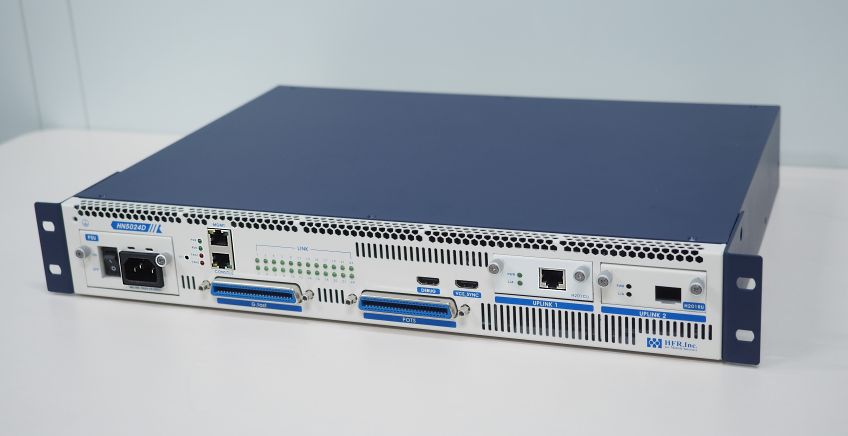
Photo above: Sckipio’s G.fast distribution point unit (DPU) that supports up to 24 subscribers in a single DPU.

Orbotech sales up 25% to $250 Million

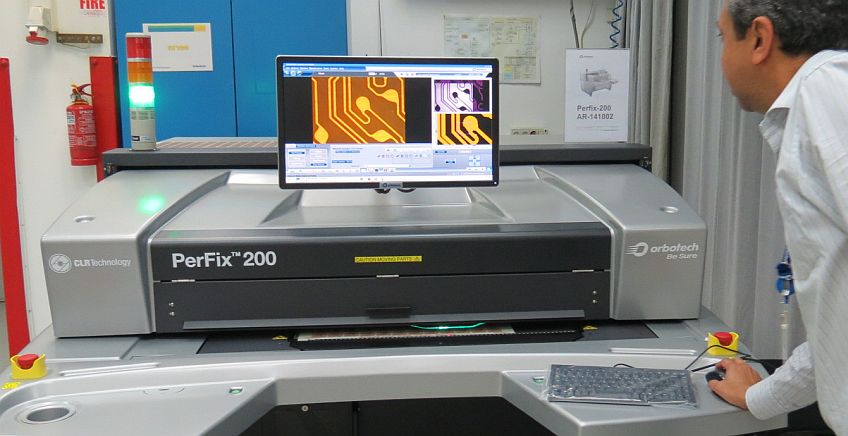
In the wake of its merger with KLA Tencor, Orbotech from Yavne, Israel, demonstrated an impressive 25% growth in Q1 2018. The company reported today  that revenues for the first quarter of 2018 totaled $250.6 million, compared with $187.6 million in the first quarter of 2017.

Orbotech also expects second quarter 2018 revenue to be in the range of $250 million to $265 million based on current expectations of product mix. In March 19, 2018 KLA-Tencor and Orbotech announced they have entered into a definitive agreement pursuant to which KLA-Tencor will acquire Orbotech for $3.4 billion in cash and common stocks. The acquisition will diversify KLA-Tencor’s revenue base and add $2.5 billion of addressable market in the high-growth printed circuit board (PCB), flat panel display (FPD), packaging, and semiconductor manufacturing.

New $50 Million Order

Orbotech covers many aspects in the production of Electronics. During the first quarter its revenues from the Company’s printed circuit board (PCB) business were $87.1 million (including $53.3 million in equipment sales). Revenues from the flat panel display (FPD) business were $80.6 million (imcluding $69.1 million in equipment sales) and revenues from the semiconductor device (SD) business were $78.6 million ($67.2 million in equipment sales).

Separately, Orbotech announced that it has received orders totaling approximately $50 million from Taipei-based Career Technology, a worldwide manufacturer of flexible printed circuit (FPC) PCBs, for a range of solutions for liquid-crystal polymer FPC production. These solutions will be implemented in Career’s new FPC production lines for the manufacture of smartphone flexible components.  Delivery is scheduled to begin during the second quarter of 2018 and to be completed by the end of 2018.

TowerJazz quarterly revenue decrease 5%

Following a sequential growth during the recent quarters, TowerJazz may begin to slow down. Revenues for the first quarter of 2018 were $313 million, reflecting a 5% decrease as compared to $330 million in the first quarter of 2017. Gross profits were $66 million, as compared to $89 million, as compared to $85 million in the first quarter of 2017. Net profit for the first quarter of 2018 was $26 million, as compared to $46 million in the first quarter of 2017.

TowerJazz expects revenues for the second quarter of 2018 to be $335 million, with an upward or downward range of 5%, representing a sequential growth of 7%. Russell Ellwanger, CEO of TowerJazz, said: “This past quarter we formally began projects and/or were informed of wins for several varied industry defining projects with respective customer market leaders.

“The quarter, as forecasted, was impacted by seasonality and some activities, moving our offering to higher value richer mixes. Present customer forecasts show continued quarter over quarter growth throughout 2018, with a fourth quarter demonstrating over 25% organic business unit growth against the first quarter.”

Semiconductor’s Production Services Provider

TowerJazz manufactures analog integrated circuits with geometries ranging from 1.0 to 0.13-micron, offering customizable process technologies for more than 300 customers worldwide in various markets including RF, high-performance analog, power, imaging, consumer, automotive, medical, and industrial as well as aerospace and defense.

With approximately 4,500 employees worldwide, TowerJazz operates two manufacturing facilities in Israel (150mm and 200mm), two in the U.S. (200mm) and three additional facilities in Japan (two 200mm and one 300mm) through TowerJazz Panasonic Semiconductor Co. (TPSCo), established with Panasonic Corporation of which TowerJazz has the majority holding.

Israeli High-Tech Raised $1.52 Billion in Q1-2018

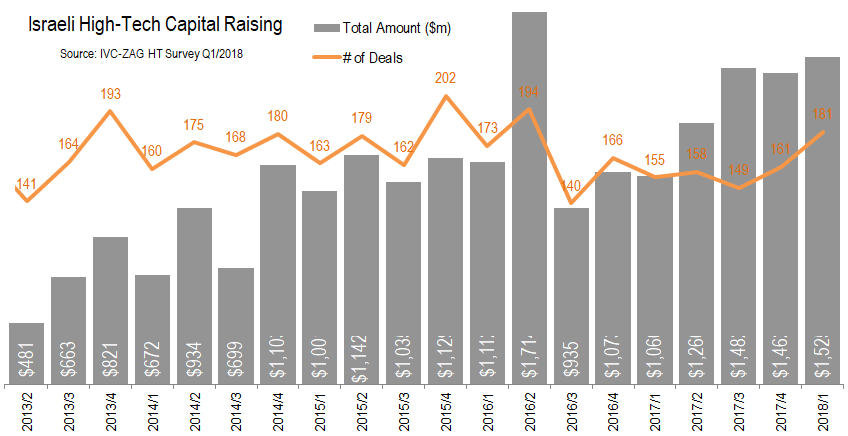
The first quarter of 2018 continues the positive trends in Israeli high-tech industry: $1.52 billion was raised in 181 deals. Both the number and the amount of deals grew compared to the previous quarter ($1.46 billion, 161 deals) and to the first quarter of 2017 ($1.06 billion, 155 deals). VC-backed deals caught 72% of the total amount raised and 61% of the total number of deals.

Three deals of over $100 million each, accounted for 23% of total capital raised in Q1. Shmulik Zysman, Attorney at Law, Managing Partner leading the high-tech sector at ZAG S&W Zysman, Aharoni, Gayer & Co, said: “Israeli high-tech opens 2018 with a strong momentum with foreign VC fund’s investments almost doubled compared to Q1 2018. We link the foreign investments increase to regulatory changes in China, which defined clear rules and recommendation for technology investments.”

Software, Cyber and IoT

Capital raising by companies in R&D stage totaled $451 million, a leap of 60% in capital volume compared with the 2017 quarterly average. This indicates the change of the role in the A financing round in Israeli high-tech industry. After two feeble years for seed stage companies, the number of deals in Q1/2018, grew to 57 deals in comparison to 42 deals in Q1 2017.

Software companies continued to attract more capital and raised $754 million. IoT (Internet of Things) number of deals grew to 29 deals raising $265 million —the highest in the last five years. Cyber security companies attracted 34 deals, almost double the number of deals (18) in Q4/2017. Those investments were made mostly in the A and seed financing rounds, and might imply that a new cyber wave is on the raise.

The Survey was made by IVC Research Center and is based on reports from 448 investors of which 59 were Israeli VC management companies and 389 were other entities.

TI Expands Lead Among Top Analog Suppliers

Texas Instruments Expands Lead Among Top Analog Suppliers in 2017

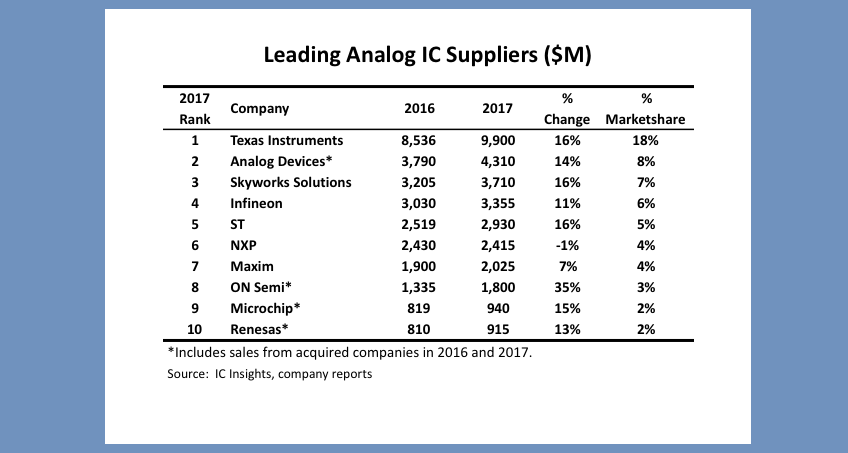
The top 10 IC suppliers in the $54.5 billion analog market last year accounted for 59% of the category’s worldwide sales in 2017, according to a recent monthly update to IC Insights’ 2018 McClean Report.  Collectively, the top 10 companies generated $32.3 billion in analog IC sales last year compared to $28.4 billion in 2016. This was a 14% increase according to the April Update to The McClean Report.

Bigger is Better

Out of the top-10 suppliers of 2017, eight companies exceeded the 10% growth rate of the total analog market. With analog sales of $9.9 billion and 18% marketshare, Texas Instruments was again the leading supplier of analog integrated circuits in 2017.  In 2016, TI’s marketshare was 17% in analog ICs.  The company’s analog sales increased by about $1.4 billion last year—rising 16%—compared to 2016 and were more than twice that of second-ranked Analog Devices (ADI).

TI’s 2017 analog revenue represented 76% of its $13.0 billion in total IC sales and 71% of its $13.9 billion total semiconductor revenue, based on IC Insights’ estimates. TI was among the first companies to manufacture analog semiconductors on 300mm wafers.  It has claimed that manufacturing analog ICs on 300mm wafers gives it a 40% cost advantage per unpackaged chip compared to using 200mm wafers.  In 2017, about half of TI’s analog revenue was generated on devices built using 300mm wafers.

Analog Top 10 IC Suppliers

Second-place ADI registered a 14% increase in analog IC sales in 2017 to $4.3 billion, according to IC Insights’ supplier ranking. The 2016 and 2017 revenue numbers shown for ADI include sales from Linear Technology, which was acquired by the company in 1Q17 for $15.8 billion.

NXP experienced a Decline

NXP was the only supplier in the top-10 ranking that experienced a decline (-1%) in its analog sales last year.  Some of NXP’s analog revenue decline can be attributed to the sale of its Standard Products business to a consortium of Chinese investors consisting of JAC Capital and Wise Road Capital.  The $2.75 billion transaction was completed in February 2017.  The Standard Products business was renamed Nexperia and headquartered in the Netherlands.

Among the top 10, ON Semiconductor showed the largest analog sales gain in 2017, with revenues increasing 35% to $1.8 billion, which represented a 3% share of the market.  This follows a 16% rise in its analog sales in 2016.

Some of the strong increases in sales during the last two years were a result of ON Semi’s acquisition of Fairchild Semiconductor in September 2016 for $2.4 billion. ON’s analog business was also boosted in 2017 by record sales of its power management products to the automotive market, specifically for active safety, powertrain, body electronics, and lighting applications.