CEVA Introduces Deep Learning in a Chip

“Our new Deep Neural Network framework for the CEVA-XM4 is the first of its kind in the embedded industry”

CEVA

CEVA, Inc. from Herzliya, Israel has revealed a ground breaking software framework to perform neural network deep learning task on its CEVA-XM4 DSP chip. The new Ceva Deep Neural Network (CDNN) enables embedded systems to perform deep learning tasks 3x faster than the leading GPU-based systems while consuming 30x less power and requiring 15x less memory bandwidth.

For example, running a Deep Neural Network (DNN) based pedestrian detection algorithm at 28nm requires less than 30mW for a 1080p 30 frames per second video stream. “Our new Deep Neural Network framework for the CEVA-XM4 is the first of its kind in the embedded industry,”  said Eran Briman, vice president of marketing at CEVA.

Key element in the solution is the CEVA Network Generator, a proprietary automated technology that converts a customer’s network structure and weights to a slim, customized network model used in real-time. This enables a faster network model which consumes significantly lower power and memory bandwidth, with less than 1% degradation in accuracy compared to the original network.

Eran Briman, vice president of marketing at CEVA

Phi Algorithm Solutions, from Toronto, Canada, has used CDNN to implement a CNN-based Universal Object Detector algorithm for the CEVA-XM4 DSP. This is now available for application developers and OEMs to run a variety of applications including pedestrian detection and face detection for security, ADAS and other embedded devices based around low-power camera-enabled systems.

The CDNN software framework is supplied as source code, extending the CEVA-XM4’s existing Application Developer Kit (ADK). It works with various networks and structures, such as Caffe, Torch or Theano training frameworks, or proprietary networks. CDNN includes real-time example models for image classification, localization and object recognition. For more information on CDNN: http://launch.ceva-dsp.com/cdnn.

CEVA is a leading licensor of DSP and IP platforms for cellular, multimedia and connectivity. Earlier this week the company announced that its revenues for the third quarter of 2015 are approximately $16.2 million, an all-time high, and above the high end of the Company’s previously revenue guidance of $15 to $16 million. As a result, its NASDAQ stock price rose from $18 to approximately $22. CEVA’s market cap jumped to $446 millions.

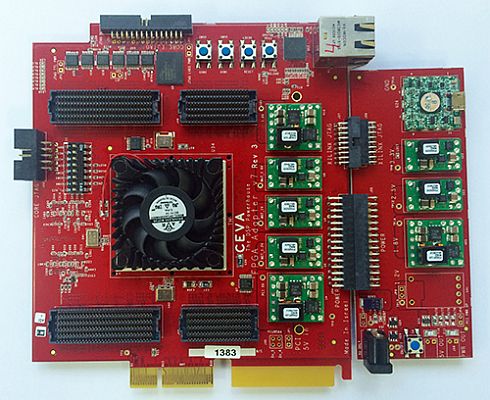
Tthe development board for CEVA-XM4

Facebook to supply internet connectivity in Africa via Amos-6 satellite

Facebook will build a ground control station in Israel to operate the Amos-6 satellite. For SpaceCom, the agreement with Facebook is worth approximately $95 millions

AMOS-6

Eutelsat Communications from Paris and Facebook have announced that they are partnering on a new initiative to get more Africans online. Under a multi-year agreement with Spacecom from Israel, the two companies will utilise the entire broadband payload on the future AMOS-6 satellite and will build a dedicated system comprising satellite capacity, gateways and terminals, to reach to large parts of Sub-Saharan Africa.

During the weekend, Mark Zuckerberg published a post in his private blog about the deal: “We are partnering with Eutelsat to launch a satellite into orbit that will connect millions of people. As part of our collaboration with Eutelsat, a new satellite called AMOS-6 is going to provide internet coverage to large parts of Sub-Saharan Africa.

“The AMOS-6 satellite is under construction now and will launch in 2016 into a geostationary orbit that will cover large parts of West, East and Southern Africa. We’re going to work with local partners across these regions to help communities begin accessing internet services provided through satellite”.

Established in 1977, Eutelsat Communications is one of the world’s leading operators of communications satellites. The company provides capacity on 39 satellites to clients that include  coverage of Europe, the Middle East, Africa, Asia-Pacific and the Americas.

5,500 kg of space knowledge

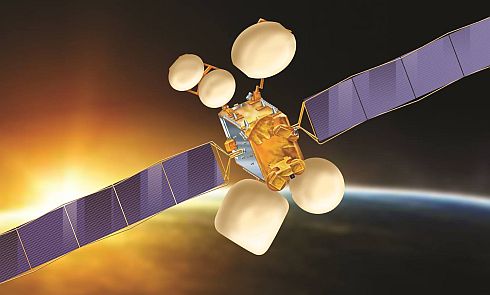
Artist's image of Amos-6 in space
Artist’s image of Amos-6 in space

Scheduled for launch in the begining of 2016, Spacecom’s AMOS-6 satellite includes 3 Ku-Band beams covering Middle East, Central East Europe (CEE) and Pan-Europe; and 36 HTS Ka-band spot beams over sub-Sahara Africa and Europe. The satellite is currently under construction in the Israel Aerospace Industries, under $200 million contract with SpaceCom.

Yesterday SpaceCom revealed that Facebook will build a ground control station in Israel to operate the satellite. For SpaceCom, the agreement with Facebook is worth approximately $95 millions.

IAI says that Amos-6 is one of the world’s most advanced communication satellites. The satellite consists of electric propulsion technology, which enables significant savings in the satellite’s launch weight and costs. With Amos 6, IAI enters to the field of large communication satellites with launch weight of 5,500 kg and payload power of 9,000 Watts.

The communication payload includes 45 transponders in three frequency bands – Ku, Ka and S, which enable the satellite to provide a variety of communication services, including direct satellite home internet services.

Mellanox to acquire EZchip for $811 Million

The acquisition will help Mellanox to deliver complete end-to-end, intelligent 10, 25, 40, 50, and 100Gb/s interconnect and processing solutions for data center and edge platforms

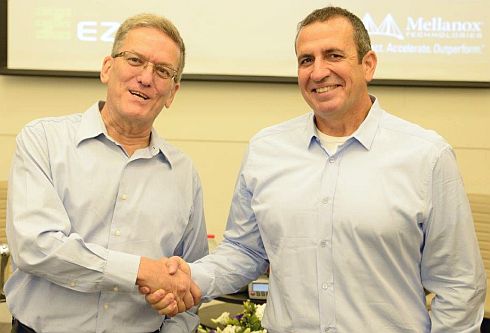
Future giant: Eyal Waldman (right) and Eli Fruchter

In a major step to expand its market reach, Mellanox Technologies from Yokneam, Israel, has entered into a definitive merger agreement with EZchip: Mellanox shall acquire 100 percent of EZchip’s outstanding ordinary shares for a cash purchase price of $25.5 per share implying a transaction value of approximately $811 million (approximately $620 million net of cash).

The acquisition is a step in Mellanox’s strategy to become the leading broad-line supplier of intelligent interconnect solutions for the software-defined data centers. EZchip’s products and expertise in security, deep packet inspection, video, and storage processing will help Mellanox to deliver complete end-to-end, intelligent 10, 25, 40, 50, and 100Gb/s interconnect and processing solutions for data center and edge platforms.

Holding layers 1-7 of the communications model

“Mellanox’s interconnect provides the fastest and most-scalable solution for moving data within the data center, allowing the continuous development, use and expansion of these applications,” said Eyal Waldman, president and CEO of Mellanox Technologies. “EZchip’s processing solutions allow users to process and analyze, at wire speed, data both within and outside the data center. We expect that the acquisition of EZchip’s technologies and team will better position us at 100Gb/s and beyond. We are looking forward to work together to build a successful company.

“Mellanox’s IS leading layer 1-3 connectivity solutions for data centers and EZchip’s is a leading layer 3–7 processing solutions for carrier networks. The two companies complement each other in technology, products, markets served and customers. Together, we enable a multitude of layer 1 through 7 solutions for data centers and carriers,” said Eli Fruchter, CEO of EZchip”.

EZchip is a fabless semiconductor company that provides high-performance network processors. Mellanox is a leading supplier of InfiniBand and Ethernet interconnect solutions for servers and storage. Mellanox plans to combine employees from both organizations. The combined businesses currently have approximately 2,400 employees, and have generated combined revenues of $668 million for the twelve months ended June 30, 2015.

The transaction is projected to close in the first quarter of 2016, subject to the completion of certain closing conditions. Mellanox intends to fund the transaction with cash on hand from the combined companies and $300 million in fully-committed debt financing. The proposed acquisition is subject to customary closing conditions, including the receipt of applicable regulatory approvals and the approval of EZchip’s shareholders.

Silicom To Acquire ADI Engineering from Charlottesville, VA.

Silicom will pay ADI’s stockholders $10 million in cash at closing. ADI design and produce reference design boards for Intel

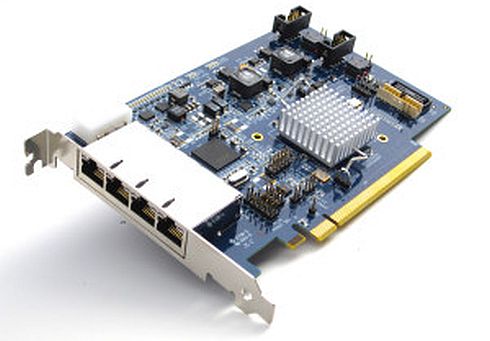
PCIe board for Intel chipset, developed by ADI Engineering

Silicom Ltd. from Kfar-sava, Israel, announced that it has entered into a definitive agreement to acquire ADI Engineering, a privately-held, US-based provider of Intel-based products targeted at the SDN, NFV, IoT, Cloud computing and Virtualization trends.

Silicom will pay ADI’s stockholders $10 million in cash at closing, and an additional consideration subject to the attainment of certain future performance milestones. The transaction is expected to close in the fourth quarter of 2015.

“We intend to continue building out ADI’s existing profitable business while also incorporating its offering into Silicom’s portfolio for our existing customers,” said Shaike Orbach, Silicom’s President and CEO. “The acquisition will also enable us to address Cloud-related providers of CPE/branch office equipment, NFV edge products suppliers and more.

“In addition, we intend to work together with ADI’s talented development staff to create new products needed by Cloud, NFV and SDN players to keep up with the challenges presented by the rapid growth of data traffic.”

ADI’s products and core technologies are highly complementary with Silicom’s and do not compete with them. In fact, since ADI frequently develops reference designs for upcoming Intel technologies, ADI can leverage its deep technical expertise and early access into a time-to-market edge over the competition.

Steve Yates, ADI’s CEO and Founder, added, “We believe the enhanced momentum of our larger group will accelerate our growth.” After the acquisition, Mr. Yates will join Silicom as President of the ADI Engineering division. Orbach concluded, “We believe this acquisition will strengthen our leadership position in the network appliances industry while expanding our technology and products for the fast-growing Cloud market.”

Silicom’s product portfolio includes multi-port 1/10/40/100 Gigabit Ethernet server adapters, Intelligent Bypass solutions, Encryption accelerators, Ultra Low Latency solutions, Time Stamping and other innovative Smart adapters. These products are available for incorporation directly into our OEM customers’ systems, or provided as part of Silicom’s patented SETAC (Server To Appliance Converter), a unique approach to the provision of high quality standard platforms with modular front connectivity.

Tadiran Batteries will supply 50,000 batteries to BrightSource’s new Solar Field

This is a Multi-million euro contract to supply more than 50,000 rechargeable lithium-ion battery packs to power BrightSource’s heliostats and optical concentrating devices for 121 MW Ashalim Thermal Solar Power Station in Israel

Ashalim power plant concept

Tadiran Batteries, from Kiryat Eqron, near Tel-aviv, a wholly-owned subsidiary of the Saft Group, has been awarded a contract to provide rechargeable energy packs to power more than 50,000 controllable mirrors – called heliostats – being deployed by BrightSource Energy at the Ashalim Thermal Solar Power Station, in the Israeli desert.

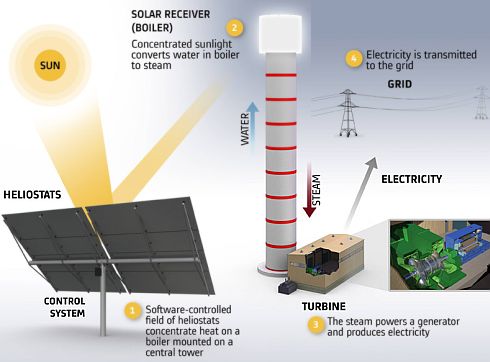
BrightSource Energy technology produces electricity the same way as fossil fuel power plants – by creating high-temperature steam to turn a conventional turbine. But instead fossil fuels, BrightSource uses the sun to create the steam. Thousands of individually-controlled heliostats track the sun and reflect sunlight onto a boiler that sits atop a tower.

When the concentrated sunlight strikes the solar receiver, it creates super heated steam which is used to turn a turbine and generate electricity. The Ashalim station will have a total power generating capacity of 121 MW, enough to meet the electricity needs of more than 120,000 homes.

During the day Tadiran’s rechargeable energy packs will drive the heliostat motors and power device communications. The rechargeable batteries eliminate expensive cabling and wiring that would otherwise be required to power the heliostat motors and control modules.

BRIGHTSOURCE

Igal Carmi, President and CEO at Tadiran Batteries, said: “This order represents a significant commercial breakthrough for Tadiran”. Tadiran designs, develops and manufactures primary and rechargeable lithium batteries for industrial use. The Tadiran group of companies represents more than 450 employees based in Israel, Germany and the US. Tadiran Batteries Ltd. is a wholly-owned subsidiary of the Saft Groupe SA.

The 121 megawatt BrightSource-Alstom Megalim plant, is one of three projects selected under Israel’s Ashalim 250 megawatt total solar tender. It is located in the Ramat Negev Regional Council 3.15 square kilometer site in the Negev Desert. The project is scheduled to come online in 2017.

The Ashalim tender includes two CSP plants and one photovoltaic technology power plant.  Once all three Ashalim projects are financed and constructed they will generate approximately 2% of Israel’s installed capacity, and help Israel achieve its goal of having 10 percent of its electricity production from renewable energy sources by 2020.

Can Lasers Shoot Lightning Out of the Sky?

Researchers from the Hebrew University in Jerusalem have developed new methods to make longer streams of plasma with greater longevity, that could lead to laser-powered lightning rods

LASER

A team of researchers from the High Intensity Laser Lab in The Hebrew University of Jerusalem, Israel, have demonstrated new techniques that bring lasers as lighting rods closer to reality.

When a powerful laser beam shoots through the air, it ionizes the molecules, leaving a thin trail of hot, ionized particles. Because this stream of plasma conducts electricity, it could be used to channel away a potentially damaging lightning bolt. The researchers found ways to make the length of the plasma channel more than 10 times longer relative to present methods.

Dr. Jenya Papeer from the lab, will present the work at Frontiers in Optics, The Optical Society’s annual meeting and conference in San Jose, California, USA, on 22 October 2015. The researchers created a channel of plasma by firing a powerful laser that produces a pulse lasting a fleeting 100 femtoseconds (one femtosecond is 10-15 seconds).

The problem is that the resulting plasma stream, 100 microns in diameter, lasts for only about three nanoseconds. After that time, the plasma cools off, the electrons recombine with the atoms and the channel disappears.

To extend the lifetime of the plasma channel, the researchers shot another laser whose beam overlaps the plasma. The secondary laser, which produces 10-nanosecond bursts, keeps the plasma hot and prevents the electrons from recombining so quickly, extending the longevity of the plasma channel by more than a factor of 10.

The team is now working on ways to fire a more powerful secondary laser — or maybe additional beams — to increase the lifetime of the channel even more. In principle, Papeer says, a longer life could also extend the length of the plasma channel, which stretches for only about a meter.

The laser creates the trailing plasma stream analogous to the way a pen leaves behind a line of ink. If the ink disappears soon after the pen makes a mark, you can only ever draw a short line. But if the ink were to last longer, you could draw a longer line. Likewise, a longer-lasting plasma would result in a longer channel.

Control the Lighting with Light

The researchers also devised a method to lengthen the plasma channel. The laser beam typically generates multiple plasma channels that spread out randomly along the laser beam. But by designing an apparatus of lenses that controls how the laser is focused, the researchers were able to make three plasma channels that line up in sequence, one after another.

The result is a three-segmented plasma channel that acts as a single, three-meter long channel. “The beauty is that you can extend it for pretty much as long as you want, as long as you have the proper optical set up and a laser beam with enough power,” Papeer says. In fact, this ability to extend the channel to an arbitrary length is the main advantage of this method.

The next step, Papeer says, is to combine both methods to produce a plasma channel that’s greater in both lifetime and in length. Maybe sometime in the future this new method will be able to replace the familiar metal poles of lightning rod, that was invented 250 years ago by Benjamin Franklin.

Dialog to acquire Atmel for $4.6 Billion

CEO Bagherli: “Our new, enlarged company will be a leader in Mobile Power, IoT and Automotive”

Dialog's newest Rapid Charge Technology
Dialog’s newest Rapid Charge Technology

Dialog Semiconductor and Atmel Corporation announced today that Dialog has agreed to acquire Atmel in a cash and stock transaction for total consideration of approximately $4.6 billion. The acquisition creates a global leader in both Power Management and Embedded Processing solutions. The combined company will address a market opportunity of approximately $20 billion by 2019. Following the announcement, Cypress has withdrawn its offer to buy Atmel.

“Our new, enlarged company will be a leader in Mobile Power, IoT and Automotive. We firmly believe that by combining Power Management, Microcontrollers, Connectivity and Security technologies, we will create a strong platform for innovation and growth in the large and attractive market segments we serve,” said Jalal Bagherli, Dialog Chief Executive Officer.

“Adding Dialog’s world-class capabilities in Power Management with Atmel’s keen focus on Microcontrollers, Connectivity and Security will enable Dialog to more effectively target high-growth applications within the Mobile, IoT and Automotive markets,” said Steven Laub, Atmel President and Chief Executive Officer.

The transaction is expected to close in the first quarter of calendar 2016. Dialog intends to fund the transaction with a combination of existing cash, $2.1 billion of new debt and the issuance to Atmel shareholders of approximately 49 million ADSs expected to be listed on the New York Stock Exchange or the NASDAQ Stock Market. It is projected that Atmel shareholders will own approximately 38% of the combined company.

Dialog anticipates achieving projected annual cost savings of $150 million within two years.