MobileTrends Report: 6% of Mobile Subscribers Visit Risky Websites Every Day

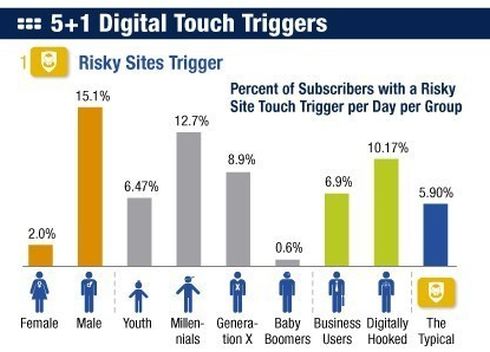
Males visit “malware-risky” websites 7.5 times more often than Females, and Millennials visit these 21 times more than Baby Boomers

Risky behavior by population

On average, subscribers have 72 daily online transactions (each with the potential to become a touch trigger), according to Allot MobileTrends Report H2/2015, 5+1 CSP Touch Triggers for Monetizing Customer Engagement. More findings: Males visit “malware-risky” websites 7.5 times more often than Females, and Millennials visit these 21 times more than Baby Boomers. Overall close to 6% of subscribers visit risky websites daily.

The report also reveals that Business Users use mobile hotspots 69% more than the typical user profile, and Millennials do this 45% more than Baby Boomers. In general, 45% of Female customers and 38% of Male customers watch video daily. Approximately 70% of video consumers are light viewers who watch 1-6 clips per day, while 8% are heavy viewers who watch 21+ clips per day. The majority of heavy viewers are Males (54%).

“As CSPs continue their transformation into digital lifestyle providers, business emphasis is shifting from byte-driven data plans to personalized service plans,” said Yaniv Sulkes, AVP Marketing at Allot Communications. “By analyzing their customers’ daily interactions with the network, CSPs will be better equipped to understand user diversity, and to offer relevant services to each customer at the most opportune moment for uptake.

Video usage of mobile subscribers

“Our report methodology included datasets covering millions of mobile transactions and taken on a given day from four Tier-1 operators around the world, during July 2015,” he said. Allot Communications Ltd. (NASDAQ, TASE: ALLT) from Hod Hasharon, Israel provides  solutions identify and leverage network intelligence. For more information: www.allot.com.

New ASIC push Mellanox to 100Gb Ethernet

Mellanox Begins Shipping Spectrum, an Open Ethernet 25/50/100 Gigabit Switch, to Cloud, Web 2.0 and Enterprise Data Centers

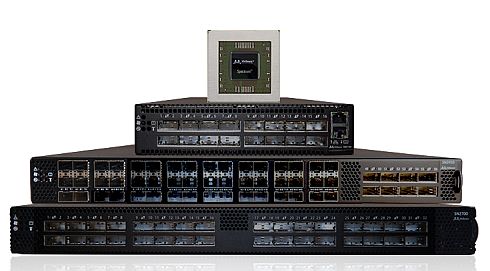
Spectrum. One chip many systems

Once again, Mellanox Technologies shows that the heart of its strategy is based on proprietary powerful self-designed chip, that run a full spectrum of communication systems. No wonder its last chip is called “Spectrum.” Yesterday, the supplier of interconnect solutions for data center servers and storage systems from Yokneam, Israel, announced that it is now shipping Spectrum, the industry’s first 10, 25, 40, 50 and 100 Gigabit Ethernet, Open Ethernet-based switch.

The shipment of Spectrum, combined with Mellanox’s ConnectX®-4 NICs, and LinkX™ fiber and copper cables, makes Mellanox the first to deliver comprehensive 10, 25, 40, 50 and 100 Gigabit Ethernet connectivity solutions for data centers. Spectrum is designed to overcome current data center infrastructure challenges by providing a flexible and scalable solution that allows businesses to deploy the hardware-software combinations best suited to meet their unique needs.

The Open Ethernet architecture, on which Spectrum is based, provides Mellanox customers with the freedom to innovate and optimize their data center for their applications. Spectrum supports network speeds of 1/10/ 25/ 40/ 50 and 100Gb/s per port with extremely low latency, low jitter and high message rate.

“We are excited to be the first to provide 10, 25, 40, 50 and 100 Gigabit Ethernet switch solutions that data center customers need in order to maintain their competitive edge while reducing their capital and operational expenses,” said Gilad Shainer, vice president of marketing at Mellanox Technologies.

TowerJazz’s new RF process for 4G LTE

Company says the new 300mm RF SOI process can reduce losses in an RF switch by as much as 30% relative to current technology

TowerJazz plant. Migdal Haemek. Israel

TowerJazz from Mogdal Haemek, Israel, and TowerJazz Panasonic Semiconductor Co. (TPSCo), announced breakthrough in RF technology for next-generation 4G LTE smartphones and IoT devices. Through a collaborative effort, TowerJazz and its subsidiary TPSCo, have developed a new 300mm RF SOI process that can reduce losses in an RF switch by as much as 30% relative to current technology, improving battery life and boosting data rates. The technology is now being sampled to a lead customer.

“This achievement reflects our strategy to combine TPSCo’s digital technology with TowerJazz’s RF expertise,” said Russell Ellwanger, TowerJazz CEO. Guy Eristoff, CEO of TPSCo, said: “This process combines 0.18um TowerJazz RF SOI technology with TPSCo’s advanced 45nm process capabilities to create a silicon-based device with breakthrough performance. To our knowledge, this is the lowest Ron X Coff demonstrated in RF SOI devices with robust power handling capability.”

The technology achieved a record Ron-Coff figure of merit of sub-90fs. Ron X Coff product is a key figure of merit for RF switching that measures the ability to pass signals with low power losses. TPSCo’s ability to print 45nm dimensions also enables the integration of an increasing number of RF features in a small footprint on a single, RF-friendly, SOI die.

“Just a few years ago, a sub-100fs Ron-Coff figure of merit for an SOI switch technology was considered unthinkable. But no longer. SOI continues to remain the most ideally suited technology for meeting the demands of 4G/LTE-A and beyond: the lowest power (insertion) loss, almost perfect isolation and the most stringent linearity, and all at a competitive cost,” said Len Jelinek, Director and Chief Analyst, Semiconductor Manufacturing, IHS Technology.

Mobile Experts LLC, a market research firm for mobile communications, forecasts the RF front- end component market size to reach $10.8 billion in 2015, rising rapidly to over $16 billion in 2018. This growth is powered by rapid growth in worldwide 4G-LTE enabled Smartphone shipments and IoT devices along with increasing RF component dollar content per mobile terminal due to rapid proliferation of frequency bands (40+) and increasing adoption of Carrier Aggregation (3+) and MIMO (up to 64 X 8).

“We are already in high volume production with our industry leading SOI technologies in our Newport Beach (USA) and Migdal Haemek (Israel) fabs. Opening up the 300mm Uozu fab in Japan now also gives us additional scale and the supply flexibility needed to capitalize on RF component market growth,” said Dr. Marco Racanelli, SVP/GM of RF/High Performance Analog and Power Business Groups at TowerJazz.

Tower Semiconductor Ltd. and its fully owned U.S. subsidiary Jazz Semiconductor, Inc. operate collectively under the brand name TowerJazz and manufacture integrated circuits in broad range of process technologies including: SiGe, BiCMOS, mixed-signal/CMOS, RF CMOS, CMOS image sensor, integrated power management (BCD and 700V), and MEMS.

TowerJazz operates two manufacturing facilities in Israel (150mm and 200mm), one in the U.S. (200mm) and three additional facilities in Japan (two 200mm and one 300mm) through TowerJazz Panasonic Semiconductor Co. (TPSCo).

Intel Introduced its 6th Generation Intel Core

This new processor was developed mainly by the Israeli team from Haifa. “At one point we were asked to comply to a 4.5W power consumption limit. It seemed impossible”

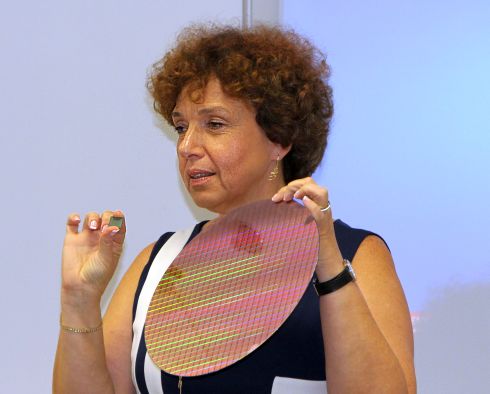
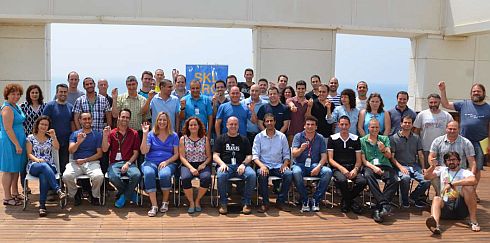
Shlomit Weiss introduce SkyLake

Intel Corporation introduced the 6th Generation Intel® Core™ processor family, code named SkyLake, it is also described by Intel as “the company’s best processors ever”. “6th Gen Intel Core processors deliver some of the most significant advancements in computing that we’ve ever seen,” said Kirk Skaugen, Intel senior vice president and general manager of the Client Computing Group.

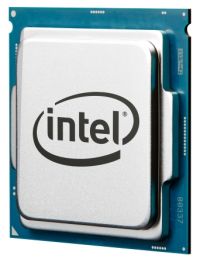
The new SkyLake Chip

“New 6th Gen Intel Core-based systems are more responsive than ever with enhanced performance, battery life and security. And they can enable amazing new PC experiences like logging into your computer with your face and having a personal assistant respond to your voice. The combination of 6th Gen Intel Core processors, Windows 10 and beautiful new systems from PC manufacturers make this the best time ever to buy a new computer.”

No more old computers

There are over 500 million computers in use today that are four to five years old or older. They are slow to wake, their batteries don’t last long, and they can’t take advantage of all the new experiences available today. Built on the new Skylake microarchitecture, 6th Gen Intel Core processors deliver up to two and a half times better performance, triple the battery life, and graphics that are 30 times better. They can also be half as thin and half the weight, faster wake up time, and battery life that lasts virtually all day.

This generation includes several firsts for mobile designs: a mobile “K” SKU that is unlocked to enable overclocking with even more user control, a new quad-core Intel® Core™ i5 processor that offers up to 60 percent improved mobile multitasking, and the Intel® Xeon® E3 processor family now powering mobile workstations. New Intel® Speed Shift technology improves the responsiveness of mobile systems so people can, for example, apply a photo filter up to 45 percent faster.

The Haifa task force

SKYLAKE-PEOPLE

This new processor was developed mainly by the Israeli team from Haifa, that also stood behind the successful Sandy Bridge. The head of the team, Shlomit Weiss, said during a press conference in Tel-aviv, that the project started about four years ago and faced many challenges.

“At one point we were asked to comply to a 4.5W power consumption limit. It seemed impossible. But by re-writing the micro-architecture and developing new concepts such as the Speed Shift Technology, we created a processor for 4.5W-45W mobile devices, and up to 91Watts for desktop devices.”

The new family is produced in a 14nm process, and appears in 2 main form factors: a processor chip for higher power applications, and a smaller SoC version in Multi Chip Package that contains both the processor’s silicon chip, and the chipst required to run a computer.

The 6th Gen Intel Core processor includes hardware to optimize Windows* 10 features’ and the True Key technology to deliver a secure experience for logging into devices and websites without the need to remember passwords.

DARPA plans to revolutionize ASIC design

With government funding of $30 million for three years, CRAFT program vision is to shorten the design cycle for custom integrated circuits by a factor of 10

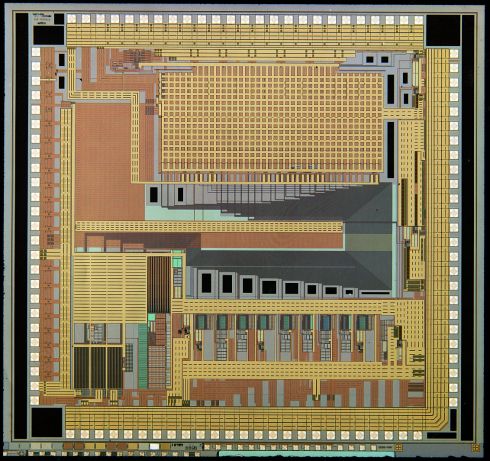
ASIC

The US Defense Advanced Research Projects Agency (DARPA) goes to the heart of the business of the rocketing costs of custom integrated circuits for specific tasks (ASIC). Now it is launch a new program that may re-shape the costs of ASIC semiconductors devices.

The new program is called CRAFT (Circuit Realization At Faster Timescales) and was budgeted with $30 million funding for three years. The agency explains that specialized integrated circuits for military electronics continues to surge exponentially, but the current design methods often result in devices that require more power than can be practically supplied on small flying platforms or on jet fighters.

“Engineers are stymied by the prospect of spending up to $100 million and working for more than two years to complete a design. As a result, Defense Department engineers often turn to more generic, inexpensive, and readily available general-purpose circuits, and then rely on software to make those circuits run the required specialized operations.” Although it can speed up design and implementation, but also burdens electronic systems with unnecessary power-gobbling circuitry.

“This dilemma has reduced the use of custom-integrated circuits and the performance of DoD systems,” said the director of CRAFT program, Linton Salmon. “The CRAFT program seeks to develop new fast-track circuit-design methods, multiple sources for integrated circuit fabrication, and a technology repository that will facilitate reuse of proven solutions.”

DARPA concept of "Distributes Air Operations". Coputation on board
DARPA concept of “Distributes Air Operations”. Coputation on board

He gave an example: Consider the Gotcha radar system that the Air Force Research Laboratory is developing to identify moving objects over city-scale areas and render detailed 3D images. “Gotcha currently requires a land-based supercomputer to make sense of the radar data and convert it into tactically useful imagery.

“However, relaying the data to a remote supercomputer across a contested data link can cause crippling delays. The CRAFT program could help put more of the necessary computational power on the UAV itself or on the backs of warfighters, enabling quicker delivery of the imagery to those who need it most.”

The idea is to reach ability to fabricate customized, technology-specific circuits using the 16 nanometer/14 nm commercial fabrication infrastructure that today produces generic commodity circuits. “A custom integrated circuit designed only to process images from an airborne radar or to analyze sensor data for warfighters on the ground doesn’t need to run a spread sheet or a word processor,” Salmon said. “Why carry around a heavy bulging Swiss Army knife when all you need is a single Phillips-head screwdriver?”

To achieve its goals, CRAFT seeks to shorten the design cycle for custom integrated circuits by a factor of 10 (on the order of months rather than years); devise design frameworks that can be readily recast when next-generation fabrication plants come on line; and create a repository so that methods, documentation and intellectual property need not be reinvented with each design and fabrication cycle.

Viola Injects $28.4 Million for Itamar Medical; Becomes the Largest Shareholder

“This investment will help position Itamar Medical as a leading player in the cardiovascular diagnosis market”

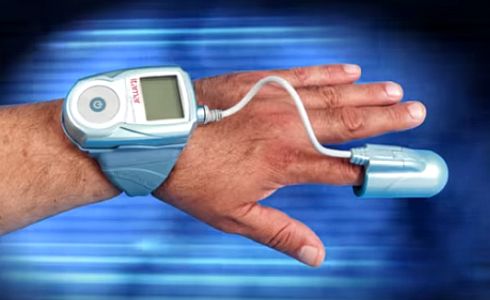
WatchPAT in action. Source:  Itamar Medical
WatchPAT in action. Source: Itamar Medical

Viola Private Equity will invest up to $28.4 million in Itamar Medical from Caesarea Industrial Park, Israel. Through this deal, Viola will become the largest shareholder of the company. As part of the investment, Jonathan Kolber, General Partner at Viola and formerly the CEO of Koor Industries, and Sami Totah, General Partner at Viola and formerly the COO of Amdocs, will join Itamar Medical’s Board of Directors.

Itamar Medical develops, manufactures and markets non-invasive medical devices based on a unique technology for the diagnosis of cardiovascular diseases and sleep apnea, based on its proprietary platform technology, the PAT (Peripheral Arterial Tone) signal. The company currently markets the WatchPAT home sleep test for respiratory sleep disorder diagnosis, and the EndoPAT, the only device approved by the U.S. FDA for testing endothelial (arterial) function and assessing the risk of coronary artery disease and other cardiovascular diseases.

The company has signed several global strategic agreements with players such as Medtronic (in the US), Viable Medical Investment (in China), Philips Respironics and Nihon Kohden in Japan.

“It was extremely important for us to enable our existing shareholders to take part in this important investment round and hence we have reached an agreement with the fund that enables issuing rights in parallel,” said Gilad Glick, CEO of Itamar Medical. “This investment will help position Itamar Medical as a leading player in the cardiovascular diagnosis market.”

According to the investment agreement, Itamar Medical will issue shares to Viola at the price of NIS 1.449 per share for consideration of $24.1 million. In addition, Itamar Medical will issue to Viola non-tradable warrants for the acquisition of up to 50% of issued shares for an exercise price of NIS 1.642 to NIS 1.745 per share.

In parallel, Itamar Medical announced that it will initiate a rights offering to existing shareholders to invest an additional $5.9 million under the same conditions of Viol’s investment. Viola Private Equity committed to increase its investment by up to $4.3 million, in case of unexercised rights, reaching a total investment of up to $28.4 million.

Following that, Itamar Medical reports that the Company has received from its major shareholders – Medtronic, Dr. Giora Yaron and Martin Gerstel – a notification regarding their intent to convert their existing $1.6 million shareholders loan to equity by participating in the rights offering, bringing the total investment in the Company to $30 million.

Viola Private Equity and the major shareholders agreed that all of their shares in the company will be locked-up for a period of 18 months. Viola is managed by four General Partners: Harel Beit-On, Jonathan Kolber, Sami Totah and Ayal Shiran. The fund manages over $410 million. Among its recent exits: Mobile Access, Amiad Water Systems, Matomy and Orad.

Spectronix won the UA Army contract, to face a class action suit

Last week Spectronix estimated that the JLTV win will result in $7 million sales year for at least 10 years. Now the shareholders want a bite in the prize, and demand NIS200 million dividend

The future Joint Light Tactical Vehicle of the US Army

Sometime success comes with unexpected price. In August 25, 2015 The U.S. Army has awarded Oshkosh Defense, LLC, a $6.7 billion production contract to manufacture the Joint Light Tactical Vehicle (JLTV), to replace many of its legacy HMMWV fleet with a new light tactical vehicle. Oshkosh expects to deliver approximately 17,000 vehicles and sustainment services.

For the small company of Spectronix from Sderot, Israel, it was a huge peace of news. Spectronix is an expert in explosion suppression and fire extinguish products inside military vehicles and armored fighting vehicles. Spectronix develops, manufactures, and markets optical flame and gas detection and suppression systems. Its solutions also include automatic fire and explosion detection systems, damage control systems, and fire extinguishing technologies. .In 2007, it have joined forces with Amerex Defense from the US. Under a licensing agreement with Spectronix, Amerex began manufacturing explosion suppression products and finally became a major sub contractor for Oshkosh JLTV program.

Last week Spectronix estimated that the JLTV win will result in $7 million sales year for at least 10 years. An important amount of money for a company whose annual sales for 2014 totaled approximately $40 million. But the celebration was very short: One day following the win announcement, it received the approval of a class action against the company, demanding the cancellation of the planned merger transaction with the US based Emerson Electric, or to compensate the shareholders, immediately, in the amount of NIS200 million.

In June this Emerson signed an acquisition agreement to buy all Spectronix shares for $99 million. The transaction will be carried out in two steps: paying $79 million for all the outstanding shars, and by the end of this month paying another $20 million as dividend to all the shareholders of the company. Now the merger agreement in under question: Spectronix announced it is study the class action suit to decide how to react, and to learn the potential implications for its future.

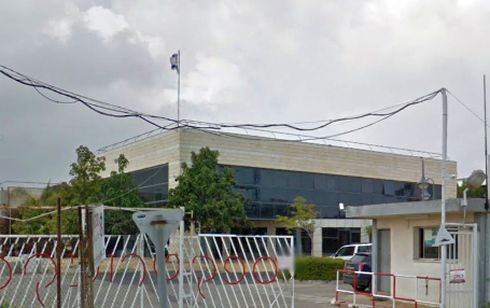
Spectronix plant in Sderot, Israel