Advantech Expands Edge AI Strategy, and Market Engagement in Israel

Sponsored Content by Advantach

Advantech is expanding its Edge Computing + Edge AI strategy and strengthening its global partner ecosystem to accelerate the deployment of intelligent applications across industries, as AI, IoT, and edge computing enter a golden decade of integrated adoption. According to IDC and Gartner, the global Edge AI market is expected to surpass USD 500 billion by 2034. 

Edge Computing and AI: From Industrial Control to Intelligence 

With nearly 50 years of industry experience, Advantech has evolved from a Taiwan-based IPC manufacturer into a global industrial automation and AIoT leader. In recent years, the company has identified Edge Computing and Edge AI as its key engines for future growth. To accelerate digital transformation across sectors, Advantech has integrated AI and edge computing into its industrial platforms and continues to develop scalable, cross-industry intelligent solutions.

In May 2025, Advantech returned to COMPUTEX 2025 under the theme “Edge Computing & WISE-Edge in Action,” showcasing its latest edge intelligence applications across manufacturing, energy, transportation, and healthcare. The event gathered nearly 2,000 partners and industry leaders worldwide, underscoring Advantech’s commitment to industrial innovation.

Vincent Chang, Managing Director of Asia and Intercontinental Region, emphasized that the company is shifting from a product-driven model to an industry-driven strategy—focusing on five key verticals: Edge intelligent systems, Smart manufacturing, Energy and utilities, Smart healthcare and Smart retail & services.

Through the WISE-Edge platform, Advantech connects hardware, software, and industry expertise to enable real-time insights and accelerate innovative edge applications, playing a critical role in the global shift toward intelligent transformation.

From Cloud to Edge: Advantech’s Ecosystem Strategy

As AI models grow more and real-time processing becomes critical, enterprises worldwide are moving from cloud-only architectures toward edge computing for efficiency and privacy. Advantech is leading this transition with:

Comprehensive Edge AI Portfolio: Industrial-grade edge devices supporting AI inference, machine vision, and real-time analytics.

WISE-Edge Platform: Integrated toolchains from NVIDIA, Qualcomm, Intel, NXP, and other major chipmakers for rapid deployment in manufacturing, healthcare, retail, energy, and robotics.

Global Tech Partnerships: Collaborations with NVIDIA, Microsoft, AWS to enhance cloud–edge orchestration, AI SDK integration, and end-to-end management frameworks.

Together, these capabilities form a scalable Edge AI ecosystem that accelerates adoption across industrial automation, medical imaging, smart retail, energy management, robotics, and smart city applications.

Expanding Edge AI Partner Recruitment in Israel

Advantech is deepening its presence in Israel—one of the world’s most advanced innovation hubs. Advantech has built a solid foundation in Israel over many years, collaborating with key partners such as Eastronics, Dor Engineering, and ICPC. Through channel development, SI collaboration, and global resource integration, Advantech supports multi-level market engagement and provides ODM/OEM customization and localized engineering services that help customers innovate from design to deployment..

Israel—recognized globally for its leadership in AI, cybersecurity, medical technology, and deep-tech innovation—is experiencing rapid acceleration in AI-driven automation. This is driving strong demand for edge AI platforms, machine vision systems, device connectivity, and industrial-grade computing. Advantech aims to deepen collaboration with Israeli partners to expand Edge AI deployment across key sectors.

To empower partners and maximize market opportunities, Advantech offers: Technical training and product onboarding, Joint marketing programs (JMF), Proof-of-concept (PoC) collaboration and Global customer matchmaking. Advantech welcomes Israeli distributors, SIs (System Integrators), and AI solution providers to join its global ecosystem and drive the next wave of intelligent transformation.

For more information:

Advantech Channel Partner Network in Israel

Uvision Acquires SpearUAV

Uvision, one of the world’s leading companies in the field of loitering munitions, has announced its full acquisition of the Israeli firm SpearUAV, a developer of AI-driven, capsule-launched autonomous loitering systems. The deal marks another step in Uvision’s global expansion strategy and positions the company as a supplier with a broad, multi-layered portfolio of precision-strike capabilities — from frontline maneuvering forces to higher-echelon operational use.

At the heart of the merger lies a shared technological foundation: loitering munitions. These systems can remain airborne above a target area for extended periods, gather intelligence, autonomously identify targets, and strike with high precision based on real-time feedback. Unlike traditional missiles, loitering munitions operate as a hybrid between a drone and a guided weapon — enabling rapid response, abort-capability when conditions change, and accurate engagement of moving targets. On modern battlefields, especially in Europe, Ukraine, and the Middle East, loitering munitions have become a decisive capability shaping operational tempo and force superiority.

SpearUAV brings to the table its VIPER family of systems, designed for land units, naval platforms and even underwater deployment. Uvision contributes its HERO family of fixed-wing loitering systems, used for intelligence, target acquisition and precision strike at varying ranges. Together, the two portfolios form a unified operational continuum — from maneuvering battalions to high-command and joint-force applications.

A Major U.S. Army Contract

The acquisition builds on years of collaboration between the companies. SpearUAV, founded in 2017 by Gadi Kuperman, has raised approximately $17 million to date — largely through a strategic investment Uvision made about four years ago. Since then, the companies have jointly developed loitering-munition technologies, built product-family integration interfaces, and expanded manufacturing capabilities. Uvision operates advanced development and production facilities in Israel and the United States, while SpearUAV runs specialized production lines for capsule-launched loitering systems. The combined capabilities now bring, for the first time, the entire chain — development, integration, deployment and manufacturing — under one roof, from battalion-level tactical solutions to complex airborne and maritime configurations.

Dr. Ran Gozali, CEO of Uvision, said: “Our years of joint work made this move a natural next step. We are combining complementary capabilities to build a multi-domain loitering-strike ecosystem tailored for the new battlefield.”
Yiftach Kleinman, CEO of SpearUAV, added: “This is a significant milestone for a company founded with a clear vision. Together with Uvision, we can expand production, deepen our global presence and increase the operational value we deliver to our customers.”

The move also aligns with Uvision’s growing presence in the U.S. defense market. In recent months, the company — together with American defense integrator Mistral — secured a multiyear $982 million contract to supply HERO 120 systems to the U.S. Army. Under the arrangement, Mistral leads integration, deployment and logistical support, while Uvision supplies the systems themselves. The contract underscores the maturity, reliability and operational readiness of the HERO systems — now recognized as core capabilities in modern warfare.

Building on nearly three decades of experience, Uvision continues to develop advanced AI-driven autonomy, new aerial-launch concepts for the HERO family, and enhanced navigation and route-planning capabilities around complex targets. Yet the acquisition of SpearUAV delivers the missing piece: a shift from a “product-family company” to a full-spectrum, multi-domain loitering-strike provider — land, sea, subsurface and air — all under a single, unified platform.

Centuries-Old Mathematical Ideas Power Today’s LLMs

By Yohai Schwiger

It’s tempting to think of large language models as a purely linguistic phenomenon — machines that read paragraphs, grasp context, and choose words as if they were human. But beneath this linguistic surface lies a vast mathematical engine, far more intricate than any grammar or vocabulary. What drives an LLM is not a stockpile of words, but an enormous machinery of algebraic, differential, statistical and informational ideas, assembled slowly over centuries. Leibniz and Newton in the 17th century, Cayley and Sylvester in the 19th, and Shannon in the 20th — none of them imagined a model that speaks Hebrew and generates ideas, yet each supplied a foundational brick for the mechanisms that allow LLMs to “understand” us today.

The irony is striking: tools invented to calculate the paths of planets, describe physical forces, or send a clear signal down a noisy phone line are now the nuts and bolts of the LLM brain. Concepts originally meant to measure motion, change, noise and uncertainty have — almost accidentally — become the bedrock on which today’s language models are built. This article traces the mathematical story: how centuries-old ideas became the conceptual and computational foundation of modern machine intelligence.

Vectors and Matrices — The Nuts and Bolts of the LLM Mind

Vectors and matrices are the most basic operations an LLM can perform. Every step — representing a word in context, interpreting a full sentence, predicting the next token or updating weights during training — ultimately reduces to multiplying them. It’s the computational language an LLM “thinks” in.

The reason is simple but deep: language is inherently high-dimensional. A word isn’t just a sound or a dictionary entry; it carries meaning, syntax, emotional tone, usage patterns — an entire semantic world stretched across hundreds or thousands of hidden dimensions. To represent such an object mathematically, you need a tool built for multi-dimensional work. A vector is the modern container for such an entity — “cat,” “run,” “curious” — and a matrix is the operator that shifts, rotates, warps or sharpens that vector within its space. Just as physicists used vectors to describe motion in physical space, LLMs use them to describe motion in semantic space.

From this foundation grew the idea that changed everything: the Attention mechanism. Introduced in the 2017 paper Attention Is All You Need by the Google Brain team, it became the cornerstone of modern models. Attention allowed LLMs not only to represent words, but to determine which words matter to which. In a sentence like:
“The cat sat on the rug because it was tired,”
the pronoun “it” is ambiguous. To resolve it, the model generates three new vectors — Query, Key and Value — from three different matrices, and calculates how much each word “attends” to each other word. If the Query of “it” is close to the Key of “cat,” the model infers a semantic link and focuses attention there. Behind this linguistic phenomenon sits a dry algebraic fact: it’s all matrix–vector multiplications.

Yet the foundation for this was laid in the 19th century, when mathematicians like Arthur Cayley and James Sylvester tackled physics, not language. Vectors emerged as a way to describe forces and motion — the path of a star, the velocity of a particle — and matrices appeared as algebraic descriptions of transformations: rotations, reflections, and systems of linear equations. Today, the same tools built to understand forces and fields now let a model understand nuance, syntax and intent. What was once the math of physics has quietly become the math of meaning.

Calculus — How an LLM Learns From Its Mistakes

If linear algebra is how an LLM thinks, then calculus is how it learns. The problem seems simple: once the model predicts the next token, how does it know how wrong it was, and in which direction it should adjust itself to improve? This is where the Loss function (typically Cross-Entropy) comes in — a numeric measurement of the gap between prediction and reality. But knowing the size of the gap isn’t enough; the model must understand the direction in its vast weight space that reduces that gap.

To do that, the model computes derivatives — the rate of change of the error with respect to each individual parameter. This is precisely the language Newton and Leibniz created in the 17th century to understand how things change: slopes, rates, directions. Gradient Descent — developed much later in the 19th and 20th centuries as part of optimization theory — takes these derivatives and updates the model’s weights in the opposite direction of the slope. Each step is tiny, but millions of steps gradually carve the mountain down, guiding the model toward better predictions. This process occurs only during training; at inference time the weights are “frozen,” and no gradients are computed.

Another historical irony: the mechanism that allows a modern LLM to shrink its error step by step is built from two ideas born in completely different worlds. The derivative, invented to describe celestial motion and the fall of objects, meets the optimization methods designed to solve engineering and economic problems. None of these thinkers imagined models corrected by a Loss, yet the math created for understanding a falling apple now helps explain how an error “falls” in weight space. The derivative tells the model what the change looks like; Gradient Descent tells it where to move — two ancient worlds fused inside the LLM’s learning machinery.

Statistics and Probability — The Art of the Intelligent Guess

Even after representing words as vectors and learning from errors through gradients, the model still faces the most basic question: what comes next? An LLM never knows the answer. It estimates it. Every step of text generation is probabilistic: the model constructs a distribution over all possible tokens in its vocabulary.

This knowledge doesn’t emerge from thin air. It comes from the weights internalized during training. Each time the model predicted incorrectly, its weights shifted; each time it predicted correctly, they stabilized. After billions of such iterations, the weights encode a grand map of linguistic tendencies: which words co-occur, which fit certain contexts, and which rarely appear together. Thus, when the model continues the phrase,
“The scientist entered the laboratory and…”
its internal map nudges probabilities toward words like “examined” or “activated,” not “napped.” The probabilities come directly from the model’s internal state — its weights and the relationships they encode.

The intellectual roots here stretch centuries back. Thomas Bayes and Pierre-Simon Laplace explored how to infer unseen truths from partial information; Ronald Fisher and Karl Pearson formalized the statistical tools for measuring variance, correlation and inference. Their ideas flow directly into today’s models: Cross-Entropy, which measures how surprised the model was by the true token, and sampling mechanisms like Temperature or Top-k, all stand on the statistical foundations those mathematicians built.

And so another irony emerges: mathematics born from the study of dice, coins and gambling tables now drives machines built to understand nuance, intent and meaning. From the candlelit rooms of 18th-century statisticians to the GPU clusters of modern AI — probability continues to do what it does best: make smart guesses.

Information Theory — Measuring Not Just Error, but Surprise

When an LLM predicts the next word, its outcome is not simply “right or wrong.” The moment it sees the true token, it measures how surprised it is. If the true word was one of the likely options, the surprise is low; if it was something the model deemed nearly impossible, the surprise is high. This measure of surprise is at the heart of Cross-Entropy: a score that tells the model not only that it was wrong, but how far reality was from expectation — and from that, the gradients determine how to adjust the weights.

The idea comes from Claude Shannon’s information theory, born at Bell Labs in the 1940s while trying to understand how to transmit messages through noisy phone lines. Shannon realized that a surprising message carries more information than an expected one. The same principle migrated directly into LLMs: an unexpected token teaches the model a lot; an expected one teaches little. This is why it’s called “information theory” — it measures how much uncertainty drops when the true token is revealed, making it the foundation for measuring learning in modern models.

Optimization Theory — How an LLM Finds Its Way Through a Mountain of Weights

Even after the model can measure surprise, compute gradients, and understand how each weight contributes to error, the hardest problem remains: how to navigate a space of billions of parameters where each point represents a different model. Optimization theory provides the principle that lets the model improve step by step. Optimization doesn’t ask, “Why did I err?” but “In which direction should I move to err less?”

The core idea is Gradient Descent. When the model predicts a token, computes its surprise, and derives the overall error, it uses gradients to determine how a tiny shift in each weight would change that error. Updating the weights in the direction that decreases the Loss creates a slow but steady journey across parameter space, where each small step reduces accumulated surprise. Training is nothing more than this journey; at inference time the weights are fixed.

What’s remarkable is that optimization was never invented for AI. The idea of descending along a slope to find a minimum appeared in the 19th century in the study of analytical and physical systems, and later found uses in statistics, economics and control theory. The mathematicians behind these ideas — from Lagrange’s analytical methods to the Karush-Kuhn-Tucker conditions — never imagined training models with 100 billion weights. What began as a method for finding an “optimal value” in a mathematical function has become the engine of deep learning. Optimization, built originally to solve engineering problems, is now the tool that lets LLMs move through their errors, converge toward the statistical truth of language, and rebuild their understanding step by step.

Has Nano Dimension Been Swallowed by the Company It Acquired?

[Photo: A Markforged printer. Source: Markforged]

By Yochai Schweiger

During Nano Dimension’s earnings call last Thursday, following the publication of its Q3 2025 results, the company’s new CEO, David Stehlin, mentioned the name Nano Dimension exactly once — in the formal opening line. From that moment on, the discussion revolved almost exclusively around the commercial activity and product lines of Markforged, the U.S. 3D-printer manufacturer Nano Dimension acquired and finalized the merger with a few months ago. Flagship FX10 and FX20 printers, the Digital Forge platform, use cases in defense, aerospace, automotive and industrial sectors — these dominated the call, while Nano’s original business disappeared almost entirely from the agenda.

The absence of any reference to Nano’s historical core operations stood out sharply. Its 3D printed-electronics technology, the DragonFly printer, and the broader focus on additive electronics — all central to the company’s identity for years — were not mentioned once.

In its early years, Nano Dimension issued press releases for nearly every DragonFly sale. But for several years now it has not announced any such deals, and the brand that once represented its technological edge has effectively vanished. Sales volumes in that legacy business can now be inferred only indirectly. After the Markforged acquisition, the company even changed its business description from “additive manufacturing of advanced electronics” to “digital manufacturing solutions.” Earlier in 2024, Nano Dimension also carried out a substantial workforce reduction in Israel.

Control Shifts From Nano Dimension to Markforged

This transition is visible not only in the narrative but also in senior leadership. Management gravity has shifted outward from Israel, and control appears to have moved from Nano’s leadership to Markforged’s.

Stehlin, the new CEO, comes from the telecom sector rather than the 3D-printing industry. His appointment surprised investors, as he replaced Ofir Baharav — a veteran of Israel’s additive-manufacturing sector via XJet — who was dismissed after just a few months in the role. Financial leadership has similarly shifted: Nano’s CFO, Assaf Zipori, has departed and was replaced by Markforged’s CFO, John Brenton.

A Loss-Making Company Taps Into Nano Dimension’s Cash Pile

Nano Dimension acquired Markforged in April 2025 for approximately $116 million. Founded in 2013 and based in Waltham, Massachusetts, Markforged employs several hundred people and specializes in industrial 3D printing of metals and composites for aerospace, automotive and industrial equipment sectors. In 2024 it generated $85.1 million in revenue but posted a net loss of $85.6 million, weighed down by $127.7 million in operating expenses.

The merger — combining a larger, higher-revenue but deeply loss-making Markforged with the smaller but cash-rich Nano Dimension — has effectively created a new company. This is clearly reflected in the financial structure shown in the first report of the combined entity: revenues surged, but profitability deteriorated sharply.

The numbers are stark. Q3 revenue jumped to $26.9 million — up 81% year-over-year — but $17.5 million of that came from Markforged. Without the acquisition, Nano’s legacy revenue dropped to just $9.4 million, a 37% decline. The message is clear: nearly all growth is coming from the acquired business, while printed-electronics revenues have shrunk to a secondary segment.

As a consequence, adjusted gross margin eroded from 50.5% to 47.4%. Unadjusted gross margin — which includes inventory charges, integration costs and accounting impacts related to the Markforged deal — fell far more sharply, from 48% to around 30%, signaling heavy one-time (and likely multiquarter) burdens.

Bottom line: if Nano Dimension lost $9.9 million in Q3 2024, the latest quarter ended with a net loss of $29.5 million. With Markforged now consolidated, Nano has also added more than $100 million in annual fixed operating expenses. Quarterly operating costs surged to roughly $29.2 million, an increase of $8–10 million per quarter versus Nano’s pre-merger expense profile.

From Markforged’s perspective, the deal is close to ideal. The company is now housed inside a cash-rich entity holding more than half a billion dollars — financial oxygen it lacked as a standalone business. Markforged has effectively joined a firm capable of funding its loss trajectory and long investment cycles, giving its product roadmap a significantly more stable foundation.

The 3D-Printing Industry’s Vicious Circle

Viewed in a broader context, the Nano–Markforged merger mirrors a familiar pattern in the 3D-printing sector. For more than a decade, the industry has oscillated between sky-high expectations and slow-moving commercial reality: expensive R&D, long sales cycles for industrial customers, and the need for heavy service and sales infrastructures. Many companies attempted to solve the problem through acquisitions — stitching together broader “platforms” in hopes of achieving operational scale and technological synergy. In practice, these moves often produced integration challenges, cost inflation and financial structures mismatched to market size.

Nano Dimension launched its acquisition strategy in 2022 after raising roughly $1 billion in cash, becoming one of the most capital-rich players in the space. Over the next two years it acquired five to six companies in 3D printing and electronic manufacturing. Most of these efforts ultimately failed: in recent quarters, Nano has shut down or significantly downsized most of the acquired operations. The clearest example is Desktop Metal — a deal in which Nano bore part of the cost burden — which ended in bankruptcy and was classified as a discontinued operation. Against this backdrop, Markforged seemed like the more sensible acquisition: a larger company with meaningful revenue and a global customer base. Yet the latest results show that Markforged also brings with it the industry’s characteristic traits: chronic unprofitability and heavy cost structures.

Nano Dimension had hoped to be the company that breaks this cycle — leveraging its cash reserves and its unique printed-electronics technology to reach profitability where many competitors failed. But judging from the latest report and the accompanying earnings call, the company is now in a transition period in which its historical core is shrinking, the acquired business dominates, and the organizational identity is shifting.

The process is still unfolding — but the question already hangs in the air:
Did Nano Dimension acquire Markforged, or has the acquired company become so dominant that it’s no longer clear who actually absorbed whom?

Infinidome Unveils Aura: A New Generation of GNSS Anti-Jamming Systems

Infinidome has introduced Aura, the latest generation of its GNSS protection systems, as GPS interference continues to spread across both civilian and operational environments. The new platform brings a series of technical upgrades over previous GPSdome models, including faster adaptive algorithms, improved C-SWaP design for reduced weight and power draw, and the ability to handle jamming from three simultaneous directions on each frequency band.

One of the most significant improvements is the deeper nulling depth: Aura can create a more effective “null”—a deliberate dip in antenna gain toward a hostile source—allowing it to suppress powerful interference from a specific direction while maintaining satellite reception from others.

Aura comes in two configurations: a ruggedized, deployment-ready version, and AuraCore, an OEM module designed for direct integration into manufacturers’ platforms. Power consumption has been reduced through a new Power Saving Mode that lowers usage whenever no active jamming is detected. According to the product brief, Aura is already available under an “early access” program that provides specifications and integration files ahead of its official launch in early 2026.

The system is designed to address the rising tide of electronic-warfare activity and GPS disruptions that have increasingly affected civilian airspace, maritime corridors, border regions, and active military theaters. As satellite-signal interference becomes a persistent global challenge, Infinidome aims to ensure reliable navigation for drones, autonomous vehicles, and a range of mission-critical platforms.

Based in Caesarea, Israel, Infinidome has spent more than a decade developing GNSS-protection technologies. The company has conducted jamming trials in multiple operational arenas, co-founded the OpenPNT navigation consortium, and attracted investment from global aerospace and defense players. “Aura applies the lessons we’ve gathered from real-world jamming incidents and translates them into a faster, more adaptive system,” said Infinidome CEO Omer Sharar as he unveiled the new generation.

Israel-Built Ethernet Puts Nvidia at the Center of the AI Infrastructure Overhaul

Photo above: Nvidia’s Spectrum-X acceleration platform

By Yochai Schweiger

Nvidia once again demonstrated overnight why it sits at the center of the global AI infrastructure race. The company reported quarterly revenue of $57 billion, up 62% year over year, with a 22% sequential jump. The primary engine remains its data-center division, which hit a new record of $51 billion, up 66% from a year earlier. Nvidia also issued an aggressive forecast for Q4: $65 billion in revenue, implying roughly 14% sequential growth, powered by accelerating adoption of the Blackwell architecture.

Gross margin reached 73.6% non-GAAP, supported by a favorable data-center mix and improvements in cycle time and cost structure. Meanwhile, inventory rose 32% and supply commitments jumped 63% quarter over quarter — a clear signal that the company is “loading up” for further growth.
“The clouds are sold out, and our GPU installed base – across Ampere, Hopper, and Blackwell – is fully utilized,” CFO Colette Kress said. The implication is clear: hyperscale clouds have virtually no free GPU capacity left. Kress added that Nvidia now has “visibility to a half a trillion dollars in Blackwell and Rubin revenue through the end of calendar 2026.”

The Connectivity Breakthrough: Israeli Ethernet Pushes Nvidia Forward

One of the most impactful revelations in the report was Nvidia’s networking business — much of it rooted in technology developed in Israel (the legacy Mellanox team). The division posted $8.2 billion in revenue, a staggering 162% year-over-year increase. Kress noted: “Networking more than doubled, with growth in NVLink and Spectrum-X Ethernet, alongside double-digit growth in InfiniBand.”
CEO Jensen Huang put it even more bluntly: “We are winning in data-center networking. The majority of large-scale AI deployments now include our switches, and Ethernet GPU attach rates are now roughly on par with InfiniBand.”

Behind this comment lies a genuine structural shift in the market — driven by the maturation of Spectrum-X, Nvidia’s AI-optimized Ethernet platform developed in its Israeli R&D hub. Unlike traditional Ethernet, which struggled under AI-scale loads, Spectrum-X delivers AI-grade performance, capable of handling massive throughput, synchronization, and collective operations at gigawatt scale. In other words, the “shift” Huang refers to was not caused by a change in customer behavior — but by Nvidia’s Ethernet finally becoming powerful enough.

Spectrum-X Becomes a Generic Infrastructure Layer

The result is profound: in some of the world’s largest AI projects, the number of GPUs connected via Spectrum-X is now approaching the number connected via InfiniBand — something unthinkable just two years ago.
For Nvidia, this is a strategic breakthrough. It allows the company to penetrate the Ethernet market long dominated by Broadcom and Arista, and prevents hyperscale customers from “escaping” to third-party Ethernet vendors simply because they preferred not to adopt InfiniBand. Nvidia is now pulling the entire Ethernet segment into its own ecosystem — which explains why networking revenue is growing far faster than the rest of the company.

Huang noted that cloud giants are already building gigawatt-scale AI factories on Spectrum-X:
“Meta, Microsoft, Oracle, and xAI are building gigawatt AI factories with Spectrum-X switches.”
With this, Spectrum-X is becoming part of the standard data-center fabric. According to Huang, Nvidia is now the only company with scale-up, scale-out, and scale-across platforms — NVLink inside the server, InfiniBand between servers, and Spectrum-X for hyperscale deployments. Competitors like Broadcom and Arista operate almost exclusively at the switching layer; Nvidia now controls the entire network stack from node to AI factory.

China Zeroed Out: Geopolitics Erase a Multi-Billion-Dollar Market

On the other side of the ledger, China is collapsing as a data-center market for Nvidia.
Kress stated: “Sizable purchase orders never materialized in the quarter due to geopolitical issues and the increasingly competitive market in China,” adding that for next quarter, “we are not assuming any data-center compute revenue from China.”
Huang echoed the sentiment, saying the company is “disappointed in the current state” that prevents it from shipping more competitive products to China, but emphasized that Nvidia remains committed to engagement with both U.S. and Chinese governments, insisting that America must remain “the platform of choice for every commercial business – including those in China.”

Rubin Approaches: Silicon Already in Nvidia’s Hands

Looking ahead, attention is shifting to Rubin, Nvidia’s next-generation AI platform.
Huang provided an update: “We have received silicon back from our supply chain partners, and our teams across the world are executing the bring-up beautifully.”
Rubin is Nvidia’s third-generation rack-scale system — a full-cabinet architecture — redefining manufacturability while remaining compatible with Grace-Blackwell and existing cloud and data-center infrastructure. Huang promised “an X-factor improvement in performance relative to Blackwell,” while maintaining full CUDA ecosystem compatibility.
Customers, he said, will be able to scale training performance without rebuilding their entire infrastructure from scratch.

Is This an AI Bubble? Huang: “We see something very different.”

Hovering above all these numbers is the question dominating the market: is this an AI bubble?
Huang rejected the premise: “From our vantage point, we see something very different.”
He pointed to three simultaneous platform shifts — from CPU to accelerated GPU computing, from classical ML to generative AI, and the rise of agentic AI — which collectively drive multi-year infrastructure investment. “Nvidia is the singular architecture that enables all three transitions,” he said.

The report strengthens that narrative. Nvidia cites a project pipeline involving around 5 million GPUs for AI factories, claims visibility to half a trillion dollars in Blackwell and Rubin revenue through 2026, and is preparing its supply chain — from the first U.S.-made Blackwell wafers with TSMC to collaborations with Foxconn, Wistron, and Amkor — for years of excess demand.
And as Kress put it, “the clouds are sold out” down to the last token. The real question is no longer whether Nvidia can realize this vision — but how long it can stretch demand before supply finally catches up.

Meta Purchased Stratasys 3D Printers for Robotics and XR

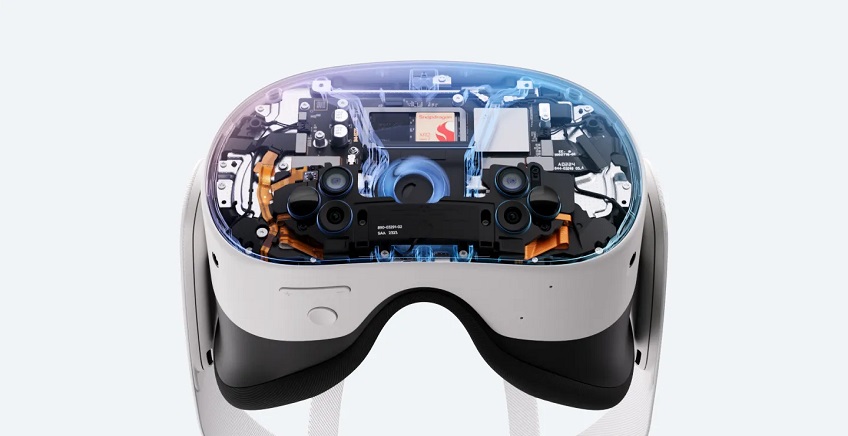
Image above: Meta’s Quest headset. Source: Meta

By Yohai Schwiger

During Stratasys’ third-quarter earnings call, CEO Dr. Yoav Zeif revealed that “one of the largest American technology companies — a global leader in social networks, artificial intelligence, and virtual and augmented reality hardware” — purchased four of the company’s new F3300 3D printers. While he did not name the customer, the clues unmistakably point to Meta, the parent company of Facebook, Instagram, WhatsApp, and the Quest headset line.

According to Zeif, the systems will initially support large-scale prototyping for the customer’s “automation platforms” and for developing “its next robot.” Over time, the same printers are expected to transition into production of end-use parts for the company’s XR devices. Zeif stressed that the customer ran a lengthy evaluation against competing solutions and ultimately chose Stratasys because of its ability to move from design to production on the same machine — a capability he described as critical for fast-cycle, globally competitive tech giants.

Meta’s Humanoid Project

The F3300 units purchased are industrial-grade FDM systems with large build volumes, engineering-grade materials, and high long-term geometric precision. Practically, that means they can produce not only early-stage prototypes but also final, production-quality components for robotics platforms, camera housings, sensor mounts, and complex XR mechanisms. Choosing such machines suggests a need for equipment capable of producing thousands of identical parts at industrial standards, supporting internal automation pipelines that change frequently.

Over the past year, reports have indicated that Meta is developing an advanced humanoid prototype featuring tactile sensing, haptics, and AI-driven control systems. Research published by the company has shown a robotic hand capable of evaluating texture, friction, and stiffness, and Meta has been investing heavily in robotics for locomotion, manipulation, and complex task execution in dynamic environments.

Zeif’s reference to “automation platforms” likely points to Meta’s internal manufacturing and testing infrastructure — a sprawling ecosystem of robotics, sensors, and automated rigs used for module assembly, quality assurance, and rapid prototyping. This world of jigs, fixtures, manufacturing tools, and test stations increasingly relies on high-throughput 3D printing, enabling Meta to iterate mechanical elements at high frequency.

“We see enormous potential here,” Zeif told analysts. “The customer selected us after a lengthy evaluation. These printers passed the highest-level certifications and tests. They’re starting with prototyping, but moving quickly into production on the same machine — and that gives them a major speed-to-market advantage.”

Stratasys Printers in the U.S. Navy’s Trident Warrior Exercise

Stratasys posted a challenging yet steady quarter. Revenue came in at $137 million, down about 2% year-on-year amid ongoing caution in capital-equipment spending. Gross margin declined due to higher U.S. tariffs and a shift in product mix, but operating expenses fell meaningfully, resulting in $1.5 million in adjusted net profit. The company maintained positive cash flow, ended the quarter with roughly $255 million in cash and no debt, and reaffirmed its full-year revenue guidance of $550–560 million with modest Non-GAAP profitability.

Defense was a standout. Stratasys reported strong activity with Boeing, Embraer, Honeywell, TE Connectivity, and L3Harris. The company also participated in the U.S. Navy’s Trident Warrior 25 exercise, which tested distributed manufacturing and advanced maintenance capabilities across thousands of kilometers. Stratasys printers were deployed at seven global sites — both as forward positions producing critical components at the edge and as part of reach-back operations, where Stratasys Direct facilities supplied complex parts. All printed components met full military specifications, demonstrating how a hybrid production network can shorten supply timelines, reduce logistical dependence, and improve operational continuity for deployed units.

Stratasys also highlighted significant progress in the dental market, which it views as a major growth engine. The company appointed Chris Cabot, formerly of Affordable Care, to lead global dental operations. It launched new post-processing solutions that reduce manual labor and minimize reliance on harmful chemicals, and it removed TPO from its dental resins to streamline safety and future regulatory approvals.

Despite macroeconomic headwinds, Stratasys is positioning itself not just as a prototyping provider but as a partner in advanced manufacturing. The Meta-scale customer win, deepening defense-sector traction, expansion in dental, and a strong balance sheet all reinforce management’s optimism as distributed production, automation, and rapid development cycles increasingly become the industry standard.