Israeli Concept, Iranian Drone, American Copy

photo above: US made LUCAS loitering munition

One of the most surprising weapons in the current war in Iran is the U.S. Army’s LUCAS suicide drone, which only entered service in September 2025 and is already influencing the course of the war. This drone is unusual: it is essentially the American copy of the Iranian Shahed-136 drone, which Iran unveiled in 2021 and soon afterward supplied to Russia in large quantities. Today, Russia manufactures it domestically under the name Geran-2.

In June 2025 the United States unveiled the new Low-Cost Uncrewed Combat Attack System (LUCAS). In July 2025 the Secretary of Defense approved accelerated procurement, and by December 2025 the U.S. Central Command (CENTCOM) announced the establishment of a dedicated task force to operate it — Task Force Scorpion Strike (TFSS) — along with the deployment of the first operational squadron in the Middle East. Ten days ago, when the joint Israeli-American attack on Iran began, CENTCOM released a special statement: “For the first time in history, TFSS has deployed one-way attack drones. These low-cost systems were developed based on the Iranian Shahed and are manufactured in the United States.”

A Training Concept That Became a Weapon

How did it happen that the United States copied an Iranian design and began producing it? And is the design Iranian at all — or Israeli? Let us begin with the United States. Behind these inexpensive attack drones stands SpektreWorks, a company based in Phoenix, Arizona. The Pentagon asked the company to develop a training platform that would allow air-defense crews to practice intercepting attack drones. To assist the development process, the company was provided with an Iranian Shahed drone captured in the Middle East.

SpektreWorks conducted a comprehensive examination of the Iranian design. To provide an authentic training experience, the company performed reverse engineering and produced an American version of the Iranian drone. Not coincidentally, it named the system FLM-136, hinting at its Iranian origin (Shahed-136).
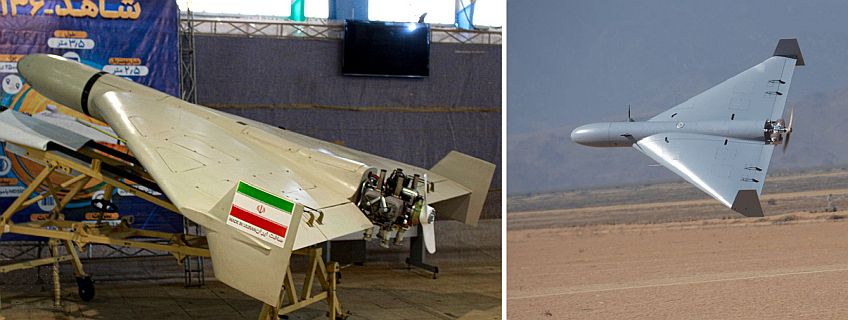
From right to left: SpektreWorks FLM-136 and Shahed-136

The platform is small, weighing about 80 kg, and equipped with a small, inexpensive rear internal-combustion engine that gives it a flight range of slightly more than 800 km at a speed of 130–140 km/h. It carries a payload of up to 20 kg and can cover its maximum distance within about six hours of flight.

The model achieved one of its most important goals: an extremely low price. The platform proved so successful that the U.S. Army decided to procure it as a weapon, not merely as a training system. The price played a decisive role in that decision, since it allows the launch of hundreds or even thousands of drones, creating an effect of deception, confusion, and shock — thereby breaking the asymmetry that often characterizes conflicts between sophisticated armies such as the Israel Defense Forces and the U.S. Army and their adversaries.

The Liberty Ship Model

In an interview with a U.S. Army publication, the Director of Experimentation at the Office of the Under Secretary of War for Research and Engineering, Colonel Nicholas Law, explained that the inspiration came from the Liberty Ship production model, which enabled the rapid manufacture of thousands of cargo ships during World War II. “LUCAS will fulfill a similar role in the new era of warfare,” he said. “There is a price point at which we want to produce large numbers of these systems very quickly.” It is not a single manufacturer: the system is designed to move to multiple manufacturers so it can be built in mass quantities.

The combat version differs slightly from the training version. It carries an 18-kg warhead and has a range of 650–800 km. The American version also includes AI-based navigation and mission-management capabilities, enabling operation as part of a swarm. The most important detail is the price: about $35,000 per unit, compared with roughly $20,000 for the Iranian version.

An Idea from Israel Aerospace Industries

Sharp-eyed observers have noticed the strong resemblance between the Iranian Shahed drone and the Israeli Harpy attack drone developed more than 30 years ago by Israel Aerospace Industries (IAI). Like its Iranian counterpart, the Harpy is a loitering munition with a broad delta wing and a small rear internal-combustion engine.

Both are launched using a booster rocket that separates after launch, both fly autonomously according to pre-programmed route data, and both can be launched from trucks and ships. However, the Harpy was more sophisticated and more expensive because its primary mission was detecting electromagnetic emissions in order to destroy radar systems.
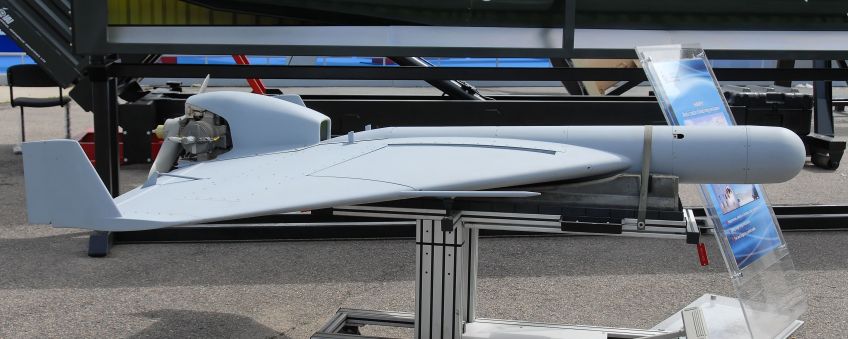
IAI Harpy at Paris Air Show 2007. Source: Wikipedia

There is no any official confirmation of the widespread assumption within the industry that the Shahed is a low-cost copy of the Harpy. Nevertheless, its history provides several possible points where the Iranians might have obtained the knowledge necessary for some form of reverse engineering. The first is the Chinese deal: in 1994 Israel sold Harpy drones to China in a transaction that caused a crisis with the United States and eventually led to the resignation of Israel’s Defense Ministry Director-General, Amos Yaron.

Under U.S. pressure, the Chinese drones were not upgraded in 2004 as originally planned. Later reports suggested that China conducted reverse engineering on them and developed its own version called ASN-301. The Harpy is used by several militaries, including those of India, Morocco, Turkey, and Azerbaijan (which borders Iran). Azerbaijan used the system in its battles with Armenia, and during those conflicts there were reports of drones that strayed from their course or were shot down.

Close military ties between China and Iran, along with the loss of drones in Azerbaijan, could help explain how design knowledge from the Israeli UAV — which was the first of its kind in the world — might have found its way into the Iranian drone. However, fully copying the Israeli concept does not necessarily require complete reverse engineering: its core characteristics — such as a broad delta wing, slow long-range flight, a small rear pusher engine, and container launch using a booster rocket — can be replicated even without reverse engineering.

Israeli Doctrine vs. Iranian Doctrine

There are also notable differences between the two platforms. The Israeli Harpy uses a Wankel engine produced by Elbit, which is very efficient and extremely quiet but expensive to manufacture. The Iranian Shahed is based on a small scooter like piston engine, which is cheap and noisy. It is so widely available. Similar engines can be purchased worldwide, even through online model-aircraft parts stores. In general, the Shahed relies on cheap, easily obtainable civilian components, while the Israeli drone is built from military grade expensive components.

The largest difference lies in the avionics systems: The Israeli Harpy searches for specific radiation sources and can navigate toward them; if it does not detect a radar signal, it can abort the mission. The Iranian Shahed, by contrast, is equipped with what might be described as “poor man’s avionics”. A set of coordinates is entered into the system, and the drone flies toward them using GPS. The bottom line is that the differences between the two are less about technology and more about combat doctrine. In this sense, the American LUCAS drone has adopted the Iranian operational concept almost in full.
Countering Drones with Cyber Warefare

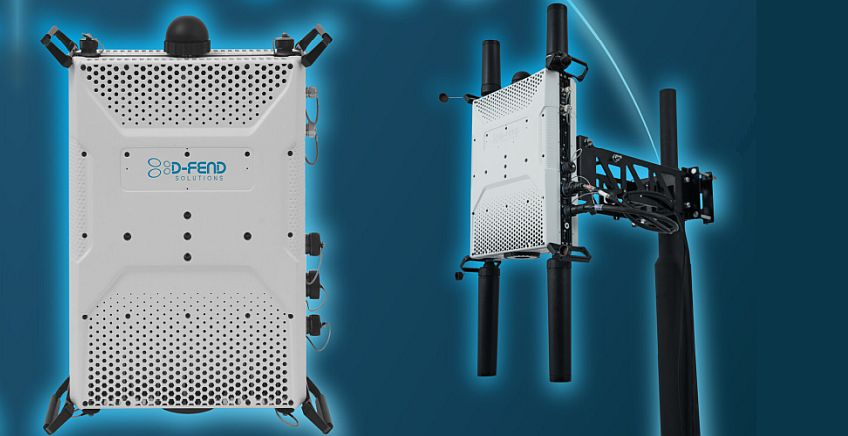
D-Fend Solutions from Ra’anana, Israel, announced this week its new RF cyber-based counter-drone takeover system, EnforceAir2. This highly mobile non-kinetic solution consists of multiple receivers and transmitters and real-time processing in a compact form factor, enabling tactical teams to overcome deployment challenges on the field. The system was adopted by the US DoD, who has ordered over $3 million worth of EnforceAir counter-drone security systems and components to various United States federal security agencies.

But what makes the EnforceAir an interesting product is its concept: instead of using classical sensors and counter measures, D-Fend adopted techniques and methods brought from the world of cyber warefare, and had stacked them over a wireless layer. Legacy counter-drone systems rely on sensors such as radars, electro-optical sensors and RF directional finders. Older radar systems can detect larger aircraft but often cannot track drones.

The limitations of Legacy Systems

Modern anti-drone radar systems cannot always differentiate between small drones and other flying objects such as birds. Radars are also impacted by weather and are sensitive to refractions and reflections, which can lead to multiple signals from different directions originating from the same object being received by the radar.

Electro-optical sensors are used for identification of drones, but they are usually triggered by other detection and tracking systems, such as radars. When combined with radars, they are used as a validation technology to reduce the number of false detections. The biggest disadvantage of EO/IR solutions for detection is that they require a clear and direct line-of-sight, which is not always available in dense, crowded, or urban environments. Darkness, fog and rain can also hinder the effectiveness of EO/IR detection solutions.

RF directional finders utilize sensors to detect and track UAVs. They monitor common frequency bands that they can match to a library of drone control signal profiles to classify these types of signals and can estimate the radial direction these signals come from. They may not be able to identify specific airframes or provide the most accurate real-time location of the drone. In addition, in urban and complex terrains, directional finders may point to the wrong direction due to RF reflections from objects like buildings or mountains.

Hacking Hostile Drones

D-Fend idea combines wireless expertise with cyber practices. EnforceAir systems continuously scan and detect unique communication signals used by commercial drones. Once detected, the solution analyzes the drone’s information and protocols,  for a classification process, and tag specific drones as authorized or unauthorized. The system can extract the telemetry information, to determine the type of drone and its accurate position. This includes the take-off position and often also the pilot position in real-time.

Cyber solutions do not require a quiet environment, a direct line-of-sight and is not affected by weather conditions. Once an hostile drone is detected, the system can activate Takeover procedure: Taking over command of the drone and directing it to follow a predetermined route and to safely land in a prearranged location.

Percepto and Boston Dynamics to provide Multi-robot Inspection

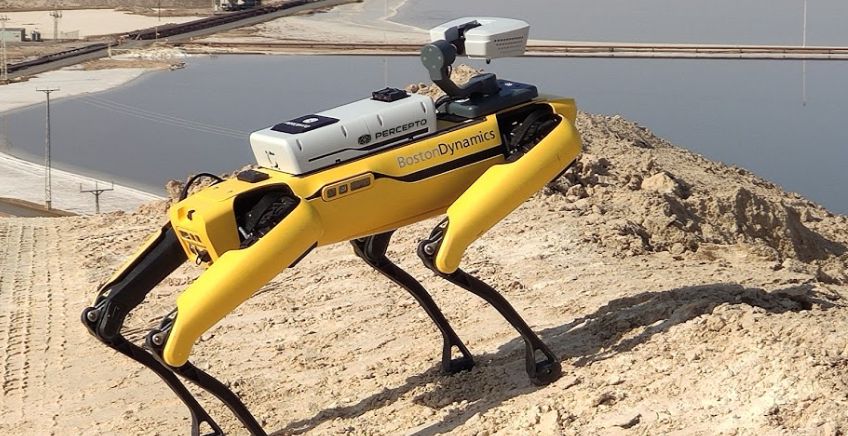
Boston Dynamics and Percepto from Modi’in, Israel, have combined their products into an autonomous monitoring and inspection solution for dangerous and remote industrial sites. Founded in 2014, Percepto has developes the autonomus industrial drone Sparrow, as a drone-in-a-box solution. Sparrow was adopted to monitor some of the world’s leading utility, oil & gas sites, mining and other critical infrastructure facilities.

Lately the company moved to a higher level: It created an Autonomous Inspection & Monitoring (AIM) platform that can manage a fleet of third-party robots alongside Sparrow drone. By installing its own PerceptoCore payload on each drone, the cloud-based AIM provides visual data management and analysis to report trends and anomalies and to alert of risks. When a member of staff request data, Percepto AIM deploys the most suitable robot independently without human accompaniment to retrieve and stream the required data.

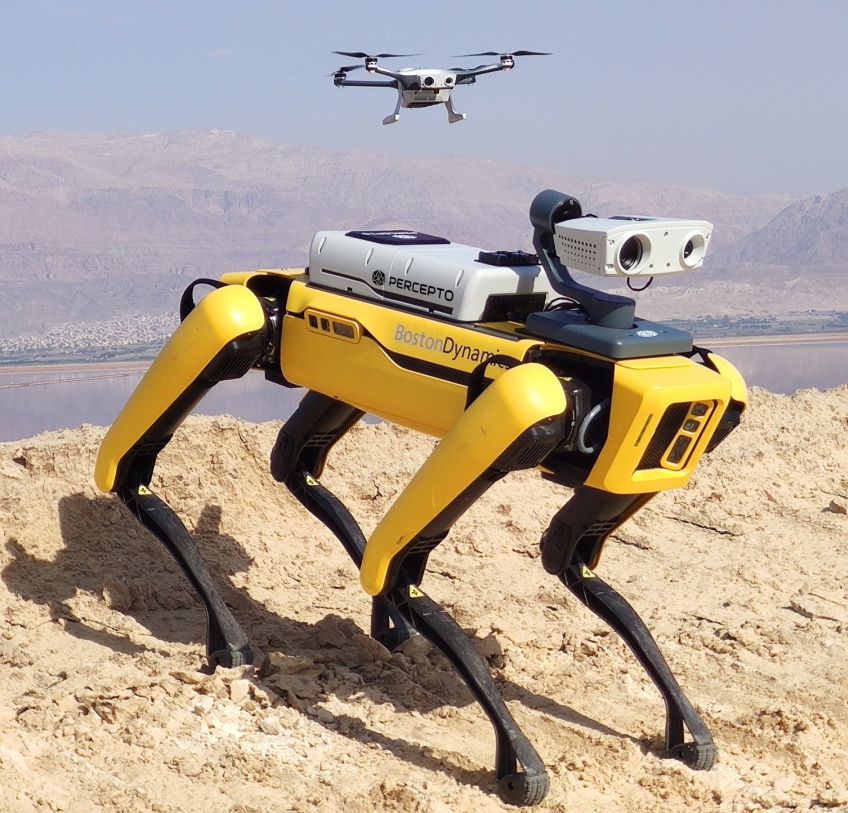
Here comes the cooperation with Boston Dynamics: Spot is an agile doglike mobile robot developed by Boston Dynamics that navigates terrain with unprecedented mobility. Percepto has integrated Spot with its AIM for automated inspection rounds completely controlled remotely via the platform. Spot carries Percepto’s PerceptoCore payload, which includes high resolution imaging and thermal vision sensors.

Spot and Sparrow working together at the Dead Sea, Israel

They are able detect issues including hot spots on machines or electrical conductors, water and steam leaks around plants and equipment with degraded performance, with the data relayed via AIM. “Combining Percepto’s Sparrow drone with Spot creates a unique solution for remote inspection,” said Michael Perry, VP at Boston Dynamics.

This week the company also won a financing boost to its vision: A strategic investment of $45 million in Series B funding led by Koch Disruptive Technologies (KDT) to launch its solution for remote, fully autonomous, asset monitoring and inspection. It brings the total investment in the company to $72.5 million.

US Army Chose RADA’s Radars for Counter-Drone Systems

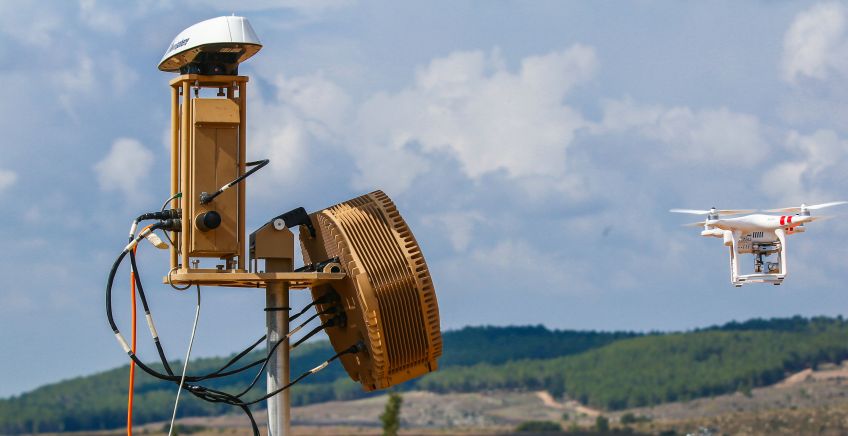
Above: Rafael’s Counter-drone system incorporates RADA’s Tactical Radar

The US Army has selected the tactical radar of RADA Electronic Industries from Netanya, Israel, for its Counter-Small Unmanned Aircraft Systems (C-sUAS) systems. The Army has defined four C-sUAS categories: fixed/semi-fixed systems, mounted/mobile system, handheld systems, and command & control.

RADA’s radars are the incumbent radar system in the L-MADIS platform which was selected as the mounted/mobile system, and are incorporated in part of the recommended fixed solutions, along with other fixed solutions deployed across the US. While not relevant to handheld systems, RADA’s radars are compatible with the recommended command and control systems.

Next-generation Tactical Radars

Dov Sella, RADA’s CEO, said that the US Army preferred not only the most up-to-date existing technologies, but those new and emerging technologies currently in development. “We are in advanced development stages of our next-generation tactical radars that aim to address future challenges at highly affordable performance-to-price points.”

According to the Congressional Research Service (CRS), in FY2021, the Department of Defense (DOD) plans to spend at least $404 million on counter-UAS (C-UAS) research and development and at least $83 million on C-UAS procurement. In December 2019, DOD streamlined the Department’s various counter-small UAS (C-sUAS) programs, creating a the Joint C-sUAS Office (JCO). On June 25, 2020, Maj. Gen Sean Gainey, director of the JCO, announced that seven C-sUAS defensive systems and one standardized command and control system are to be further developed.

How to Tackle Drones

C-UAS can employ a number of methods to detect the presence of hostile or unauthorized UAS. The first is using electro-optical, infrared, or acoustic sensors to detect a target by its visual, heat, or sound signatures, respectively. A second method is to use radar systems. However, these methods are not always capable of detecting small UAS due to the limited signatures and size of such UAS.

A third method is identifying the wireless signals used to control the UAS, commonly using radio frequency sensors. These methods can be—and often are—combined to provide a more effective, layered detection capability. Once detected, the UAS may be engaged or disabled. Electronic warfare “jamming” can interfere with a UAS’s communications link to its operator.

Jamming devices can be as light as 5 to 10 pounds and therefore man-portable, or as heavy as several hundred pounds and in fixed locations or mounted on vehicles. UAS can also be neutralized or destroyed using guns, nets, directed energy, traditional air defense systems, or even trained animals such as eagles. DOD is developing and procuring a number of different C-UAS technologies to try to ensure a robust defensive capability.