
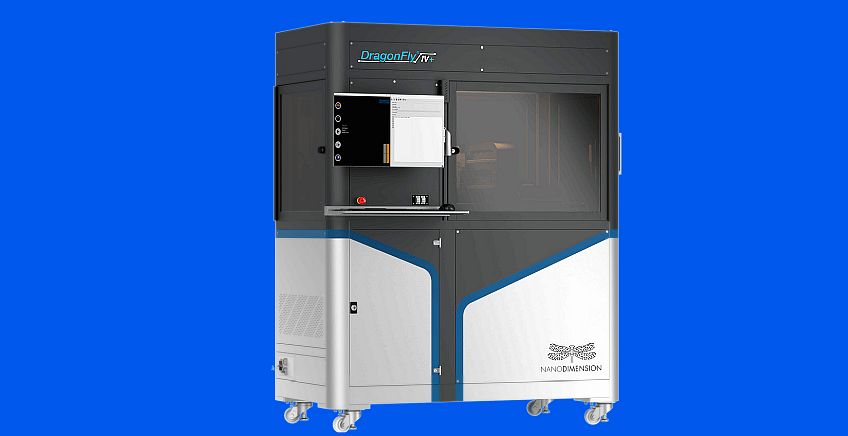
Image: DragonFly system for on-demand 3D printing of printed circuit boards (PCBs)
By Yohai Schwiger
Nano Dimension is divesting the business that once defined it. The company announced the sale of its Additively Manufactured Electronics (AME) division to Inspira Technologies in a deal worth up to $12.5 million. The transaction includes $2 million in cash at closing and up to $10.5 million in performance-based payments over the coming year.
Under the agreement, Inspira will acquire not only AME’s product lines but also its intellectual property, engineering know-how, manufacturing and laboratory infrastructure, and parts of its workforce. Operational control will transfer immediately, while formal closing remains subject to regulatory approvals.
The move carries both symbolic and strategic weight. AME is built around Nano Dimension’s original breakthrough: on-demand manufacturing of printed circuit boards using systems such as the DragonFly. Developed in Ness Ziona, the technology aimed to revolutionize electronics development by allowing engineers to print functional circuit boards in-house, dramatically shortening prototyping cycles.
The deal also includes what remains of the Fabrica product line—high-precision micro-3D printers originally developed by Israel’s NanoFabrica, which Nano Dimension acquired in 2021 for approximately $55–60 million. The company estimates the divestment will reduce its annual cash burn by around $10 million.
A Bargain Sale of a Once-Promising Technology
The buyer is intimately familiar with the technology it is acquiring at what appears to be a steep discount. Inspira is a relatively small Nasdaq-listed company with a market capitalization of about $20 million. It operates primarily in the medical device space, focusing on advanced respiratory systems that also monitor blood parameters.
In 2025, the company reported less than $300,000 in revenue and a net loss exceeding $13 million, reflecting its early commercialization stage and ongoing search for growth directions.
Its CEO and founder, Dagi Ben-Noon, is no stranger to Nano Dimension. He was one of the company’s co-founders and a key developer of its PCB-printing technology, serving as COO in its early years before leaving around 2017. That same year, he founded Inspira.
Announcing the deal, Ben-Noon said: “We have deep and intimate knowledge of the AME technology, and we believe in our ability to unlock its potential in new directions.”
Inspira plans to repurpose the technology for quantum computing applications—specifically, for building components used in dilution cryostats, ultra-low temperature cooling systems required to operate quantum processors at near absolute zero (10–20 millikelvin). The company believes AME’s ability to produce complex 3D electronic structures could help address connectivity challenges inside these systems.
Dual Strategy: Medical Devices and Quantum Ambitions
Inspira emphasized that its core medical device business will not be abandoned. Instead, it will be transferred into a wholly owned subsidiary and continue operating independently. This effectively creates a dual-structure company: one arm focused on medical technologies, and another on quantum computing—an area that appears to be emerging as its primary strategic focus.
The company is even planning a rebranding to “QTREX” to reflect this shift.
From Breakthrough Promise to Strategic Exit
Founded in 2012, Nano Dimension set out to transform electronics manufacturing with its inkjet-based PCB printing technology, combining conductive and insulating materials in a layered 3D process. The technology achieved notable milestones, including the production of aerospace-grade circuits with embedded passive components such as capacitors, resistors, and coils.
The vision attracted significant investor enthusiasm. The company raised hundreds of millions of dollars through public and private offerings, peaking in 2021 with approximately $1.4 billion in cash on its balance sheet.
However, commercial adoption fell short of expectations. Over time, Nano Dimension shifted its focus through a series of acquisitions, most notably Markforged, which specializes in metal and advanced materials printing.
The company also pursued additional acquisitions that, in retrospect, appeared less cohesive, including an unsuccessful attempt to acquire Stratasys. Management turbulence followed, culminating in the departure of CEO Yoav Stern.
Gradually, electronic printing products faded from investor discussions, and Nano Dimension repositioned itself as a broader digital manufacturing solutions provider. At the same time, its geographic center of gravity moved away from Israel.
Last week, the company announced a re-domestication process expected to conclude in the first half of 2026, after which it will operate as a fully U.S.-based company.
Against this backdrop, the sale of the AME and Fabrica businesses marks more than a divestment—it represents a definitive exit from the technology and geography that once defined Nano Dimension. Technologies that attracted hundreds of millions of dollars in investment are now being sold for up to $12.5 million.
