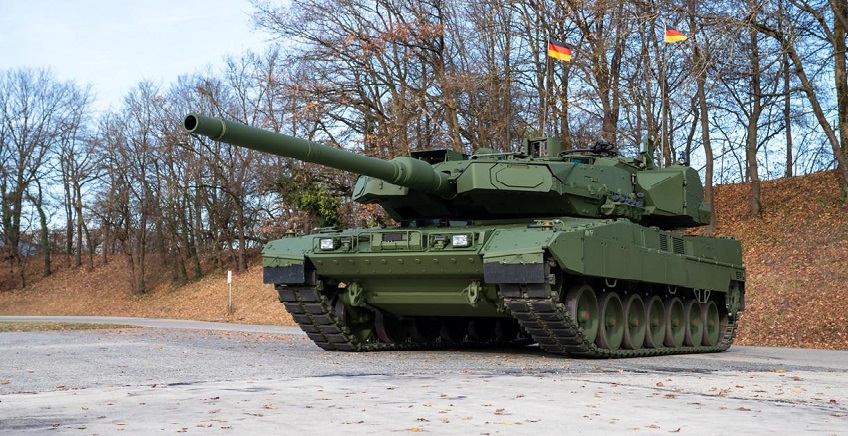
[Image: The Leopard 2A8 main battle tank. Photo credit: EuroTrophy GmbH and KNDS Deutschland]
Rafael’s Trophy active protection system has been selected as part of the standard baseline configuration of the Leopard 2A8, the next-generation variant of Germany’s Leopard 2 main battle tank family. The decision was made under a broad, multinational contract signed between EuroTrophy and tank manufacturer KNDS Deutschland, covering tank deliveries to four NATO members: Lithuania, the Netherlands, the Czech Republic and Croatia.
The contract, estimated at approximately €330 million, includes the supply of Trophy systems, spare parts, training, and comprehensive lifecycle logistical support. Beyond its financial scope, the agreement reflects a broader shift in how NATO defines baseline requirements for next-generation armored platforms.
Not an Upgrade — Integration from the Start
One of the most significant aspects of the deal is the way Trophy is being incorporated: not as a retrofit or optional add-on, but as an integral part of the tank’s standard baseline configuration.
This means the active protection system is embedded at the production stage, fully integrated into the tank’s electrical, sensor and command-and-control architecture, as well as its overall operational concept. The fact that KNDS Deutschland, the tank’s manufacturer, is a direct party to the agreement further reinforces the assessment that this is a production-line integration rather than a post-delivery modification. From NATO’s perspective, active protection is increasingly being defined as a baseline requirement rather than a future enhancement.
Leopard 2A8: A Veteran Platform, Reimagined
The Leopard 2 family entered service in the late 1970s, but the Leopard 2A8 represents a significant leap forward. It is the most advanced variant of the platform to date and the first in many years to be produced as a newly built tank, rather than a conversion of older hulls.
The 2A8 is designed for the contemporary battlefield — one characterized by advanced anti-tank missiles, drones, dense sensor networks and network-centric warfare. It combines an upgraded 120mm main gun, enhanced fire-control systems, multi-layered survivability and the ability to operate as part of a joint, multinational force.
Integrating Trophy as part of the baseline configuration complements this concept, providing real-time interception of anti-tank threats while significantly improving crew situational awareness.
How Many Tanks — and How Many Systems?
Based on publicly reported procurement plans, the four participating countries have each committed to purchasing dozens of Leopard 2A8 tanks, with a combined baseline total of approximately 170–180 tanks, and the potential for further expansion should options be exercised.
Since Trophy is defined as part of the tank’s baseline configuration, this implies the integration of several dozen active protection systems — potentially approaching 200 units if procurement plans are fully realized.
EuroTrophy: Bridging Israeli Technology and European Industry
The European implementation of the deal is being carried out through EuroTrophy, a German joint venture between Rafael, KNDS Deutschland and General Dynamics, headquartered in Frankfurt. The company focuses on the marketing, production and integration of the Trophy system for NATO and European Union customers.
This structure enables the incorporation of combat-proven Israeli technology into Europe’s defense-industrial base, while meeting local regulatory, industrial and logistical requirements — positioning Trophy as a core element of Europe’s armored warfare architecture for years to come.
Trophy: Operational Active Protection
Trophy, developed and manufactured by Rafael, is an operational active protection system designed to intercept anti-tank threats using a hard-kill mechanism. The system incorporates detection, tracking and alert capabilities, providing armored crews with information on the direction and source of incoming threats as part of the engagement cycle.
The system is deployed on Merkava tanks, M1 Abrams, Leopard 2 platforms and additional armored vehicles. Its selection as a baseline configuration for the Leopard 2A8 reflects the integration of active protection as an inherent component of modern Western armored force doctrine.
More Than a Contract — A Strategic Statement
Beyond its commercial dimensions, the agreement reflects lessons learned from recent battlefields and a growing recognition within NATO that tank survivability can no longer rely on passive armor alone. The shift toward integrated active protection marks a deeper transformation in armored warfare doctrine — one that positions the Leopard 2A8, together with Trophy, as a central pillar of Europe’s armored forces in the coming decade.