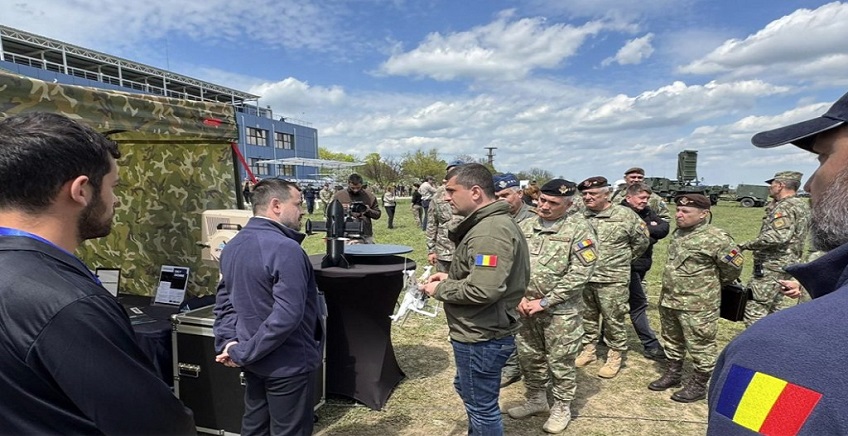
[Image: Scene from the NATO exercise in Romania. Courtesy of Autonomous Guard]
Last week, NATO conducted a large-scale operational exercise in Romania to evaluate advanced counter-drone systems—an increasingly critical capability in modern battlefields such as Ukraine. The exercise brought together 21 countries and tested more than 200 technological solutions, including the integrated Sky Dome system developed by Israeli company Skylock, a subsidiary of Autonomous Guard.
According to the company, Sky Dome consistently demonstrated the highest performance in detecting and neutralizing drones throughout the exercise. Autonomous Guard believes these results position the system as a strong contender for future procurement programs across NATO member states.
The exercise, held at the Capu Midia range on the Black Sea coast under the name LCI-X Crucible Eastern Phoenix 2026, was designed as a full-scale field trial rather than a controlled demonstration. Systems were required to operate under realistic combat conditions, handling complex scenarios such as coordinated drone swarms, timed attacks, and multiple simultaneous intrusions. Around 150 different types of drones were deployed, enabling a broad evaluation across diverse threat profiles.
The testing process included several phases. Following an initial screening round, only four systems advanced to the final stage—those developed by Skylock, Rheinmetall, Cognifly, and Bluespace. The final evaluation was attended by senior Romanian defense officials, including the Minister of Defense and the Air Force Commander. Systems that performed well are expected to be listed in NATO’s procurement portal, making them eligible for future acquisition programs.
Sky Dome is built on a multi-layered architecture combining radar, RF sensors, electro-optical systems, and acoustic sensors to deliver precise detection, classification, and tracking. The system operates across multiple ranges and is designed to counter drones that do not rely on GPS, including those using alternative navigation methods. Interception is primarily achieved through “soft-kill” techniques such as communication jamming and navigation spoofing, allowing effective neutralization even against drone swarms.
The company noted that the system also performed well against larger drones, which are typically more challenging to intercept using kinetic methods. Participation in the exercise has reportedly generated interest from additional European NATO members.
Alongside its operational efforts, Skylock is working to establish a local presence in Romania through the SAFE framework—an accelerated defense funding mechanism—in collaboration with a local partner. The company is also exploring the integration of additional interception technologies, including laser-based solutions, in line with evolving battlefield requirements.