
Honda Takes on Electreon in Electric Roads
11 October, 2026
Honda plans a Japanese highway trial of in-motion wireless charging in 2027, challenging Israel’s Electreon, which already operates a similar system in France
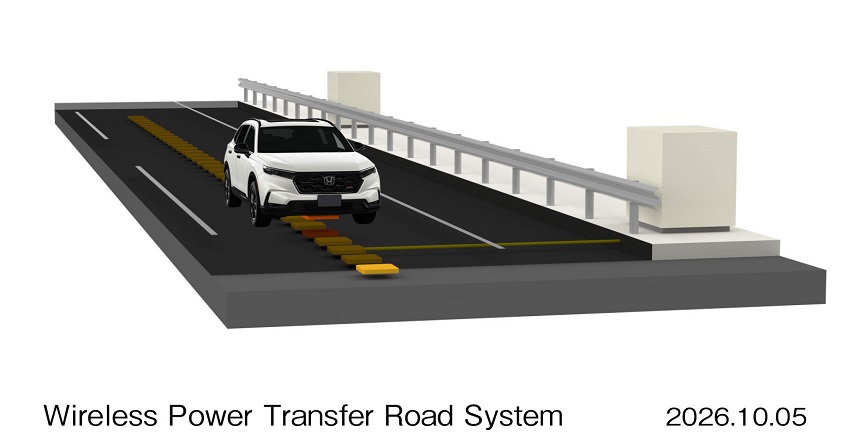
Pictured: Honda’s dynamic wireless charging system. Units embedded in the road transfer power to vehicles as they drive. Rendering: Honda.
Japanese automaker Honda is entering the electric road market, creating direct competition for Israel’s Electreon. On Monday, the company unveiled a dynamic wireless power transfer (DWPT) system that charges moving vehicles through coils embedded beneath the asphalt. Honda is initially targeting trucks and commercial transport, with testing on a public highway in Japan scheduled to begin in fiscal 2027.
The system has been under development since 2025 in partnership with Japanese infrastructure companies Taisei and Taisei Rotec. Honda is responsible for the road’s power transmission units and the vehicle-mounted receiver, Taisei for the power supply system, and Taisei Rotec for embedding the hardware in the road. The companies will subsequently participate in a project led by highway operator NEXCO East on the Tateyama Expressway in Chiba Prefecture.
Honda is developing units capable of delivering up to 150 kW of instantaneous power and aims to demonstrate that the system can operate while trucks travel at highway speeds. A test track will be built later this year to assess the infrastructure’s durability under loads equivalent to one million wheel passes, as well as electromagnetic field leakage.
Two Approaches to Charging Roads
The underlying physics is similar to Electreon’s: coils embedded in the road generate a magnetic field, and a receiver mounted beneath the vehicle converts that energy into electricity. Honda, however, has chosen a different architecture. Its ground assembly (GA) units are connected through a DC power network, with each unit incorporating both the transmission coil and the electronics needed to operate it. According to Honda, this design simplifies wiring and allows the system to rapidly activate only the units directly beneath a vehicle.
Electreon’s architecture, by contrast, uses roadside management units to supply power to sections of embedded coils. One potential advantage is that more of the active electronics remain accessible outside the pavement. Honda’s modular approach could simplify power distribution and unit replacement. It is still too early to determine which architecture will prove cheaper and more reliable over years of operation. Honda has not provided a cost estimate, and a company engineer told Reuters that the economics still need to be assessed against conventional fast-charging infrastructure.
Electreon currently has a substantial lead in deployment. On the A10 motorway south of Paris, it operates an approximately 1.5-kilometer charging section under real traffic conditions. In tests conducted with Gustave Eiffel University, the system delivered more than 200 kW on average to a truck traveling at 85–90 km/h, with instantaneous power exceeding 300 kW. The same project also supports a bus, a commercial van, and a passenger car.
Why Trucks?
Honda’s entry is particularly interesting because it targets an application where electric roads are still seen as having significant economic potential: heavy freight transport. Long-haul electric trucks require large, heavy batteries and substantial charging time. Supplying energy while they travel could enable smaller batteries, reduce weight, and cut downtime.
Heavy transport is also one of Electreon’s core markets. In recent years, however, the company has broadened its strategy beyond its original vision of electrifying roads. Alongside LINE for dynamic charging, it offers DASH for charging during slow travel or brief stops, and DOT for stationary charging. Its acquisition of InductEV earlier this year further strengthened its stationary charging business for bus, truck, and industrial vehicle fleets, at power levels of 75–300 kW.
That shift also reflects the market’s current state. Deploying electric roads across entire highway networks still requires major infrastructure investment, standardization, and cooperation among governments, road operators, and automakers. Progress is therefore concentrated in demonstration projects and transport corridors regularly used by heavy vehicles.
Against this backdrop, Honda’s entry sends a meaningful signal. It does not establish the business case for electrifying thousands of kilometers of roads, but it shows that a major automaker continues to see value in the technology and is investing in a system of its own. For Electreon, Honda represents both a new competitor and support for the technological premise on which the company was built: in some applications, the road itself can become part of the charging infrastructure.
Posted in: News