Last week, Intel and Microsoft brought together nearly 100 security and Artificial Intelligence (AI) experts to discuss new standards for Homomorphic Encryption (HE), which is emerging as a leading method to protect privacy in machine learning and cloud computing. The HE standards workshop took place on Intel’s Santa Clara, California campus. Following the first meeting in October, 2018, Intel and Microsoft initiated the founding of the HomomorphicEncryption.org group.
As more data is collected and used to power AI systems, concerns about privacy are on the rise. Casimir Wierzynski from the office of the CTO of AI Products Group at Intel, said that Intel is collaborating with Microsoft Research and Duality Technologies on standardizing HE, “to unlock the power of AI while still protecting data privacy.”
Fully homomorphic encryption, or simply homomorphic encryption, refers to a class of encryption methods envisioned by Rivest, Adleman, and Dertouzos already in 1978, and first constructed by Craig Gentry in 2009. Homomorphic encryption differs from typical encryption methods in that it allows computation to be performed directly on encrypted data without requiring access to a secret key. The result of such a computation remains in encrypted form, and can at a later point be revealed by the owner of the secret key.
It allows AI computation on encrypted data, thus enabling data scientists and researchers to gain valuable insights without decrypting or exposing the underlying data or models. This is particularly useful in instances where data may be sensitive – such as with medical or financial data. Homomorphic encryption also enables training models directly on encrypted data, without exposing its content. Such encryption would enable researchers to operate on data in a secure and private way, while still delivering insightful results.
Photo above: A development team at Hailo. The Tel Aviv based company employs around 65 workers today
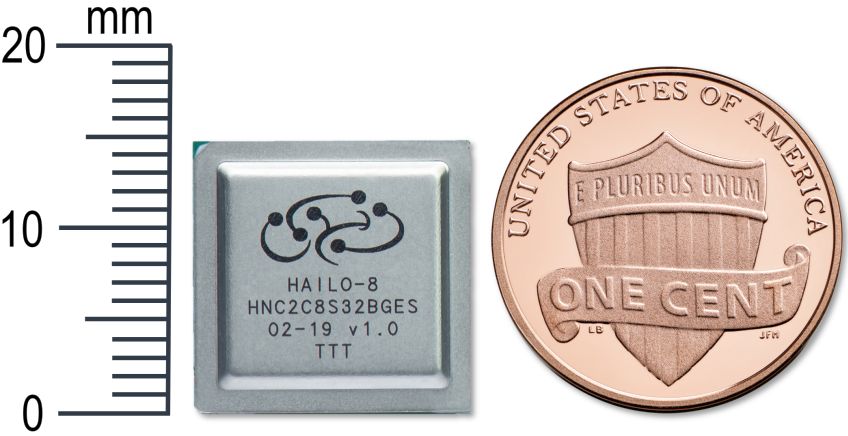
Tel Aviv-based Hailo is preparing for the mass production of its AI chip that meets the ASIL-B standard of the automotive industry, and start full-scale production during 2020. Company co-founder and CEO Orr Danon told Techtime that the new chip is named Hailo-8 and was developed as part of the cooperation between Hailo and auto manufacturers. The chip enables the meeting of demands for critical life-saving systems, including the meeting of working under conditions of up to 105 degrees Celsius.
According to company data, the Hailo-8 processor reaches up to 26 tera operations per second (TOPS) and 3 TOPS per Watt power efficiency. It will meet the strict ISO 26262 ASIL-B as well as the AEC Q 100 Grade 2 standards. Hailo-8 is comprised of four main components: an Image Signal Processor that improves the image from the sensor before its transfer for processing by the neural network core, an H.264 encoder that handles the video stream, an ARM-M4 processor that manages the chip, and the neural network core itself, that is comprised of a flexible matrix of software-configurable processing, controls, computational resources and memory units.
Renew the Old Idea of DFP Processors
Hailo was established in February 2017 by CEO Orr Danon, CTO Avi Baum and the Business Development Manager Hadar Zeitlin. The first investor in the company was Zohar Zisapel, who serves today as Chairman of the board. To date Hailo has raised around $24 million, of which $21 million was in the latest round of financing which was completed in January 2019. The company developed a new architecture for AI chips for edge devices that carry out the execution phase – i.e. the application of the inference of a neural network in edge devices at a rapid speed and with a huge saving in energy. According to Danon, the architecture, which is protected by dozens of pending patents, “belongs to a forgotten family of processors from the Data Flow Processors type.”
CEO Orr Danon. “Our architecture describes the structure of a neural network”
In DFP processors, the processing activity takes place only when data is fed into the processor, which conducts a fixed series of operations on top of this information, and then transfers the processed information. “In recent years, it turned out that the reliance on neural networks is an efficient and reliable means of solving many problems, and therefore most of the AI systems that we see in the market are based on neural networks. Here the challenge is structural, since the chip needs to implement a structure of a neural network. In a neural network one infuses experience into the description of a structure, and therefore it is a very efficient solution in solving problems which are based on recognizing examples.”
How is your chip designed? What are the main principles of the architecture?
Danon: “Our architecture describes the structure of the neural network and allocates resources to every layer in the network. We identified that in during the processing of inference, there were differences in the behavior of the various layers of the neural network, and therefore there was a need to provide them with different resources. This runs counter to our competitors, who use solutions such as GPU processors that allocate to each and every layer the same level of resources. Our development software learns the specific problem, characterizes it, and knows how to transfer to the chip instructions on how to manage the resources of each layer in an optimal method.”
What are the components of the chip?
“The idea is to use the memory units that are located very close to the processing units. We allocate memory and processing units in accordance with every task, and in this way achieve very fast processing, and extensive savings in the chip’s power consumption. This allows us to meet the extremely strict standards of the automotive industry, since the chip does not heat up and is capable of operating in the environmental temperatures that the industry demands.”
You claim that your chip is more efficient that other solutions in the market. However, there is no universally accepted means of measuring AI chips.
“We measure the performance of our chips by checking how many operations per Watt we execute a specific neural network. Nowadays there is the MLPerf consortium that is attempting to define a benchmark which will serve as a basis for comparing different deep learning processors. Regarding edge devices, the industry is apparently going in the direction of measuring the number of operations per Watt (TOPS/W) that the neural network carries out for a specific task, like an image.”
Today new methods are being developed for deceiving neural networks. How are you dealing with this problem?
“It is possible to relate to AI deception as a weakness, just as one relates to security vulnerabilities. At the outset, the weaknesses of the software systems surprised the industry, but gradually they found solutions. In the AI field, first of all this is a conceptual problem that lacks a solution on the silicon level. However, if the network was trained in the wrong way, and the attacker is aware of how the network was trained, then he is capable planning an attack. We also deal with this problem, and in principle it shows the advantage of installing AI systems at the edges of the network, since in this way there are less vulnerabilities along the route of transferring information.“
Hailo is growing quickly, and currently employs around 65 workers. The company is in the process of hiring additional manpower. Hailo is focusing its efforts on two key markets: the automotive and IoT. These two markets are expected to be huge and are also very demanding as in both there is a need for a product which is very reliable, low-cost, with very low power consumption. Danon: “In many respects the camera in a vehicle is no different than the IoT camera in a smart city. These are two areas that will be very dominant, and they share many common requirements.”
A recent report made by BIS Research, Elbit Systems from Israel is mentioned as one of the 10 key players in emerging global Cognitive Electronic Warfare systems market. BIS estimates that the market will witness high growth during 2023-2028, as cognitive electronic warfare systems have the capability to help overcome the problem of reprogramming the electronic warfare models.
“Artificial Intelligence and Machine Learning with computational hardware are likely to revolutionize the electronic warfare (EW) systems.” According to BIS Research analysis, the global cognitive electronic warfare system market is expected to report a revenue of $385.7 million in 2023 and is estimated to cross $928.4 million by 2028, at a CAGR of 19.20% during 2023-2028.
The analysts indicate that since cognitive EW systems make use of AI and machine learning techniques, they are expected to overcome most of the drawbacks of current electronic warfare system, such as incapability of handling excessive load and being non-responsive to unknown threats. This market is expected to witness a high growth rate owing to countries such as the U.S., Russia, and China, who plan to implement artificial intelligence (AI) in the military.
A European Surprise in the Market
AI is required for handling the data and information of huge sensors and communication networks, as the quantity of information is increasing. AI and machine learning offer potential benefits to military organizations by providing fast and high-quality data, which can support in deep analysis of complex and strategic data. Europe, including some of the major companies such as the U.K, Brazil, Russia, Germany, and France is the most prominent region for the cognitive electronic warfare systems market.
North America is the second most prominent regions, which is continuously progressing in the field of cognitive electronic warfare systems market. According to Swati Chaturvedi, Senior Research Analyst at BIS Research, Europe is one of the most prominent regions for the growth of the global cognitive EW market and will dominate it in 2023. “Europe is keenly focusing and investing in the research and development of AI for military.
“However, the geographical analysis of this market unveils an immense potential for its growth in the region of North America. Similarly, the Asia-Pacific market is also likely to witness numerous growth opportunities during the forecast period 2023-2028.” According to BIS Research, the 10 key players in the global cognitive electronic warfare system market are BAE Systems, Elbit Systems, General Dynamics, Harris Corporation, Leonardo S.p.A., Lockheed Martin, Raytheon Company, Saab AB, Textron Inc., and Thales Group.
Hailo from Tel Aviv announced the the first samples of its Hailo-8 Deep Learning Processor were delivered to selected partners, mainly from the automotive industry. To allow running deep learning applications on the edge devices, Hailo re-designed the main pillars of computer architecture: memory, control, and compute and added a comprehensive Software Development Kit (SDK) co-developed with the hardware.
The result is a 16 nano-meter chip produced by TSMC capable of delivering up to 26 Tera Operations Per Second (TOPS). The company said that during ResNet-50 benchmark tests, Hailo-8 outperformed Nvidia’s Xavier AGX and consumed almost 20 times less power while performing the same tasks. Hailo was established in 2017 by former members of the Israel Defense Forces’ intelligence unit.
AI Beyond the Cloud
Its deep learning processor is designed to run complex algorithms on autonomous vehicles, smart cameras, smartphones, drones, AR/VR platforms, and wearable devices. The company said it is now working in cooperation with tier-1 automotive companies on advanced driver-assistance systems (ADAS), and with major players in smart city and smart home markets, to empower powerful IoT devices.
“In recent years, we’ve witnessed an ever-growing list of applications unlocked by deep learning, which were made possible thanks to server-class GPUs,” said Orr Danon, CEO of Hailo. “However, there is a crucial need for an analogous architecture that replaces processors of the past, enabling deep learning to run devices at the edge. Hailo’s chip was designed from the ground up to do just that.”
Walmart adopts Artificial Intelligence software to enhance the end-to-end shopping experience. The company announced that it has acquired Aspectiva, an Israeli-based start-up from Tel aviv, for an undisclosed sum of money. Aspectiva will be joining Walmart’s Store No 8, the incubation arm launched by the retailer in 2017 to uncover the ideas that will transform the future of commerce.
Aspectiva has built an Artificial Intelligence software suite to analyzes consumer opinions and turning them into valuable insights in order to help eCommerce visitors to make informed decisions resulting in increased online conversion rates. By applying deep Natural Language Processing and Machine Learning, Aspectiva surfaces what people say about any product and understands what they feel about it. The software automatically identifies product attributes shoppers talk about by analyzing massive volumes of user generated content.
Aspectiva was founded in 2013 by Ezra Daya, Eyal Hurwitz and Yoad Arad. Prior to founding Aspectiva, The CEO Ezra Daya managed the global Text Analytics group at NICE Systems. The CTO Eyal Hurwitz is also a veteran of NICE Systems where he served as a senior scientist and led innovative initiatives, including international collaborations. Yoad Arad, VP Business Development, held senior sales roles at Clicktale, McAfee (Intel Security) and ECI.
“Aspectiva has developed incredibly sophisticated machine learning techniques and natural language processing capabilities, which are areas we believe will have profound impact on how customers will shop in the future,” said Lori Flees, Principal of Store No 8. This is not the first activity for Walmart with Israeli-based technology companies. It has also made a strategic investment in Team8, an Israeli think tank and tech incubator, launched a joint venture with Eko, an interactive media and technology company with offices in Tel Aviv and New York, and recently joined The Bridge, a technology accelerator connecting global companies with the start-up community in Israel.
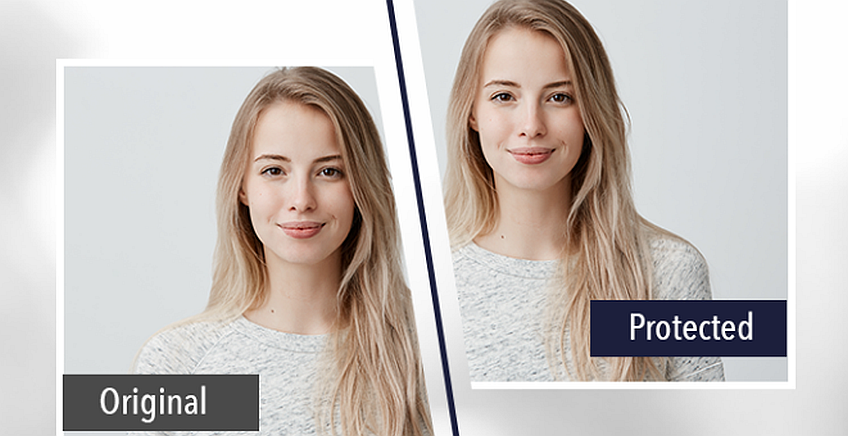
Photo above: Illustration to demonstrate Protected image vs Unprotected image
The surprising start-up company from Tel Aviv, D-ID, has officially announced its initial product at TechCrunch Disrupt San Francisco 2018 this week . The company has developed a solution that protects photos and videos of organizations from face recognition, while keeping them similar to the human eye. The company serves organizations that store photos and videos of employees, customers or citizens, amog them cloud storage providers, social networks, financial institutions, health management organizations and governments that want to protect their biometric databases.
The name D-ID originated from the professional term de-identification. D-ID’s first customer is Cloudinary, an image and video management solution which helps more than 350K companies manage, optimize and deliver more than 22B media assets. The company has also signed significant agreements with customers in the financial services and automotive industry.
“Our photos contain biometric data. Using them with face recognition, anyone can track you, hack your devices and steal your identity. That’s why our photos must be protected,” says Gil Perry, CEO and Co-Founder of D-ID. “We’ve moved too fast with face recognition and it is now a threat to our fundamental human right to privacy.” The face recognition market is growing exponentially. It’s increasingly used all around the world: To analyze shopping behavior, to authenticate payments, to access smartphones and even to rank citizens’ or track people in protests.
Faces are “sensitive information”
The company’s approach to digitally manipulating images renders images unreadable by the machine learning tools that are used to identify an individual, but are imperceptible to the human eye. “We use advanced image processing and deep learning to process the photo or video in such a way that it will look similar to the human eye but machines, AI, face recognition classifiers will not be able to recognize the individual,” says Perry. He also mentioned that the solution is constantly inspected by a special “red team” that launch attacks in order to break the protection and reveal weaknesses in its defense.
The issue of image protection draws a public interest. Data privacy regulations like the European Union’s General Data Protection Regulation (GDPR), which became enforceable in May 2018, address face images as “personal sensitive information” and require companies to protects this data or risk heavy fines and lawsuits. “People are aware and concerned about the security risks of face recognition. Now is the time to protect this data and we are here to make sure it happens,” said Perry.
D-ID was founded in 2017 by CEO Gil Perry, COO Sella Blondheim and CTO Elira Kuta. The founders served in the Israeli Special Forces and intelligence unit 8200. They experienced first-hand the risks to privacy when, due to the sensitive nature of their roles, they were not allowed to share photos on social media. The company received Gartner’s Cool Vendor 2018 recognition. D-ID has raised $4mm led by Pitango Venture Capital with participation from Y Combinator, Maverick Ventures, Foundation Capital and Fenox Venture Capital.
We use cookies to personalize content and ads, to provide social media features and to analyze our traffic. We also share anonymous information about your use of our site with our social media, advertising and analytics partners. View more
What personal data we collect and why we collect it
We collect anonymous data on visitors in this website for business purposes such as enhancing user experience, digital marketing and search engine optimization.
We collect personal data such as email address and names on various forms - all forms present in this website include consent checkboxes and clear reason for collecting the data: general inquiries on our products, newsletter subscription, professional inquiries job applications. All forms are designed in accordance with GDPR requirements.
Comments
When visitors leave comments on the site we collect the data shown in the comments form, and also the visitor’s IP address and browser user agent string to help spam detection.
An anonymized string created from your email address (also called a hash) may be provided to the Gravatar service to see if you are using it. The Gravatar service privacy policy is available here: https://automattic.com/privacy/. After approval of your comment, your profile picture is visible to the public in the context of your comment.
Media
If you upload images to the website, you should avoid uploading images with embedded location data (EXIF GPS) included. Visitors to the website can download and extract any location data from images on the website.
Contact forms and newsletter
We use Gravity Forms as our platform of choice for all forms present in this website. Forms present in this website have been modified to fit GDPR requirements.
Unless specifically specified and approved by visitor, we do not use the collected data for marketing purposes.
We use Mailchimp to collect email addresses and send periodical marketing materials to our customers.
Handling and management of all email addresses and mailing operations is conducted under GDPR terms and guidelines provided by Mailchimp.
All subscribers are able to change their subscriptions preferences or unsubscribe at any given time.
Techtime has accepted the Data Processing Addendum agreement provided by Mailchimp for all its Mailchimp accounts.
All our lead collection forms have been altered in accordance with GDPR requirements and now include unchecked checkboxes in order to accept the explicit consent of the user prior to form submission.
Cookies
If you leave a comment on our site you may opt-in to saving your name, email address and website in cookies. These are for your convenience so that you do not have to fill in your details again when you leave another comment. These cookies will last for one year.
If you have an account and you log in to this site, we will set a temporary cookie to determine if your browser accepts cookies. This cookie contains no personal data and is discarded when you close your browser.
When you log in, we will also set up several cookies to save your login information and your screen display choices. Login cookies last for two days, and screen options cookies last for a year. If you select "Remember Me", your login will persist for two weeks. If you log out of your account, the login cookies will be removed.
If you edit or publish an article, an additional cookie will be saved in your browser. This cookie includes no personal data and simply indicates the post ID of the article you just edited. It expires after 1 day.
Embedded content from other websites
Articles on this site may include embedded content (e.g. videos, images, articles, etc.). Embedded content from other websites behaves in the exact same way as if the visitor has visited the other website.
These websites may collect data about you, use cookies, embed additional third-party tracking, and monitor your interaction with that embedded content, including tracing your interaction with the embedded content if you have an account and are logged in to that website.
Analytics
We use Google Analytics regularly for monitoring user behavior and traffic sources and utilize the gathered information for enhancing user experience and for business purposes.
The use of Google Analytics in done according to GDPR terms and guidelines provided by Google.
Legal Entity: Techtime.
Primary Contact (a.k.a. "Notification Email Address"): roni@techtime.co.il - this email is designated for receiving notices under the Google Ads Data Processing Terms.
Who we share your data with
We use various cloud platforms and third party providers for the purpose of operating this website.
We do not share or sell your data for any commercial purpose other than specified above.
We use the following processors for the operating this website and executing related digital marketing campaigns:
WP Engine - Hosting Provider
Cloudflare - Cloud based security and web performance processor.
Google Cloud Platform - data centers provider for WP Engine
Sucuri - Website security provider
Mailchimp - Newsletter service provider
Google Analytics, Adwords, Webmasters
Facebook - We use Facebook for advertising and place tracking code on our website for enhancing digital marketing campaigns (i.e - Facebook Pixel).
Planwize Ltd - Digital Marketing Agency.
How long we retain your data
If you leave a comment, the comment and its metadata are retained indefinitely. This is so we can recognize and approve any follow-up comments automatically instead of holding them in a moderation queue.
For users that register on our website (if any), we also store the personal information they provide in their user profile. All users can see, edit, or delete their personal information at any time (except they cannot change their username). Website administrators can also see and edit that information.
What rights you have over your data
If you have an account on this site, or have left comments, you can request to receive an exported file of the personal data we hold about you, including any data you have provided to us. You can also request that we anonymize or erase any personal data we hold about you. This does not include any data we are obliged to keep for administrative, legal, or security purposes.
Request for Receiving Data Associated with One’s Email Address
Users may request to receive access to all related information submitted to this website for their review.
In accordance with GDPR compliance, user may further request the anonymization of such data.
In order to request access for all data associated with a given email address, users may submit the request here. Users then receive an email with a link to a page with all related information.
The link is valid for 24 hours. Users may submit additional request for the same email address once in every 24 hours.
A request for anonymization should be sent separately: User may select the data he or she wishes the site owner to anonymize so it cannot be linked to his or her email address any longer. An email confirmation will be sent once linked data has been successfully anonymized.
Where we send your data
Visitor comments may be checked through an automated spam detection service. All our processors and third party providers comply with GDPR requirements and apply privacy by design and necessary measure to ensure that personal data is being processed and handled in accordance with requirements. The list of our third party service providers and processors is listed above.
Contact information
For all privacy-specific concerns inquiries, you may contact us at mail@mail.com
How we protect your data
We use rigorous practices in order to protect our website and data collected, as well as world class cloud and hosting providers.
Communication between visitor and the server is encrypted using SSL.
The site is protected with web application firewall and is undergoing daily security scans, regular software updates by a dedicated team in order to minimize the risk of data breach.
What data breach procedures we have in place
Once a data breach is detected, our providers execute a dedicated standard operational procedure in order to assess the scope and potential damage, provide immediate remedy, patch any potential security holes and notify users who may be affected by the breach.
We may contact affected users with one or more form of communication within 72 hours and provide the needed information as to the scope of the data breach and actions taken.
What third parties we receive data from
We do not receive data from third parties for our marketing campaigns.
What automated decision making and/or profiling we do with user data
We may apply remarketing/retargeting methods while conducting online advertising using Google Facebook and the likes.
The above is conducted by applying various tracking codes into our website in order to track and retarget users based on
By visiting and using this website you are hereby provide your consent for the use of the above means and methods.