
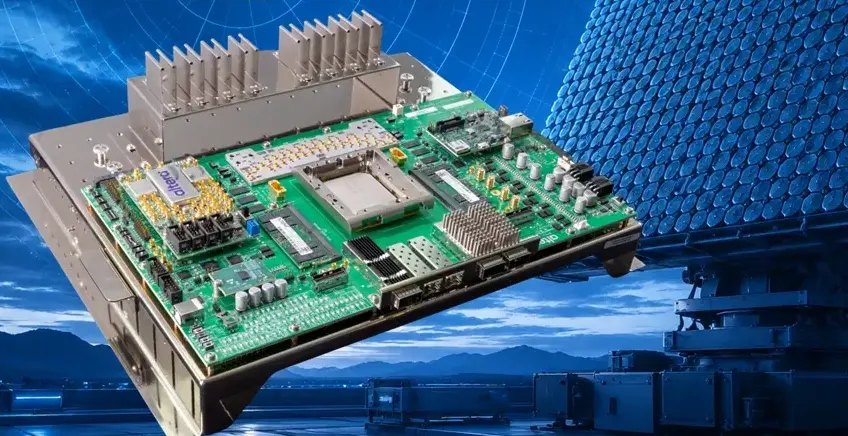
[Photo caption: Altera’s new Agilex 9 Direct RF-Series FPGA family targets high-performance communications, aerospace, defense and advanced AI infrastructure]
By Yohai Schwiger
Programmable chipmaker Altera is growing at an annual rate of about 20%, while its operating income has more than doubled following several years of declining revenue and market share losses. The figures were disclosed by CEO Raghib Hussain in an interview with Reuters.
According to Hussain, the company grew by more than 20% last year and expects revenue to increase by approximately 25% this year. As a privately held company, however, Altera no longer publishes detailed financial results.
Hussain attributed part of the turnaround to bringing engineering teams closer to customers. “I believe in engineer-to-engineer conversations,” he said, adding that the company has reorganized its engineering organization to increase direct customer engagement and is already seeing stronger collaboration.
Over the past year, Altera also produced working prototypes for six new chips while reducing the number of service agreements inherited from Intel from 125 to just 15, underscoring the speed of its transition back into an independent company.
The improvement follows a difficult period. Altera’s revenue declined from approximately $2.9 billion in 2023 to about $1.5 billion in 2024. Reuters attributed the downturn to customers shifting spending toward AI GPUs, market share losses to rival Xilinx—now part of AMD—and an extended inventory correction across the FPGA industry following the semiconductor shortages of previous years.
Today, however, Altera argues that the AI revolution that initially hurt its business could become its next major growth engine.
Reinventing Itself—Twice
Founded in Silicon Valley in 1983, Altera became one of the pioneers of the FPGA industry after introducing programmable logic devices that could be erased and reprogrammed. For decades, it competed with Xilinx across communications, industrial automation, aerospace, defense and data center markets.
Intel acquired Altera in 2015 for $16.7 billion, hoping to combine Xeon processors with FPGA accelerators to improve data center performance and workload acceleration. However, the rapid rise of GPUs as the dominant platform for AI computing, together with Intel’s broader technological and business challenges, prevented that vision from fully materializing.
In October 2023, Intel announced plans to separate its programmable logic business. The company restored the Altera brand in early 2024 and relaunched it as an independent business. In September 2025, investment firm Silver Lake acquired a 51% stake in Altera for $4.46 billion, valuing the company at $8.75 billion. Intel retained the remaining 49%, while Altera began preparing for a potential future IPO.
The company also maintains a major R&D center in Jerusalem, Israel, where engineers develop FPGA hardware and software technologies for communications, AI and data center applications.
Not Replacing GPUs—Working Alongside Them
Hussain argues that FPGAs should no longer be viewed as competitors to GPUs for AI training or large-scale inference. Instead, they add value in the surrounding infrastructure—handling connectivity, data preprocessing, protocol conversion, scheduling and sensor fusion. “If the GPU is the brain, the FPGA is the nervous system,” Hussain said.
That distinction is becoming increasingly relevant in robotics and physical AI applications. While GPUs excel at massively parallel computation, FPGAs offer deterministic, ultra-low-latency processing and can be reconfigured even after deployment.
Modern robots must simultaneously process information from cameras, radar, LiDAR, motion sensors and control systems before forwarding synchronized data to AI processors in real time. FPGAs can perform these tasks efficiently while remaining flexible enough to accommodate new sensors, interfaces or system architectures without requiring new silicon.
From Data Centers to the Edge
Altera continues to target AI infrastructure as well. An expanded partnership with Arm is designed to integrate FPGAs alongside Arm-based processors in AI systems, where programmable logic can accelerate networking, SmartNIC functionality, specialized data processing and communication between processors and AI accelerators.
At the same time, the company’s commercial focus is shifting increasingly toward edge AI applications—including robotics, autonomous systems, industrial automation and other real-time environments where deterministic performance is essential.
The recovery may extend beyond Altera. AMD’s Embedded segment, which includes the former Xilinx business, reported 6% year-over-year growth in the first quarter of 2026 after a prolonged downturn.
While the numbers do not yet confirm a broad FPGA market recovery, they suggest demand is stabilizing.
The more important question, however, is not whether FPGAs are returning to the role once envisioned for them as alternatives to AI accelerators. They probably are not.
If the FPGA market is indeed entering a new growth cycle, it is doing so in a different role—not as the primary compute engine, but as the flexible hardware layer that connects sensors, networks, processors and AI accelerators. As AI increasingly moves beyond data centers into robots, industrial machines, vehicles and autonomous systems, the ability to reconfigure hardware after deployment may once again become one of the FPGA’s most valuable strategic advantages.