

photo above: ION FLUX founders Ofer Zohar (right) and Omer Hiram. photograph credit: Techtime
Haifa-based ION FLUX has developed a hydrogen generation technology that could transform the economics of using fuel cells for electricity generation. Fuel cells generate electrical energy through a chemical reaction between hydrogen and oxygen drawn from the atmosphere. This process produces water as the only byproduct (zero tailpipe emissions) while releasing electrons that generate an electrical curent. Although this technology has been known for decades, its adoption has remained limited because of the challenge of supplying hydrogen to fuel cells.
Today, hydrogen is typically produced at large centralized facilities and then transported to end users under high pressure. However, hydrogen is highly flammable, making transportation both hazardous and costly. ION FLUX’s technology, inspired by research conducted by Professor Alon Gany at the Technion – Israel Institute of Technology, is designed to overcome precisely this challenge. It produces hydrogen on demand using specially treated particles of recycled aluminum, a low-cost material that is safe to transport.
The particles undergo pre-treatment process before being sealed inside sealed pods which are inserted into the power generation unit. The hydrogen is generated on-site and fed directly into the fuel cell—much like inserting a capsule into a household coffee machine.
The company was founded in 2024 by Professor Ofer Zohar, whose background is in neuroscience at Johns Hopkins University, and by chemical engineer and hydrogen expert Omer Hiram, who conceived the original idea.

The two first met just days after the October 7, 2023 Hamas attack. At the time, Hiram had established a neighborhood watch in Haifa’s Old Carmel neighborhood to help local residents cope with growing security concerns. Zohar joined the volunteer patrol, and the two got to know each other while serving together on neighborhood watch shifts.
Omer recalls: “I told him about the difficulties I had experienced transporting hydrogen to customer sites across Israel, and that we needed a completely different approach. Instead of transporting hydrogen, we should generate it at the point of use. Hydrogen is so volatile that, nearly a century after the Hindenburg disaster, it continues to suffer from a public perception problem.”
Those conversations gradually evolved into a business plan, and the two founded ION FLUX, developing new directions based on the technology originally demonstrated by Professor Gany.
Professor Ofer Zohar explains: “Aluminum is one of the most abundant metals on Earth, and it is easy to process and manufacture. It is generally regarded as a corrosion-resistant metal because it oxidizes almost instantly, forming an extremely thin surface layer. As a result, the aluminum becomes coated within seconds with a protective oxide layer that prevents further corrosion, making it appear as though it does not rust.”
A New Solution to an Old Idea
“Every water molecule contains two hydrogen atoms and one oxygen atom. More than a century ago, scientists proposed that aluminum’s strong tendency to oxidize could be used to strip oxygen atoms from water molecules, thereby releasing hydrogen. The challenge was finding a way to penetrate the protective oxide layer covering the aluminum surface.
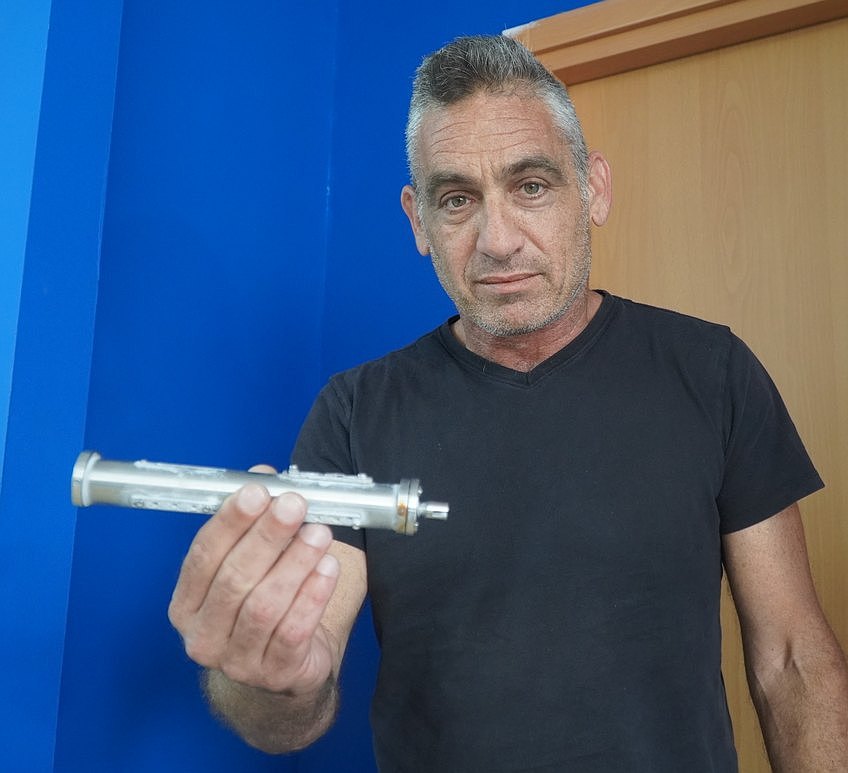
“Professor Gany demonstrated that coating aluminum with lithium hydride (LiH) weakens this protective layer, enabling the aluminum to react with water and extract hydrogen from water. The product we have developed consists of two complementary components: a proprietary aluminum fuel, branded ALF, and a hydrogen generator marketed under the name HyGen, which produces hydrogen on demand.”
The company’s ALF fuel consists of consists of aluminum particles coated with lithium hydride sealed inside closed pods. The material is solid and stable, making it easy to store, transport, and handle safely. These pods are inserted into the HyGen generator, where the particles are mixed with water to produce hydrogen gas, which is supplied directly to virtually any type of fuel cell. After hydrogen generation, the aluminum is converted into alumina (aluminum oxide), which can be recycled into new aluminum products.
Israel’s Directorate of Defense R&D Places Initial Order
The company’s concept has attracted considerable interest. ION FLUX raised its seed funding through the Road-2 incubator, a joint initiative of the Haifa Municipality and NVIDIA. It also secured funding from CreationsVC through the Creation-Space program and received its first product order from Israel’s Directorate of Defense Research & Development (DDR&D, MAFAT) for a field battery charging system.
Omer Hiram explains: “Our target market includes virtually every off-grid application: remote infrastructure, power tools, electric vehicles, backup power systems. and many others. The technology is fully scalable, making it suitable for both low-power and high-power applications. Recently, we demonstrated a small RC vehicle powered by our hydrogen generator. Within about two years, we expect to deliver a 5-kW generator capable of powering a forklift, charging an electric vehicle, or providing backup electricity for an average home.”
Professor Ofer Zohar adds: “We have developed a closed-loop (fully circular) energy process. The process produces no hazardous emissions. It is producing only water as a byproduct (resulting in zero tailpipe emissions). We believe our solution can unlock the hydrogen economy, which has long been constrainedremained by the fundamental challenge – and safety concerns – associated with transporting hydrogen in its conventional form.”