From Drones to Command: XTEND Software Integrates into Lockheed Martin’s U.S. Military C2 Stack

Lockheed Martin has announced a collaboration between its advanced development arm, Skunk Works, and Israeli drone manufacturer XTEND, aimed at integrating XTEND’s XOS operating system into Skunk Works’ MDCX command-and-control platform. As part of the partnership, the two companies conducted an operational pilot in which a large drone carried a smaller drone into the operational area, deployed it for a tactical mission, and enabled seamless control of both platforms through a single system operated by one user. The demonstration underscores a fundamental shift in how modern militaries design and operate unmanned systems on the battlefield.

To understand the significance of the move, it must be viewed in the broader context of the Pentagon’s evolving command-and-control doctrine. In recent years, the U.S. Department of Defense has been advancing the JADC2 concept—short for Joint All-Domain Command and Control—designed to connect all branches of the military, across all domains, into a single, continuous command network. The core idea is that every sensor, of any type, can contribute to a shared operational picture, enabling rapid decision-making and coordinated action even in contested environments marked by jamming and electronic warfare.

Skunk Works plays a central role in translating such concepts into operational systems. As Lockheed Martin’s advanced innovation and development division, it operates as a semi-autonomous unit and has been responsible for breakthrough defense technologies for decades. In recent years, Skunk Works has expanded its focus beyond platforms and airframes toward software, artificial intelligence, and command-and-control layers that connect multiple systems into a single coordinated force.

XTEND as a Tactical Control Layer: Linking Large and Small Drones

Skunk Works’ MDCX platform is designed as a multi-domain command-and-control layer that integrates sensors, manned and unmanned platforms, and diverse data sources into a single interface. MC-MDCX—the configuration into which XTEND’s operating system was integrated—is specifically intended to manage platforms from different categories, such as a large drone and a small tactical drone, within a single mission flow, without requiring control to be handed off between operators.

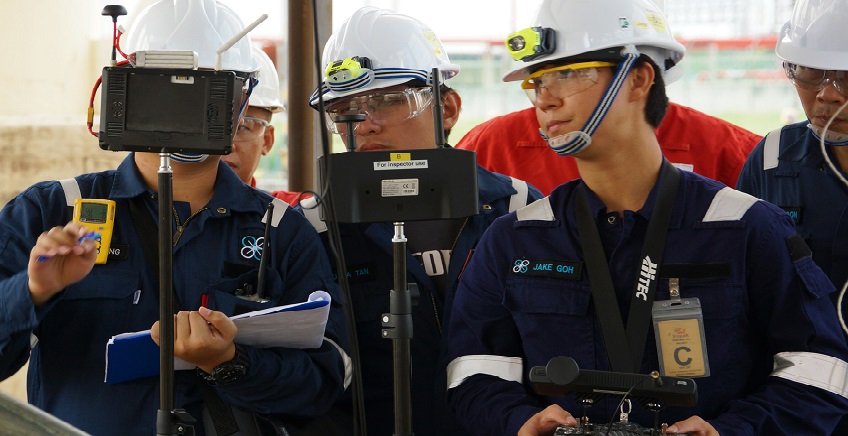
This is where XTEND comes in. While the company is best known as a manufacturer of tactical drones, its core technology lies not in the airframe itself but in the operating system developed to control it. XTEND’s XOS is designed to enable intuitive and precise control of tactical drones in complex operational environments, while reducing operator cognitive load and shortening training time. Accordingly, the collaboration with Lockheed Martin is primarily focused on software rather than on a specific drone platform, and on how this tactical control layer integrates into broader command-and-control architectures.

XTEND’s XOS is integrated within Skunk Works’ MDCX command-and-control platform, which serves as the top-level control layer in Lockheed Martin’s multi-domain C2 experiments. Within this framework, XOS functions as the operating layer for the small tactical drone, creating a continuous interface between the operation of the larger aerial platform and the deployment of the smaller drone. The integration allows a single operator to manage transitions between platforms within the same mission context, without switching between separate systems or losing operational awareness—reducing cognitive burden and minimizing real-time points of failure.

The operational need to combine large and small drones has become increasingly evident in recent years. Small drones are inexpensive, precise, and difficult to detect, but limited in range and endurance. Larger drones can travel long distances, loiter for extended periods, and serve as carrier platforms, but are more expensive and more conspicuous. Combining the two enables deep penetration and the deployment of low-cost, precise effectors at the right place and time—provided the command-and-control system can support such integration.

Another Layer in a Deepening Relationship with the U.S. Military

While Skunk Works remains an innovation laboratory rather than a full-scale acquisition program, a successful maturation of the concept could eventually see XTEND’s control system embedded at the heart of U.S. military command-and-control architectures. In this context, the collaboration with Lockheed Martin represents another step in XTEND’s deepening ties with the U.S. military, which already makes extensive use of the company’s solutions. XTEND supplies the U.S. Army with thousands of drones, operates a manufacturing facility in the United States, and is developing advanced capabilities for the simultaneous control of multiple drones, in line with the military’s transition toward autonomous and multi-platform formations.

The fact that Lockheed Martin—one of the Pentagon’s most significant defense contractors—is integrating XTEND’s software layer into an advanced command-and-control platform points to a deeper level of integration between the company’s Israeli-developed technology and the U.S. operational ecosystem, as well as alignment with the emerging drone strategy of the U.S. Army.

Xtend to Develop AI-Enabled One-Way Attack Drone Swarm for the U.S. DoW

Israeli drone maker Xtend has secured a multi-million-dollar contract from the U.S. Department of War (DoW) to develop and supply One-Way Attack (OWA) drones — single-use loitering munitions designed to strike a target and detonate on impact. The new system will be the first operational solution of its kind globally that enables a single operator to command and deploy a coordinated swarm of disposable attack drones. Production will take place at Xtend’s Tampa, Florida facility, inaugurated only a few months ago and now serving as the company’s main U.S. manufacturing hub.

Under the contract, Xtend will deliver the drones as a complete combat kit, including a command-and-control station, interchangeable payload and sensor modules, onboard safety systems, batteries, and field-ready accessories. The system is built around dual-comms resilience — a fiber-optic tether combined with hardened RF — ensuring precise, zero-latency control even in heavy electronic-warfare conditions. This architecture is designed to preserve continuity of mission and maintain control despite jamming attempts or signal degradation.

Because the drones carry explosive payloads, Xtend places strong emphasis on safety mechanisms, particularly the Electronic Safe-and-Arm Device (ESAD). This unit ensures the warhead cannot arm or ignite until all authorized conditions are met — a certified firing command, sensor verification, and proper flight parameters. The U.S. configuration incorporates a High-Voltage ESAD, an electronic ignition system designed to prevent accidental detonation caused by low-voltage electrical noise, adding another layer of controlled, deliberate activation.

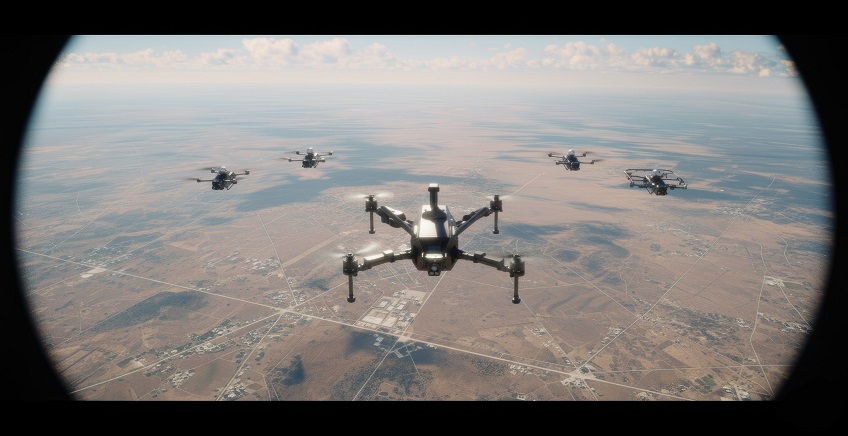
Despite being single-use munitions, the new platform will support coordinated swarm operation: multiple drones flown and managed simultaneously by one operator. This represents a major innovation in the OWA domain, enabling complex battle formations such as saturating enemy defenses, distributing tasks across multiple drones, and striking several targets at once. In this concept, the operational advantage comes not from any individual drone, but from the swarm acting as an integrated unit.

“This is the world’s first operational system that enables a single operator to remotely command and deploy swarms of AI-enabled tactical drones,” said Xtend Co-Founder and CEO Aviv Shapira. “After years of real-world combat deployments across five war zones, this is not a prototype or experiment — it’s a battle-proven system, built on lessons learned, that provides warfighters with reach and an unmatched tactical overmatch.”

The award comes as the U.S. military undertakes its most ambitious drone-procurement initiative to date. As recently reported by Reuters, the United States plans to acquire one million drones over the next two to three years, a dramatic increase from its current annual procurement rate of roughly 50,000. The shift reflects deep lessons from the Russia-Ukraine war and the central role drones now play in modern combat.

Within this broader transformation, the new program positions Xtend among a small group of companies worldwide developing AI-driven OWA systems with true operational swarm capability.

Xtend Inaugurates Drone Manufacturing Facility in the U.S.

Xtend, a Tel Aviv-based drone company, inaugurated a new production facility this week in Tampa, Florida. The plant spans 8,000 square meters and is located near MacDill Air Force Base, home to the headquarters of U.S. Special Operations Command (SOCOM), one of Xtend’s primary clients. The new facility has the capacity to produce several thousand drones per year across all of the company’s models and is expected to employ several dozen workers. Xtend also has the option to double the plant’s size in the future.

Production at the site is already underway, fulfilling an order placed in 2023 by the U.S. Department of Defense for hundreds of drones manufactured by Xtend. CEO Aviv Shapira told Tampa Bay’s Channel 13 that the proximity to SOCOM is no coincidence, noting that “SOCOM was our first client, and it remains the company’s largest customer since day one.”

The facility will serve as Xtend’s main manufacturing hub, supporting growing demand not only from U.S. defense agencies but also from NATO member states. “This will be a production arm capable of fulfilling orders worldwide,” said co-founder Rubi Liani in a statement to Techtime. Initially, the factory will focus on producing drones already ordered by the U.S. Department of Defense. Later on, it will expand to manufacture key components such as communication modules, motors, and controllers, which will be supplied to other drone manufacturers operating in the U.S.

During the inauguration ceremony, company representatives highlighted the plant’s importance for U.S. national security, aligning with the federal government’s current strategy to strengthen domestic supply chains. “We are not just building drones—we are building capabilities, resilience, and trust. This is a major milestone for Xtend in the United States,” said Shapira. The company also emphasized the strong support it received from local authorities in establishing the facility.

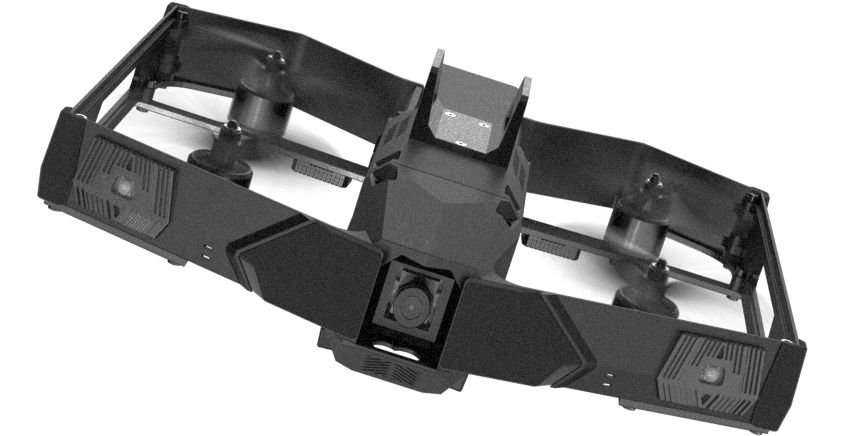
Xtend’s portfolio includes three drone models, all of which have been ordered by the U.S. Department of Defense. The Wolverine is a tactical multi-mission drone equipped with advanced surveillance and maneuvering capabilities, as well as a robotic arm that can lift and remove suspicious objects without destabilizing the drone. The Griffone is a lightweight interceptor drone, weighing just one kilogram, designed to neutralize small- to medium-sized drones. It can hover up to five kilometers away, reach speeds of 130 kilometers per hour, and intercept targets using a ramming arm. It is also compatible with external command and control systems.

The third model, Xtender, is a micro-tactical drone designed for operations in complex urban environments. Its unique capability lies in entering buildings, gathering intelligence, and exiting the scene undetected. The combination of these three platforms enables a wide range of mission profiles to be executed seamlessly from end to end.

All three drones are operated remotely via Xtend’s proprietary operating system, which allows users to control the drones using simple hand gestures—even during complex maneuvering. For example, to instruct a drone to enter a specific window or remove an explosive device, the operator simply points at the location and issues the command. The user interface leverages gaming and virtual reality technologies, giving the operator the sensation of seeing through the “eyes” of the drone. Thanks to this intuitive system, even untrained users can learn to operate the drones after just a few hours or days of instruction.

[In the photo: from the inauguration ceremony. Source: Xtend]

Xtend to acquire Singapore-based Performance Rotors

Performance Rotors, founded in 2016, develops small, innovative aerial drone solutions designed for inspection missions. The company focuses on monitoring oil and gas infrastructure and the maritime inspection of containers and cargo ships. Together with thermal and visual sensors, the company’s flagship product, Raven, is equipped with ultrasonic depth detectors (UTG/UTM), providing high-resolution depth images. In addition, due to its small size – 12×16 in – the drone can fly in narrow spaces and is GPS-independent.

One of the strategic investors and also a client of Performance Rotors is the Dutch Royal Vopak, which specializes in storing and maintaining materials for the chemicals, shipping, gas, and oil industries. Although based in Singapore, an international maritime trade hub, Performance Rotor’s activity spans Asia, Europe, and the U.S, and its clients carry out projects in the oil, gas, infrastructure, and shipping markets. 

Xtend developed  operating system for drones operators, that enables anyone to efficiently operate the drone, even on complicated maneuvering missions, with short hours or days of training. In addition, the interface is based on gaming and VR technologies and gives the operator a sense of watching events through the eyes of the drone.

Thus, for instance, to command the drone to enter a building through a specific window or move out an explosive device, the operator is required to point the window in the building or mark towards the explosive device and order the operation. The IDF already uses this system and successfully intercepts thousands of incendiary balloons and kites in the Gaza Envelope. In addition, the company signed a contract last year for delivering more than 100 drones to the US Army, and it currently develops new solutions for the IDF and the US Ministry of Defense.

Xtend also owns a drone line branded Wolverine, mainly used for battlefield missions such as removing explosive loads, entering buildings, and leading troops. However, Xtend is primarily a software company, and its flagship product is the operating system.

[Picture above: by Xtend]

Xtend offers its drone operating system for civil customers

Israeli drone company Xtend has announced that its drone operating system, supplied until now to military customers, is now available for integration into civilian drones. This step marks the expansion of the company’s activity, which has focused on the military market and worked extensively with the US army and the IDF towards civil applications, such as inspection missions, homeland security, rescue, firefighting, and more.

It was reported to Techtime that the operating system has already been integrated into the drone of an American agtech company, an Israeli drone company, and ground robots of an American defense company. According to Xtend, the operating system intensifies the drone’s capabilities and simplifies its operation, and provides the drone’s manufacturer with a competitive advantage.

The uniqueness of the operating system, which was used until now for military drones, is in that it provides the ability for everyone to efficiently operate the drone, even on complicated maneuvering missions, with short hours or days of training. In addition, the interface is based on gaming and VR technologies and gives the operator a sense of watching events through the eyes of the drone.

Thus, for instance, to command the drone to enter a building through a specific window or move out an explosive device, the operator is required to point the window in the building or mark towards the explosive device and order the operation. The IDF already uses this system and successfully intercepts thousands of incendiary balloons and kites in the Gaza Envelope. In addition, the company signed a contract last year for delivering more than 100 drones to the US Army, and it currently develops new solutions for the IDF and the US Ministry of Defense. 

Drone’s apps store

One of the main civil fields targeted now by Xtend is the inspection field, such as aerial inspection of infrastructures and buildings. In a conversation with Techtime, CEO and co-founder Aviv Shapira explained that a human operator carries out most drone missions, and complete autonomy is a long way off.

“Autonomous drones perform only 10% of the inspection missions. Our solution was designed for any mission that requires a human being  to make decisions in real-time, such as in an engineering inspection of bridges for detecting fractures and corrosion. Missions of this kind require the drone to maneuver in very dense spaces; currently, no autonomous drone can accomplish this mission. In general, in unknown environments, when real-time decisions are required, our system provides the operator with the capability of effortlessly operating, on premise or from anywhere in the world, even five drones and robots parallelly”. 

Shapira: “Using our operating system, drones can be operated in complicated missions where the current interface is insufficient. In addition, drone manufacturers can develop designated applications, for example, for corrosion detection. It also makes it possible for them to enter new areas and offer their customers a variety of applications. It provides them with a competitive advantage”.

The drone as a Swiss knife

Xtend also owns a drone line branded Wolverine, mainly used for battlefield missions such as removing explosive loads, entering buildings, and leading troops. However, Xtend is primarily a software company, and its flagship product is the operating system.  

According to the company, a drone should serve as a “Swiss Army knife”, capable of performing various activities based on switching payload (sensors, robotic arm, etc.) or installing new apps. This concept extends the basic drone’s capabilities beyond the manufacturer’s original specifications. The company’s operating system makes it possible for drone manufacturers and for developers to develop designated applications to be installed on drones in the same way it is done on a smartphone. To achieve this, the company provides the developers with their proprietary SDK.  

Xtend Company, headquartered in Tel Aviv, was founded in 2018 by brothers Aviv and Matteo Shapira. The brothers are also co-founders of Replay Technologies, the developer of FreeD system, which allows viewers to see and experience real-life scenes through immersive camera views at sports events. In 2016 it was purchased by Intel and was the basis for the Intel Sports Group.