DELMIA CEO: “AI Is Bringing the Digital Twin to the Factory Floor”

[Photo: Guillaume Vendroux, DELMIA CEO]

Generative AI is beginning to seep into the worlds of manufacturing and industrial operations, bringing with it a level of accessibility and simplicity that was previously unimaginable. Just as AI models now allow anyone to generate a realistic video clip, image, or audio sequence within seconds, the same principles are starting to apply to one of the most complex layers of industry – the creation of virtual twins. What once demanded long engineering cycles, data modeling, manual simulations, and expertise across multiple systems is now becoming faster, cheaper, and increasingly available to manufacturers of all sizes.

At the center of this shift is DELMIA, the manufacturing and operations brand of Dassault Systèmes. The company is positioning generative AI as the engine enabling a new kind of virtual twin: modular, dynamic, built quickly from existing plant layouts or physical environments, and extended over time as production evolves. “We’re entering a moment where generative AI makes the virtual twin accessible to every factory, not just the giants,” says Guillaume Vendroux (גיום וונדרו), CEO of DELMIA. “What used to require teams of specialists can now be done simply, quickly, and at a much lower cost. It’s a real democratization of industrial innovation.”

Virtual twins did not start this way. Two decades ago, they were primarily used to represent a single engineered object – an engine, a gearbox, a wing assembly. Over time, as sensors, MES platforms, and simulation engines matured, the concept evolved into something far more dynamic. Today a digital twin is no longer just a model of a product but a behavioral model of an entire system: the production line, the flow of materials, the workforce, the supply chain, and the way all these elements respond to change in real time. “We moved from modeling objects to modeling entire operations,” says Vendroux. “It’s a profound shift in mindset.”

This shift is not a matter of technological fascination but of necessity. The manufacturing world is facing severe labor shortages, rapidly rising product complexity, and a supply chain landscape riddled with disruptions. Factories of every size are being forced to re-evaluate how they plan, execute, and adapt. “The complexity and speed of manufacturing today simply don’t allow us to work the way we used to,” says Vendroux. “The variety of products, the frequency of changeovers, and the constant supply chain pressure make traditional management almost impossible. A factory without a virtual twin is basically operating blind.”

The COVID-19 pandemic exposed this fragility with unprecedented clarity. Lockdowns, logistical delays, energy price spikes, geopolitical tensions, and sudden shifts in demand turned supply chains volatile. For many factories the need to simulate scenarios, predict failures, and maintain continuity became existential. “COVID revealed the real vulnerability of global supply chains,” he explains. “Since then the ability to simulate, anticipate, and prepare has become fundamental.”

Traditionally, creating a virtual twin required gathering detailed engineering data, creating 3D models, manually connecting operational parameters, and running discrete simulations. Generative AI alters the process from the ground up. Modern systems can interpret images, videos, CAD files, or existing plant documentation and automatically build much of the required structure. “We start from an existing view of the shop floor,” Vendroux explains. “AI can recognize equipment, convert it into rich models, and begin running simulations within minutes. A few years ago that would have been science fiction.”

And the impact is anything but incremental. “We’re not talking about five percent improvement,” he says. “With generative AI we’re talking about fifty to eighty percent additional efficiency. These are magnitudes that fundamentally change a factory.”

DELMIA’s own history illustrates how the industry arrived at this point. The brand emerged in the late 1990s from Dassault Systèmes’ acquisition of Deneb Robotics, one of the early pioneers of virtual factory simulation. Initially focused on discrete manufacturing – aerospace, automotive, trucks, heavy machinery – DELMIA quickly grew to dominate these sectors. Over time it expanded into continuous manufacturing such as chemicals and metals, batch processing like cosmetics, and hybrid industries including batteries and advanced materials. Today the company serves around 2,500 customers and about 1.8 million users worldwide. Remarkably, more than one million of them are shop-floor workers. “That’s the strongest indication that these tools are not reserved for executives,” says Vendroux. “They reach the people doing the actual work.”

Credit: DELMIA

Labor shortages remain one of the industry’s most pressing challenges. Younger generations are less inclined to work on the shop floor, and manufacturers are struggling to maintain expertise as older workers retire. “If we don’t make the work more intelligent, there simply won’t be enough people to run our factories,” says Vendroux. “Workers today want to use their minds, not just their hands.” This is where AI-powered assistants come in. DELMIA is developing language-based companions capable of guiding operators, generating step-by-step instructions, analyzing issues, and providing safety or technical guidance through natural conversation. “An operator will be able to ask: ‘How do I carry out this specific weld?’ and receive complete instructions, safety guidelines, and a simulation within seconds.”

For small and midsize manufacturers the implications are transformative. Building a digital twin was once a privilege of giant corporations with vast engineering resources. Now DELMIA offers twin-building automation as well as Twin-as-a-Service for factories that lack the time or expertise to build one themselves. “You bring us the problem, and we bring you the twin,” Vendroux says. “We simulate, run scenarios, and give you the insights. It’s fast and accessible.”

The most significant innovation is the unification of three layers of virtual twins: the product twin, the process twin, and the supply chain twin. Only when these layers interact coherently can a factory achieve true operational stability. “We connect all of it,” he explains. “When the product, the production system, and the supply chain all speak the same language, the factory can finally breathe.”

Looking ahead, DELMIA envisions a future in which factories are defined largely through natural language: an engineer describes a desired line, and the system builds, validates, and optimizes it automatically. “Generative AI will allow entire production lines to be created from textual descriptions,” Vendroux says. “The role of humans will shift from model-building to decision-making. It will change everything we know about manufacturing.”

The fusion of AI, simulation, and industrial operations marks the beginning of a new era. What happened to video creation and image generation is now happening to manufacturing itself. The world of production is moving into a phase where every factory can have a virtual replica, every operator can access knowledge instantly, and every process can be optimized continuously. For DELMIA and for the manufacturers adopting these tools, the implications are enormous: more flexibility, greater resilience, and a path toward an industrial ecosystem that is finally as intelligent as the products it creates.
 

NVIDIA’s Driving Model Poses a Challenge to Mobileye

By Yohai Schweiger

While NVIDIA’s Rubin platform for next-generation AI infrastructure captured most of the attention at CES 2026 in Las Vegas last week, the company quietly unveiled another move with potentially far-reaching strategic implications for the automotive industry: the launch of Alpamayo, an open foundation model for autonomous driving designed to serve as the planning and decision-making layer in future driving systems.

The announcement is expected to influence not only how autonomous driving systems are developed, but also the balance of power among technology suppliers in the automotive value chain — with particular implications for Israeli auto-tech companies.

Most Israeli players, including sensor makers Innoviz and Arbe, as well as simulation and validation specialists Cognata and Foretellix, do not provide full vehicle systems but rather core components within the broader stack. For them, NVIDIA’s move could prove supportive. By contrast, the availability of an open and flexible planning model that allows automakers to assemble software-hardware stacks around a unified computing platform poses a strategic challenge to Mobileye, which has built its market position around a vertically integrated, end-to-end solution and full system responsibility.

NVIDIA DRIVE: An AI-First Ecosystem for Automotive

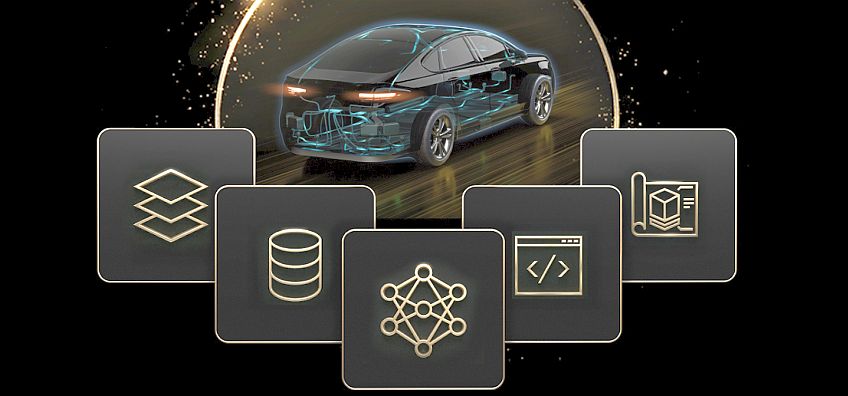
Alpamayo now joins the broader set of solutions NVIDIA groups under its NVIDIA DRIVE platform — a comprehensive ecosystem for developing intelligent vehicle systems. DRIVE includes dedicated automotive processors such as Orin and Thor, an automotive operating system, sensor data processing and fusion tools, simulation platforms based on Omniverse and DRIVE Sim, and cloud infrastructure for training and managing AI models. In other words, it is a full-stack platform designed to support automakers from development and validation through real-time deployment on the vehicle itself.

This aligns with NVIDIA’s broader push toward an AI-first vehicle stack — shifting away from systems built primarily around hand-crafted rules and task-specific algorithms toward architectures where large AI models become central components, even in layers traditionally handled by “classical” algorithms, such as decision-making.

In this context, Alpamayo plays a strategic role. For the first time, NVIDIA is offering its own foundation model for planning and decision-making, effectively re-centering the DRIVE platform around an end-to-end AI-driven architecture — from cloud training to execution on the in-vehicle computer.

The Vehicle’s Tactical Brain

Alpamayo is a large multimodal Vision-Language-Action (VLA) model that ingests data from multiple video cameras, LiDAR and radar sensors, as well as vehicle state information, and converts it into an internal representation that enables reasoning and action planning. Based on this, the model generates a future driving trajectory several seconds ahead. It does not directly control actuators such as steering or braking, but it determines the vehicle’s tactical behavior.

Unlike general-purpose language models, Alpamayo operates in a physical environment and combines perception with spatial and contextual reasoning. Its inputs include video sequences, motion data, and in some cases maps and navigation goals. The model performs scene understanding, risk assessment, and path planning as part of a single decision chain. Its primary output is a continuous trajectory passed to the vehicle’s classical control layer, which handles physical actuation and safety constraints.

Training such a model relies on a combination of real-world data and massive amounts of synthetic data generated using NVIDIA’s simulation platforms, Omniverse and DRIVE Sim.

The model is released as open source, including weights and training code, allowing automakers and Tier-1 suppliers to retrain it on their own data, adapt it to their system architectures, and integrate it into existing stacks — not as a closed product, but as a foundation for internal development. NVIDIA has also announced partnerships with industry players including Lucid Motors, Jaguar Land Rover (JLR), Uber, and research collaborations such as Berkeley DeepDrive to explore advanced autonomous driving technologies using Alpamayo.

Mobileye: A Challenge to the Full-Stack Model

An autonomous driving stack typically consists of several layers: sensors, perception, planning and decision-making, and control. Alpamayo sits squarely in the planning layer. It does not replace perception, nor does it replace safety-critical control systems — but it does replace, or at least challenge, the traditional algorithmic decision-making layer.

This enables a more modular system design: perception from one supplier, planning from NVIDIA’s model, and control from another Tier-1. This represents a conceptual shift away from closed, end-to-end “black box” solutions.

That is where the tension with Mobileye emerges. For years, Mobileye has offered a nearly complete stack — sensors, perception, mapping, planning, and proprietary EyeQ chips running the entire system with high energy efficiency. This model fits well with ADAS and L2+ systems, and even more advanced autonomous configurations.

However, foundation models for planning shift the balance. They require more flexible and powerful compute than dedicated ADAS chips typically provide, pushing architectures toward GPU-based computing.

While in some scenarios Mobileye perception components can be integrated into broader stacks, most of the company’s advanced autonomy solutions are offered as tightly integrated system units, which in practice limits the ability to swap out individual layers. Moreover, the very presence of an open planning model weakens the value proposition of proprietary planning software. Instead of developing or licensing dedicated planning algorithms, automakers can adapt an existing foundation model to their own data and operational requirements.

This is not an immediate threat to Mobileye’s core business, but over the longer term — as the market moves toward L3 and L4 autonomy and the decision layer becomes increasingly AI-driven — it represents a genuine strategic challenge to the closed, end-to-end model.

That said, Mobileye retains a significant structural advantage: it delivers a complete system and assumes full responsibility for safety and regulatory compliance. For many automakers, especially those without deep in-house AI and software capabilities, this is critical. They prefer a single supplier accountable for system performance rather than assembling and maintaining a complex “puzzle” of components from multiple vendors, with fragmented liability and higher regulatory risk.

Innoviz and Arbe: Sensors Gain Strategic Importance

For Israeli sensor suppliers such as Innoviz and Arbe, NVIDIA’s move could be distinctly positive. Advanced planning models benefit from rich, reliable, multi-sensor input. LiDAR provides precise three-dimensional geometry and depth, while advanced radar excels at detecting objects in poor lighting and adverse weather conditions.

This sensor data is essential for planning layers and decision-making models operating in dynamic physical environments. As a result, both companies are positioning themselves as part of NVIDIA’s ecosystem rather than alternatives to it. Both have demonstrated integration of their sensing and perception pipelines with NVIDIA’s DRIVE AGX Orin computing platform.

In a stack where decision-making becomes more computationally intensive and AI-driven, the value of high-quality sensing only increases. No matter how advanced the model, limited input inevitably leads to limited decisions.

Cognata and Foretellix: Who Verifies AI Safety?

Another layer gaining importance is simulation, verification and validation — where Israeli firms Cognata and Foretellix operate.

Cognata focuses on building synthetic worlds and complex driving scenarios for training and testing, while Foretellix provides verification and validation tools that measure scenario coverage, detect behavioral gaps, and generate quantitative safety metrics for regulators and safety engineers.

As AI models become central to driving stacks, the need for scenario-based safety validation grows, beyond simply accumulating road miles.

Both companies are aligned with NVIDIA’s simulation-centric development approach. Cognata integrates with DRIVE simulation and Hardware-in-the-Loop environments (where real vehicle hardware is connected to virtual scenarios) for large-scale testing, while Foretellix connects its validation tools to Omniverse and DRIVE to assess AI-based driving systems under diverse physical conditions.

Open Source, Semi-Closed Platform

Although Alpamayo is released as open source, it is deeply optimized for NVIDIA’s hardware platforms. Optimization for CUDA, TensorRT, and low-precision compute enables real-time execution on DRIVE computers, which are architecturally closer to GPUs than to traditional ADAS chips.

This fits into NVIDIA’s broader open-model strategy: the company releases open models for robotics, climate science, healthcare and automotive — but after deep optimization for its own computing platforms. The approach enables broad ecosystem adoption while preserving a performance advantage for those building on NVIDIA hardware.

In practice, this allows NVIDIA to expand AI into physical industries while shaping the computing infrastructure those industries will rely on.

A Threat to One Model, an Opportunity for Others

NVIDIA’s driving model does not herald an immediate transformation on public roads, but it does signal a deeper shift in how the automotive industry approaches autonomy: fewer hand-crafted rules, more general AI models, more in-vehicle compute, and heavier reliance on simulation and validation.

For much of the Israeli auto-tech sector — sensor providers, simulation vendors and validation specialists — this trajectory aligns well with existing products and strategies, and could accelerate adoption and partnerships within the DRIVE ecosystem. For Mobileye, by contrast, it signals the emergence of an alternative path to building the “driving brain” — one that does not necessarily rely on a closed, vertically integrated stack.

If autonomous driving once appeared destined to be dominated by a small number of players controlling entire systems, NVIDIA’s move points toward a more modular future — with different layers supplied by different vendors around a central AI platform. At least in the Israeli auto-tech landscape, many players appear well positioned for that scenario.

Lightricks Goes Open Source with LTX-2, Taking on Big Tech in AI Video

Photo above: Lightricks CEO and co-founder Dr. Zeev Farbman. Credit: Riki Rahman. Photo illustration

Lightricks announced at CES the full open-source release of its generative video-and-audio model, LTX-2, including model weights and training code. The move is unusual in a market where advanced video models are largely controlled by closed cloud platforms. Announced in partnership with NVIDIA, the launch positions Lightricks as an open alternative to approaches led by companies such as OpenAI and Google, and signals a potential shift in how generative video technology is deployed and adopted.

LTX-2 can generate synchronized video and audio at up to 4K resolution, with clip lengths of up to 20 seconds and high frame rates. The model is optimized to run locally on RTX-powered workstations as well as on enterprise DGX systems, and is positioned as production-ready rather than a research demo. Unlike closed platforms such as Sora or Veo, Lightricks allows developers and organizations not only to use the model, but also to retrain, customize and integrate it directly into products and internal workflows.

Full open-source availability

While open video models already exist, most suffer from significant limitations, including lack of audio, lower visual quality or poor suitability for commercial use. LTX-2 is the first to combine full open-source availability with capabilities designed for real-world production, positioning it as a bridge between open research and the operational needs of the media and creative industries.

Lightricks is an Israeli company best known for its popular creative and editing apps, including photo and video tools used by millions of users worldwide. In recent years, the company has been expanding beyond consumer applications into the development of AI models and creative infrastructure aimed at professional creators and enterprise customers.

Behind the decision to open-source the model lies a clear business strategy. Lightricks is giving up exclusive control over the core technology in order to establish it as a standard platform others can build on. Rather than monetizing usage of the model itself, the company is positioning LTX-2 as the foundation for commercial tools, platforms and paid services developed on top of it. The approach mirrors familiar open-source business models in which economic value is created around the code rather than within it.

NVIDIA is not involved in developing the model itself, but plays a central role in positioning LTX-2 as a natural workload for RTX hardware and DGX systems. The partnership reflects a broader vision in which advanced generative video can and should run outside the cloud, on local workstations and within enterprise environments.

The release of LTX-2 reflects a broader shift in the generative video market, from closed models optimized for demonstrations and limited cloud-based access, toward open infrastructure designed for deep adoption and large-scale product development. Rather than focusing on producing the most eye-catching demo, Lightricks is aiming to provide the foundation on which the next generation of video creation tools will be built.

Rubin Pushes the GPU Off Its Pedestal

Above: The full Rubin platform. Source: Nvidia

At CES 2026 in Las Vegas, Nvidia unveiled Rubin, a platform it describes as “the next generation of AI infrastructure.” Rubin’s existence, and the fact that it is scheduled to reach the market in the second half of 2026, were already known. What this announcement revealed for the first time, however, was the idea behind it: not another generation of GPUs, but a deep conceptual shift in how large-scale AI systems are built and operated. Instead of a massive GPU at the center supported by surrounding components, Nvidia presented a complete architecture that functions as a single system, tightly integrating compute, memory, networking and security.

The recurring message is that Rubin is not a chip but a full rack-scale computing system, designed for a world in which AI is no longer a one-off chatbot but a constellation of agents operating over time, maintaining context, sharing memory and reasoning within a changing environment. In that sense, Rubin marks Nvidia’s transition from selling raw compute power to selling what is effectively a cognitive infrastructure.

Codesign as a principle, not a slogan

Nvidia has used the term “full stack” for years, but in practice it usually meant a collection of components built around the GPU. With Rubin, the concept of codesign takes on a very different meaning. This is not about tighter integration of existing parts, but about designing every element of the system—CPU, GPU, networking, interconnect, storage and security—together from the outset, as a single unit built to serve entirely new types of workloads.

The practical implication of this approach is that the GPU is no longer the architectural starting point. It remains a powerful and central component, but it is no longer the system’s unquestioned master. Rubin is designed around the assumption that the next AI bottleneck is not raw compute, but context management, persistent memory and orchestration across processes and agents. These are not problems solved by a faster GPU alone, but by redistributing responsibilities across the system.

In Rubin, architectural decisions are driven not by what the GPU needs, but by what the system as a whole must accomplish. This is a turning point for Nvidia, as it effectively moves away from the GPU-first mindset that has defined the company since the early CUDA era, replacing it with a system-level view in which compute is only one layer of a broader architecture.

The role of the CPU, and what it means for the x86 world

One of the most intriguing components in Rubin is the new Vera CPU. Unlike traditional data center CPUs, whose main role has been to host and schedule GPU workloads, Vera is designed from the ground up as an integral part of the inference and reasoning pipeline. It is not a passive host, but an active processor responsible for coordinating agents, managing multi-stage workflows and executing logic that is poorly suited to GPUs.

In doing so, Nvidia signals a profound shift in how it views the CPU in the AI era. Where the CPU was once largely a bottleneck on the path to the GPU, it now reemerges as a meaningful compute element—one that operates in symbiosis with the GPU rather than beneath it. The choice of an Arm-based architecture, and the fact that the CPU was designed alongside the GPU and networking rather than as a standalone component, point to Nvidia’s ambition to control the orchestration and control layer, not just the compute layer.

More broadly, the decision to use Arm reflects the need for flexibility and deep control over CPU design. Unlike general-purpose processors built to handle a wide variety of workloads, Arm allows Nvidia to tailor a processor precisely to the needs of modern AI systems, stripping away logic that is irrelevant to inference and agent orchestration. The implication is that the classic data center model—built around general-purpose x86 CPUs as the default foundation—is no longer a given for systems designed as AI-first from the ground up.

Memory, storage and the birth of a context layer

Perhaps the most significant architectural shift in Rubin lies in how inference context memory is handled. Nvidia introduced a new approach to managing the context memory of large models, particularly the KV cache generated during multi-step inference. In classical architectures, designed for short and isolated workloads, this memory had to reside in GPU HBM to maintain performance, making it expensive, scarce and ill-suited for long-running, multi-agent systems.

Rubin breaks this assumption by moving a substantial portion of context memory out of the GPU and into a dedicated layer that behaves like memory rather than traditional storage. This is also where the role of BlueField-4—the DPU derived from Mellanox networking technology—changes fundamentally. It no longer serves merely as an infrastructure offload engine, but becomes an active participant in managing context memory and coordinating access to it as part of the inference pipeline itself.

This shift reflects the gap between architectures built for training or one-off inference, and the needs of agent-based systems that operate continuously, preserve state and share context across components. In Rubin, memory and context management become integral to the inference performance path, not an external I/O layer—an adjustment that aligns closely with how modern AI systems are expected to function.

Connectivity also takes on a new role in Rubin. NVLink continues to serve as the high-speed internal interconnect between GPUs, but the Ethernet layer—embodied by Spectrum-6 and Spectrum-X—assumes a very different function than in traditional data centers. Instead of merely moving data between servers, the network becomes part of how the system manages compute and memory.

In this architecture, connectivity allows GPUs, CPUs and DPUs to access shared context memory, exchange state and operate as if they were part of a single continuous system, even when distributed across multiple servers or racks. Technologies such as RDMA enable direct memory access over the network without CPU involvement, turning the network into an active participant in the inference flow rather than a passive transport layer.

As a result, data movement, context management and inter-component coordination no longer happen “around” computation—they become part of computation itself. This is a prerequisite for distributed AI systems and long-running agents, where memory and state are as critical as raw compute.

This brings us back to the central theme of Nvidia’s announcement: the shift from training as the center of gravity to continuous, multi-agent inference. Rubin is designed primarily for a world in which most AI costs and business value reside in deployment, not training. In such a world, what matters is not only how fast you can compute, but how effectively you can remember, share and respond.

Rubin is, ultimately, Nvidia’s attempt to redefine the rules of AI infrastructure. No longer a race for TFLOPS alone, but a competition over who controls the entire architecture. If the strategy succeeds, Nvidia will not merely be an accelerator vendor, but a provider of full cognitive infrastructure.

10 Israeli Companies to Watch at CES 2026

By: Yohai Schweiger

CES 2026 opens this week in Las Vegas, and once again the Israeli presence is defined less by the number of companies and more by the direction they represent. From LiDAR moving behind the vehicle windshield, through neuromorphic chips that push AI directly into sensors, to AI agents that require enterprise-grade governance layers, alongside robots, sensing systems and digital health solutions already operating in the field, a clear pattern emerges. For Israeli companies, CES is becoming less of a stage for flashy demos and more a showcase for technologies designed to integrate into real-world systems, with demands for reliability, safety and scalability. Artificial intelligence is no longer the headline act, but a component embedded inside products and operational processes. The following ten Israeli companies offer a clear snapshot of this shift, from technological promise to deployable solutions.

Innoviz: Change the location, change the game – LiDAR moves behind the windshield

Innoviz arrives at CES with the first public unveiling of InnovizThree, a LiDAR sensor that aims to change not only performance metrics but the very role of LiDAR within the vehicle sensing stack. The key innovation is not incremental gains in range or resolution, but the ability to install the sensor behind the front windshield, inside the passenger cabin. For automakers, this location is considered strategically critical, offering better protection, simpler installation and maintenance, and cleaner integration into vehicle architecture. The move goes to the heart of the long-running debate around LiDAR, positioning it not as a controversial external add-on, but as an integral sensor alongside cameras and radar. Beyond automotive use, Innoviz signals that InnovizThree is also targeting additional markets such as humanoid robots, drones and physical AI systems, where compact, reliable and energy-efficient 3D sensing is required. Unveiling the sensor at CES is no coincidence, as the show has become a central platform for automotive technology innovation and a key meeting point between technology suppliers and automakers seeking mature solutions for next-generation sensing and autonomous driving systems.

Carteav: Modest autonomy that works today

Carteav approaches autonomous driving from a very different angle than what is often presented at technology exhibitions. While CES frequently serves as a stage for prototypes and long-term visions, Carteav arrives with a clearly defined and deployable solution for low-speed autonomous mobility in controlled environments. At CES, the company will showcase its transportation platform built around small electric autonomous vehicles and smart fleet management, designed for campuses, resorts, parks and gated communities. Rather than tackling the full complexity of autonomous driving on public roads, Carteav focuses on environments where autonomy can be deployed today, with lower regulatory and safety barriers. This pragmatic approach places the company within a broader trend of applied autonomy, favoring functional, near-term solutions over impressive but distant demonstrations, and highlighting how AI and fleet management can already deliver tangible operational value.

POLYN Technology: Neuromorphic intelligence directly on the sensor

POLYN is making its first appearance at CES with its edge AI technology based on analog neuromorphic chips. Founded in 2019, the company is developing an approach that enables intelligent processing directly on the sensor, before data is sent to a central processor or the cloud. The technology targets applications where ultra-low power consumption and fast response times are critical, including medical devices, wearables, industrial robotics and large-scale IoT systems. POLYN’s innovation goes beyond pushing computation to the edge; it redefines the role of the sensor itself. Instead of acting as a passive data source, the company’s neuromorphic approach turns the sensor into an active computational component capable of filtering, recognition and early decision-making at the hardware level. Presenting this technology at CES, rather than at an academic conference, signals a transition toward commercial readiness, positioning POLYN as an alternative to power-hungry digital accelerator-based AI models at a time when the market is seeking more efficient and scalable solutions for physical AI.

Avon AI: Managing AI agents as an organizational challenge

Avon AI is a very young Israeli startup operating in one of the fastest-emerging areas of artificial intelligence: the management and deployment of AI agents within enterprises. At CES, the company will present a platform designed to govern, monitor and operationalize intelligent agents in organizational environments, at a moment when many enterprises are moving from experimenting with models and chatbots to deploying AI systems that perform actions, make decisions and interact with sensitive data. Rather than building another model or conversational interface, Avon AI focuses on the control layer: who operates the agent, which systems it can access, what it is allowed to do, and how unexpected behavior can be monitored and mitigated over time. The platform enables organizations to treat AI agents as digital employees, with transparency, measurement and continuous improvement, rather than experimental code owned solely by development teams. The company’s debut at CES aligns with the expectation that AI agents will be one of the show’s dominant themes, reflecting AI’s broader shift from demos to enterprise production environments, where reliability, governance and compliance become baseline requirements.

bananaz AI: Artificial intelligence for mechanical engineers

While Avon AI addresses AI agents at the enterprise level, bananaz AI focuses on a very different audience: mechanical engineers and product development teams. At CES, the company will unveil its Design Agent for the first time, an AI agent that integrates directly into engineering workflows, reads CAD files and technical drawings, and helps identify design issues, compliance risks and manufacturing challenges early in the development cycle. Unlike general-purpose AI tools, bananaz’s agent is built on deep domain knowledge of mechanical engineering and the relationships between geometry, materials, manufacturing constraints and safety requirements. Showcasing the solution at CES, a consumer-oriented event that has increasingly become a platform for the entire product development pipeline, underscores the link between engineering tools and the physical products that ultimately reach consumers. For bananaz, this marks its first global exposure; for the market, it illustrates how AI agents are moving into the core of industrial design and engineering, not just customer service, marketing or analytics.

iRomaScents: Digital experiences with a sense of smell

iRomaScents is an Israeli startup operating in a less conventional corner of technology and user experience. The company has developed a smart digital scent delivery system that adds an additional sensory layer to content and consumer experiences. At CES, iRomaScents will present an advanced version of its solution, having already appeared at the show in previous years, with this year’s focus on deeper integration between scent, digital content and interactive experiences. The compact system, based on digitally controlled scent capsules, enables precise control over timing, intensity and personalization, allowing scent to become a natural part of the experience rather than a novelty effect. The company’s approach positions smell as a functional interface layer alongside screen and audio, opening the door to applications in consumer products, retail and home entertainment. Its return to CES with a stronger emphasis on commercial use cases reflects a broader shift from experimental multisensory experiences toward practical, scalable applications.

Validit AI: Real-time identity and intent verification

Validit AI is an Israeli startup operating at the intersection of cybersecurity, artificial intelligence and behavioral analysis. At CES, the company will present its platform for real-time identity verification and intent analysis, aiming to expand the concept of authentication beyond a single login event. Instead of relying on passwords, codes or one-time biometric checks, Validit AI continuously analyzes usage patterns and behavior to detect anomalies and prevent unwanted actions at an early stage. For organizations deploying AI in production and operating autonomous systems that handle sensitive data and processes, this challenge becomes increasingly critical as autonomy grows. Presenting at CES highlights the show’s evolving role as a venue not only for consumer products, but also for foundational technologies of trust and security in the AI era, particularly those addressing the risks introduced by intelligent and autonomous systems.

Smart Sensum: Metamaterials as next-generation sensors

Smart Sensum is an Israeli deep-tech company focused on sensing and wireless communication, developing smart radar and antenna systems based on metamaterials and metasurfaces. At CES, the company will showcase its compact mmWave radar systems and programmable antennas, designed to deliver more accurate sensing and communication in smaller form factors and with lower power consumption. Smart Sensum’s approach addresses long-standing bottlenecks in sensing technologies, including size, complexity and cost, by replacing parts of traditional RF electronics with intelligently engineered electromagnetic structures. The solutions target applications such as robotics, drones, industrial IoT and mobility systems, where reliable sensing and communication are essential for autonomous operation. Its presence at CES reflects the show’s growing emphasis not only on AI software, but also on deep sensing and communication technologies that form the physical foundation of intelligent systems.

Motion Informatics: Neurological rehabilitation with AI and AR

While CES is often associated with consumer innovation, the exhibition has increasingly expanded into digital health, where AI-driven and data-centric technologies are reshaping clinical practice. In this context, Motion Informatics will present its neurological rehabilitation solutions, combining AI, biofeedback and augmented reality. The company develops platforms that analyze muscle activity in real time using EMG data and adapt electrical stimulation and training protocols to the patient’s condition, creating an interactive and personalized rehabilitation process. The system enables patients to perform guided exercises at home or under clinical supervision, while AI models optimize neurological recovery over time. Motion Informatics’ presence at CES reflects the growing demand in digital health for practical, outcome-driven solutions, positioning the company within a broader wave of cross-industry technologies that merge AI, advanced sensing and patient-centered experience.

temi: Robotics as a service, not a gimmick

temi is one of the most established Israeli companies in the service robotics space, and it comes to CES not to present a futuristic concept, but to demonstrate the next stage in the evolution of its robot as a mature, deployable product. This year, the company will present an updated version of the temi platform, focusing on expanded capabilities, greater modularity and deeper integration with enterprise systems and AI applications. Already deployed in hotels, senior living facilities, lobbies and service environments, the robot is positioned as a practical tool that performs defined tasks such as welcoming guests, guiding visitors, providing information and connecting to existing management systems. temi’s presentation at CES highlights a broader shift in robotics, from general-purpose machines that showcase basic capabilities to service platforms that deliver clear operational value in real-world environments, positioning the company as a mature player in a market that is only now beginning to scale.

The Race to Exploitation Is Accelerating: AI Enables Hackers to Weaponize One-Day Vulnerabilities Within Hours

By Yohai Schweiger

One of the most troubling trends to emerge in the cyber world in 2025 is the dramatic acceleration in how quickly attackers are able to exploit known security vulnerabilities—sometimes within hours of their public disclosure. Data collected throughout the year points to a sharp reduction in the time between the publication of a One-Day vulnerability and the appearance of real-world attack activity. The global average has fallen from around 30 days just a few years ago to roughly five days in 2025, with nearly a third of cases seeing exploitation in under 24 hours. This shift is no coincidence. It cuts across sectors, critical infrastructure, cloud environments, commercial organizations and service providers, and is closely tied to the growing use of artificial intelligence across the attack chain.

AI Shortens the Path From Disclosure to Breach

Two complementary lines of research from recent years reinforce the conclusion that this is a structural change rather than a temporary spike. On one hand, a series of academic studies published between 2023 and 2025 showed that advanced language models can turn vulnerability descriptions into working exploit code within minutes. The most prominent study in this space, published in 2024 and focused on GPT-4, found that the model successfully generated functional exploits in more than 80 percent of the cases tested, including for non-trivial One-Day vulnerabilities, and in development times far shorter than what had been considered normal in the past. On the other hand, empirical data from incident-response and security-operations teams shows that in 2025 more than 55 percent of vulnerabilities exploited in the wild were attacked before organizations managed to deploy the available patch, compared with roughly 40–50 percent in previous years. At the same time, average Time to Exploit has collapsed from about 30 days in 2022 to just five days in 2025. Together, these findings paint a clear picture of an AI-driven acceleration in which attackers are simply moving faster than defenders.

That picture is also recognized by Amir Preminger, CTO of Claroty, a company specializing in securing industrial and operational technology networks. “We’re seeing a clear acceleration in the time between vulnerability disclosure and real-world exploitation,” he says. “From the moment a vulnerability is published, the hourglass flips. Today it’s much easier both to weaponize a vulnerability and to identify who is exposed. The time it takes vendors to develop and distribute updates hasn’t shortened at the same pace, and that gap is exactly where attacks happen.”

Why One-Day Became the Preferred Target

One-Day vulnerabilities are flaws that have already been publicly disclosed, typically after being discovered by security researchers, software vendors, bug bounty programs or independent research teams. Once identified, they receive a CVE identifier—a standardized reference that allows vendors, organizations and security companies to track and coordinate remediation. Publishing a CVE does not mean systems are already fixed; it simply means the information is available and action can begin. Unlike Zero-Day vulnerabilities—flaws that are unknown to the public and lack an available patch—One-Day vulnerabilities are fully documented and accessible to everyone. Ironically, that transparency is exactly what makes them so attractive to attackers.

In recent years, and especially in 2025, the window between disclosure and full remediation has become the primary point of weakness. The median exposure window for critical vulnerabilities now stands at around 70 days, a figure that has barely changed since 2022. What has changed is what happens inside that window: far more malicious activity, and much earlier in the lifecycle of the vulnerability.

The fundamental shift is not in how quickly organizations respond, but in how fast attackers operate. Hackers are increasingly using language models and AI tools to analyze vulnerability disclosures, quickly understand exploitation mechanics and translate technical descriptions into active exploit code. What once required deep expertise and long development cycles has become a semi-automated process, where humans guide the system and the system does much of the heavy lifting.

In practice, the moment a One-Day vulnerability is disclosed, a two-sided race begins. Vendors release patches and security teams assess risk and plan deployment, while attackers simultaneously launch large-scale scans to locate unpatched systems and identify vulnerable versions. AI allows them to do this faster and at a scale that was previously impossible.

This is one of the main reasons One-Day vulnerabilities have become one of today’s most significant attack vectors. They offer a powerful combination of reliability and scale, particularly in edge products such as VPN gateways, web servers, management systems and cloud platforms that remain widely deployed in partially or completely unpatched environments.

The trend is also reflected in the industry metrics used to measure real-world risk. Time to Exploit has fallen from an average of around 30 days in 2022 to just five days in 2025, while the overall Exposure Window has remained largely unchanged at roughly 70 days. Patch Latency tells a similar story: in 2025, only about 30 percent of organizations deploy critical patches within 30 days, down from around 45 percent in 2022. Lists of vulnerabilities exploited in the wild show that roughly 50 percent of the vulnerabilities added in 2025 were One-Day flaws, with the median time between CVE publication and confirmed exploitation dropping to under 20 days.

Amir Preminger, Claroty. Credit: Keren Mor

“As Zero-Day vulnerabilities are expensive and difficult to develop, most attackers today focus on One-Day vulnerabilities simply because they’re more profitable,” Preminger says. “AI tools have accelerated not only exploit development but vulnerability research itself. Attackers understand this is the holy grail—once a vulnerability is disclosed, everyone races to be first through the door. It’s a cat-and-mouse game, and there’s no reason for attackers to change their strategy.”

For organizations and customers alike, the implication is a profound shift in mindset. The fact that a vulnerability is not a Zero-Day no longer provides breathing room. The first days after disclosure are the most dangerous, and during that period organizations must rely on rapid risk assessment and temporary mitigations, even if full patch deployment comes later. In an era where attackers operate at AI-driven speed, defense strategies can no longer depend solely on manual processes and comfortable timelines.

Ultimately, One-Day vulnerabilities have become one of the defining attack paths of the decade—not because they are new, but because the way they are exploited has changed. Artificial intelligence did not create the flaws, but it has dramatically shortened the time it takes for them to become truly dangerous. In that race, those who fall behind in the opening days may discover that the attack has already begun.

Nukkleus Acquires Tiltan for NIS 48 Million

Nukkleus has announced the completion of its acquisition of Israeli company Tiltan, a long-standing player in AI-based simulation, synthetic data, and GPS-denied navigation solutions. The transaction is valued at approximately NIS 48 million, or about $14 million. Following the closing, Tiltan becomes a wholly owned subsidiary of Nukkleus, which trades on the Nasdaq under the ticker NUKK. The consideration will be paid 75% in cash, spread over six installments through June 2026, with the remaining 25% paid in Nukkleus shares that will be released from escrow upon closing.

Tiltan is one of Israel’s most veteran and recognized companies in the defense AI domain. With more than three decades of activity, its technologies are embedded in several of the world’s most advanced defense programs. The company’s simulation systems are used to train pilots and operators for Israel Aerospace Industries; its synthetic data solutions support machine-learning development at Elbit Systems; and its navigation technologies enable Rafael platforms to operate under conditions of electromagnetic interference and GPS denial. Over the years, Tiltan has received multiple innovation and excellence awards from Israel’s Ministry of Defense and is regarded as a key player in simulation, GIS, and operational AI.

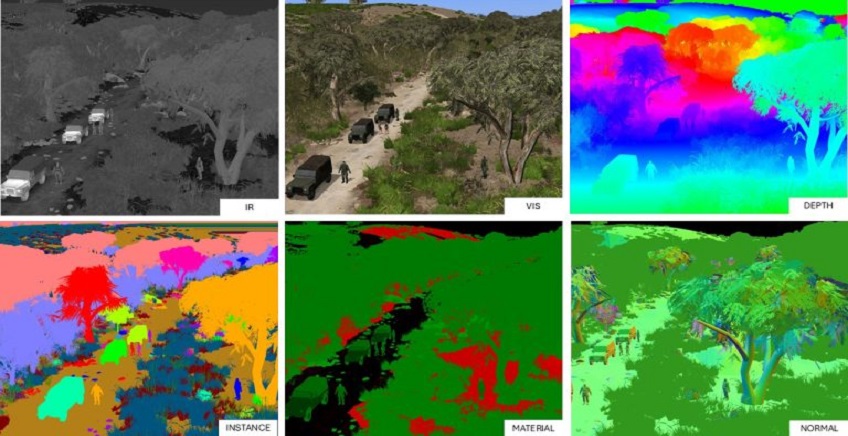
Among Tiltan’s flagship products is TOPS, a physics-based simulation system that generates highly detailed 3D environments for training, testing, and system validation, including the modeling of optical, thermal, and radar sensors. Majestic.ai is an AI-driven platform for generating synthetic and visual data, used to train machine-learning systems in scenarios where real-world data is limited or unavailable. Another solution, T-SAR, enables high-fidelity 3D simulation of SAR radar imagery for testing and operational environment analysis. T-BAT serves as an engine for developing autonomous capabilities for aircraft and unmanned platforms, with a focus on navigation and operation in complex, contested environments. In addition, AGM provides advanced geospatial mapping and spatial database generation from aerial imagery, while T-VERSE is used to create high-quality, precise 3D content for simulation, training, and mapping. Completing the portfolio is T-AWARE, a multi-sensor operational management system that delivers real-time situational awareness and supports decision-making processes.

According to Nukkleus CEO Meni Shalom, the acquisition is of clear strategic significance. “When Israel’s leading defense contractors needed reliable simulations, accurate synthetic data, or navigation systems that function without GPS, Tiltan was the address,” Shalom said. “This is an exceptional legacy, and we are proud to welcome it into the Nukkleus family.”

Nukkleus itself is in the midst of an accelerated strategic transformation. Founded in New York in 2013 and previously operating as a diversified holding company, the firm has over the past year sharpened its focus on defense and aeronautics. Recently, it signed a flexible equity financing facility of up to $250 million with an existing U.S. investment fund, a move designed to allow it to swiftly pursue additional acquisition opportunities. In parallel, Nukkleus acquired control of Star 26 Capital, which owns the Israeli company Rimon, a supplier of energy components and hybrid systems integrated into advanced defense platforms.

The acquisition of Tiltan fits into a broader effort to build an integrated defense portfolio encompassing AI, simulation, navigation, energy, and unmanned platforms, positioning Nukkleus as an emerging player in the global defense arena.

Main image source: Tiltan