IBM develops a Giant 1,000-qubits Quantum Computer

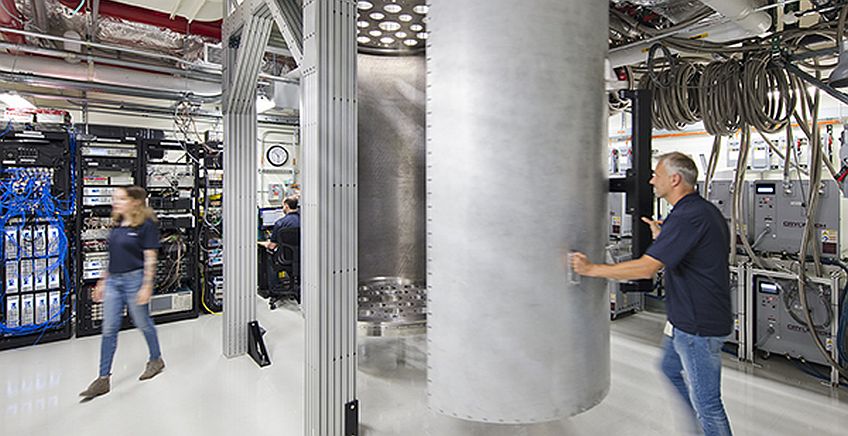
Above: Members of the IBM Quantum team at work. Credit: Connie Zhou for IBM

IBM announced an ambitious quantum computing roadmap that includes an array of 1,000 qubits (Qbit) quantum computer by the end of 2023. Today’s machinres consist of only a few dozen qubits. According to IBM, the number of qubits in quantum processors will double every year or two. In 2022 IBM will complete the development of a quantum processor with 400 cubits, and in 2023 it will launch a processor with 1,121 cubits to be called Condor.

IBM’s vision is very ambitious: “Our future computers will include more than a million qubits.” IBM is one of the most advanced players in quantum computing. In 2016, it was the first to offer public access to its quantum computer via the cloud. Today, IBM’s cloud provides access to more than 20 quantum computers of 5-qubits and 24-qubits. Earlier this year it launched a new 65-qubit quantum computer, which is the most powerful quantum computer to date.

“Super-fridges” for millions of qubits

IBM is using superconductors to build the new computers, due to their zero resistance at low temperatures. As part of the needed infrastructure, it will build a 10-foot-tall and 6-foot-wide super-refrigerator (to be called Goldeneye), which can accommodate arrays of 1,000 qubits. The long range goal is to build a network of interconnected “super-fridges” that together provide a computing capability of one million qubits.

These fridges keep the qubit array at a temperature close to absolute zero, in order to avoid any electromagnetic interference that may interrupt the quantum circuit. In quantum computing, the smallest radiation can destroy the computational process, thus the biggest challenge in developing a large quantum computer is the ability to preserve the quantum state of the qubits, until the computational process is completed.

Cracking the cholesterol mystery

Speaking with Techime, Nir Minerbi, CEO of the Israel-based Classiq which develops software solutions for quantum computing, explained the practical significance of IBM’s roadmap. “The very fact that a company like IBM, which does not usually release far-reaching statements, presents a detailed technological roadmap with clear goals–  increases the industry’s confidence in the future of quantum computing.”

According to Minerbi, quantum computing is a “tie-breaker” in exactly the types of problems that classical computers, and even supercomputers, have difficulty dealing with. “All the supercomputers in the world, together, will never be able to simulate a single cholesterol molecule. But a quantum computer with several hundred qubits will be able to do this, and will be able to test how different molecules react with cholesterol and to develop drugs.”

The next layer of Quantum Stack

Classiq is developing CAD solutions that will make it possible to write applications for quantum computers. “The quantum revolution consists of two things: hardware and software. Nowadays it is almost impossible to develop applications for a quantum computer, since you have to program at the logic gate level. It’s like designing a chip at the transistor level. We build the tools that allow developing applications at a higher level of abstraction. The next layer in the quantum stack.”

For Classiq, IBM’s roadmap is good news. “As computers get stronger, more companies are interested in developing applications for quantum computers. Today, the entire industry is looking at IBM’s statement. Now there is a clear horizon, and companies know that in a few years there will be quantum computers running significant algorithms. That’s why they are now starting to invest in software development and will need solutions like ours.”

Hailo Challenges Google and Intel

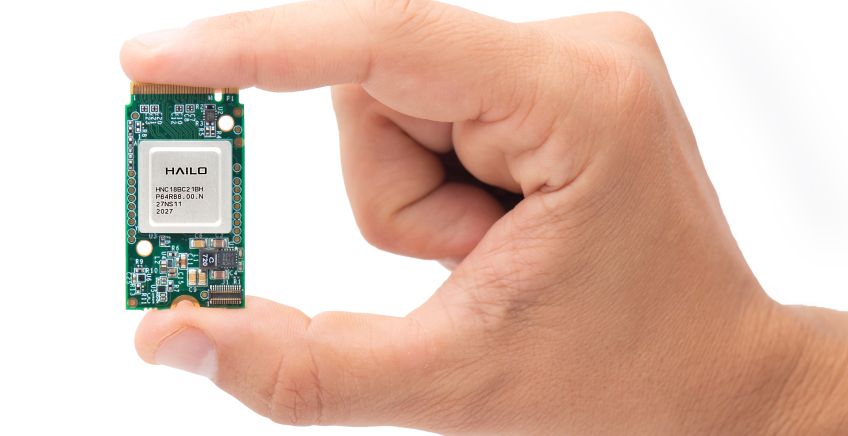
AI chipmaker Hailo announced the launch of its M.2 and Mini PCIe high-performance AI acceleration modules for empowering edge devices. Integrating the Hailo-8 processor, the modules can be plugged into a variety of edge devices. The modules provides high performance Deep Learning-based applications to edge devices. Hailo’s AI acceleration modules seamlessly integrate into standard frameworks, such as TensorFlow and ONNX, which are both supported by its Dataflow Compiler.

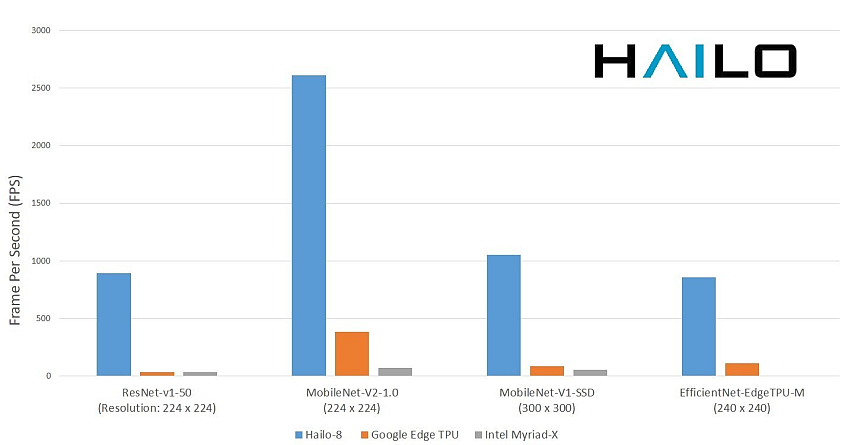
Hailo announced that a comparison between the Hailo-8 average Frames Per Second (FPS) with competitors across multiple standard NN benchmarks shows that Hailo’s AI modules achieve a FPS rate 26x higher than Intel’s Myriad-X modules and 13x higher than Google’s Edge TPU modules. The Hailo-8 M.2 module (photo above) is already integrated into the next generation of Foxconn’s BOXiedge with no redesign required for the PCB.

“Manufacturers across industries understand how crucial it is to integrate AI capabilities into their edge devices,” said Orr Danon, CEO of Hailo. “Simply put, solutions without AI can no longer compete.” The Hailo-8 AI modules are already being integrated by select customers worldwide. More information on the Hailo-8 M.2 and Mini PCIe AI modules can be found here.

Hailo-8 vs. Intel Myriad-X(1) and Google Edge TPU(2) Performance across common Neural Network benchmarks

Northland Capital: CEVA’s DSP Processor to enter Apple’s 5G Modem

Apple is developing its own cellular modem that will be utilized in its 5G-compatible cellphones. The modem will be based on the DSP technology of the Israeli-based CEVA. Apple plann to bring the new modem to the market in the second half of 2022 along with the iPhone 13, and will be installed on all of the models that will follow it. This is according to a report by Gus Richard, an analyst at Northland Capital Markets.

Apple’s modem will likely be based on CEVA’s PentaG 5G platform, which provides full IP and algorithms needed for mobile 5G systems. PentaG contains specialized scalar and vector DSP processors, co-processors, AI processor, accelerators, software and other essential IP blocks, in a highly configurable and modular architecture. It supports all 5G bandwidths, including sub-6 GHz and millimeter waves (mmWave) bands, and allows a bit rate of up to 10Gbps.

Apple’s move began in July 2019, when it signed an agreement to acquire the majority of Intel’s phone modems division, for an estimated $1 billion. Upon completion of the transaction, all 2,200 employees of the division joined Apple. The deal came to fruition due to Intel’s decision to leave the 5G modems for smartphones business. Apple’s decision to build its own modem is a results of a bitter two-year legal dispute with Qualcomm that ended in a dissatisfying compromise.

CEVA is enjoying Intel’s Legacy

Intel’s cellular modems have been based on CEVA’s processor for many years, and in recent years CEVA has intermittently enjoyed and suffered from the changes made by Apple, when it switched between Intel’s and Qualcomm’s modems, and in some cases even split its production capacity between the two. But now the situation is different: Apple will not purchase a modem with CEVA inside – but will purchase the intellectual property directly from CEVA itself.

Richard analyzed CEVA’s sales mix, concluding that the fact that it was unaffected by the China-US trade war, as well as its growing presence in the 5G market, are advancing it toward a trajectory of growth. He therefore gave the company’s share a target price of $48 – compared to the price of $36.8 at which it is currently traded. Along with Apple, CEVA has several key Chinese customers, such as ZTE and Spreadtrum, which is its largest customer and whose sales are expected to rise in the third quarter of the year.

He estimates that next year Nokia will increase the production of 5G base-stations that include CEVA processors. He anticipates a 30%-50% increase in CEVA’s sales during the next 3-5 years in non-mobile fields, such as Wi-Fi, Bluetooth and smart home products, smart TVs, smart light bulbs, control systems, etc. CEVA’s 2019 annual sales totaled $87 million. In the Q2 2020, sales grew by 28% compared to Q2 2019, to approximately $23.6 million.

Intel and Lightbits Labs enter into a Strategic Collaboration

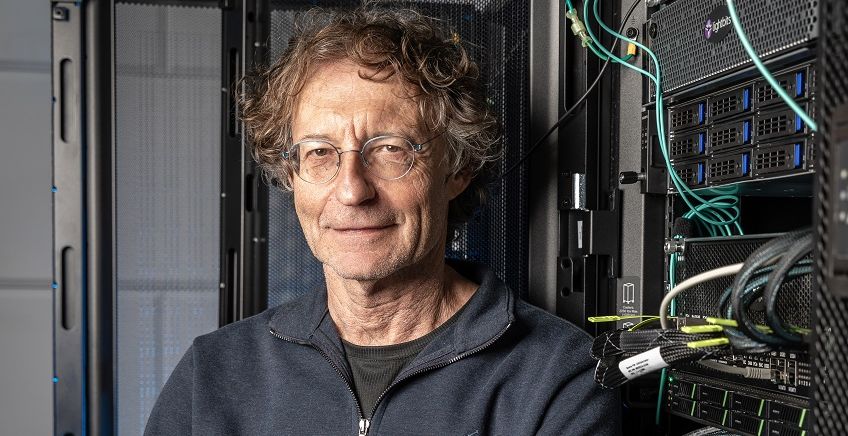
Above: Avigdor Willenz, founder of Lightbits Labs, Habana Labs, Annapurna and Galileo Technologies

Intel Corp. and Lightbits Labs from Kfar-saba, Israel, will co-develop new storage solutions for the data center. Intel announced an agreement for a strategic partnership includes technical co-engineering, marketing collaboration and an investment of Intel Capital in Lightbits Labs.  “The data center is being transformed,” said Remi EL-Ouazzane, Intel’s Data Platforms Group chief business development officer. “Our hardware capabilities coupled with Lightbits NVMe over Fabrics software gives our joint customers an exceptional economic solution.”

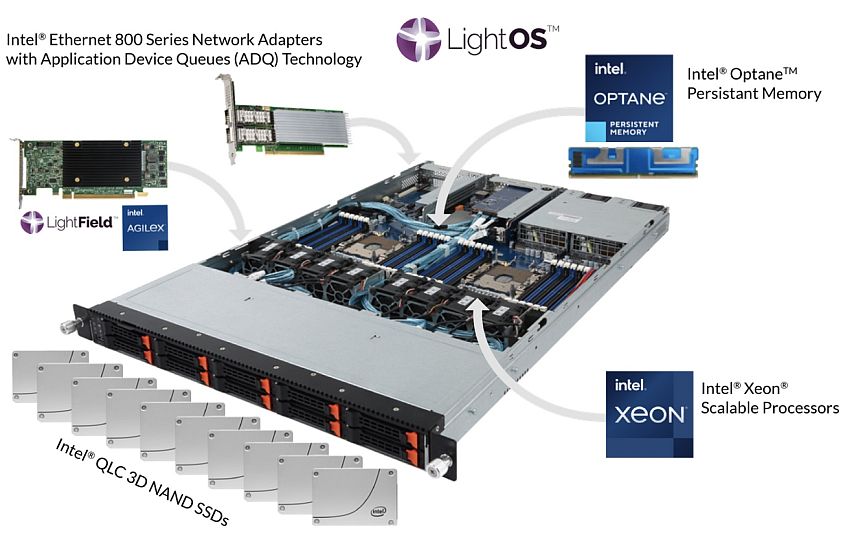
Lightbits NVMe/TCP protocol separates storage and compute without touching the network infrastructure or data center clients, and thus enables to reduce the latency of direct-attached NVMe SSDs by up to a 50%. Its LightOS provides a software-defines management of the entire distributed database. According to the agreement, Lightbits Labs will enhance LightOS for Intel’s technologies, to create an optimized software and hardware solution. The system will utilize Intel hardware solutions such as Optane memory, 3D NAND SSDs based on Intel QLC Technology, Xeon processors, Intel Ethernet Network Adapters and its FPGAs.

In addition to the technical collaboration, Lightbits and Intel are collaborating to provide complete solutions. They already started: Lightbits Labs demonstrated LightOS NVMe over Fabrics TCP (NVMe-oF/TCP) storage with remote direct memory access (RDMA)-class performance, when accelerated with the Intel Ethernet 800 Series Network Adapter with ADQ technology. It reported the results: up to 30% improvement in response time, up to 50% reduction in average latency and up to 70% throughput increase.

Founded in 2017, Lightbits Labs worked until mid 2019 in a stealth mode. Only in April 2019 and after raising $50 millions, it exposed it first product. The company was founded by the chairman Avigdor Willenz, the CEO Eran Kirzner and the CTO Sagi Grimberg. Avigdor Willenz is a serial entrepreneur. He is also currently the Co-founder and chairman of Habana Labs, which develops solutions for artificial intelligence and deep-learning computing and was sold to Intel in 2019 for $2 billion. Earlier in his career, he had co-founded Annapurna Labs (sold to Amazon for $370 million).

His first semiconductor’s exit was the selling of his startup Galileo Technologies Marvell in 2001 for $2.7 billion. Eran Kirzner came from PMC-Sierra where he served as VP for Software & Solutions in the Enterprise Storage Division. Sagi Grimberg came from Mellanox Technologies (now owned by NVIDIA). In his last position there he served as the Storage Software manager of Mellanox.

MIPI’s first spec for vehicles is based on Valens

The international organization MIPI Alliance, that develops interface specifications for the mobile industrie and includes most of the leading names in the electronics and chip industry, has released a new spec called MIPI A-PHY v1.0, which for the first time standardized the interface between the sensors and monitors in the vehicle and the computing units. The spec is designed to ensure the reliability of the in-vehicle safety and infotaiment systems. MIPI is mainly focuses on mobile interfaces, and A-PHY is the first spec it devised for the vehicle market, due to the importance of data link between in-vehicle systems.

The specification provides a common base for chip companies, camera and sensor manufacturers, software companies and auto-makers, for the development of integrated solutions in a uniform standard. The new standard is based entirely on the technology of the Israeli company Valens, which participated in the working group that formulated the standard. The group included about a dozen companies, selected from the roughly 330 members in the organization. Among the prominent companies in the group are Intel, Sony, Tectronics, ST, ON Semiconductor and others.

16Gbps along 15 meters

Valens’s VP of Marketing, Dana Zelitzki (a participant on behalf of the company in one of MIPI’s subgroups), explained to TechTime that the new standard is of great significance for MIPI and the industry as a whole. “MIPI dominates the mobile world, and it now wants to gain a similar footing in the automotive world. The goal is to produce a collection of solutions for all communication protocols in the vehicle environment. There are now working groups that are already working on additional standards.”

The A-PHY standard defines an architecture for fast and reliable asymmetric communication between vehicle systems on a single cable. Given the safety and performance requirements in the automotive world, the specification requires that the communication will have an ultra-low packet error rate (10-19 per communication package), ultra-high immunity to electromagnetic interference (EMC effects), and a data rate of 2-16 gigabits per second (Gbps) to a reach of up to 15 meters, with a future road map of up to 48Gbps in the future.

Zelitzki: “This standard will help simplify the interior architecture of the vehicle. Instead of having to use conversion components between different manufacturers’ hardware, manufacturers will be able to integrate the specification into the product during development, and ensure compatibility with all other products.”

The first product on the market that complies with the spec

In fact, the specification reflects the technology developed by Valens. The company’s communication chips enable to transmit uncompressed video and audio content, and data in various formats and protocols such as USB and Ethernet, at ultra-fast speeds and over a single Unshielded Twisted Pair (UTP) for up to 15 meters. This accommodates major hardware issues in the car, such as the excessive weight of cables in the vehicle and electromagnetic interferences that can impair signal quality.

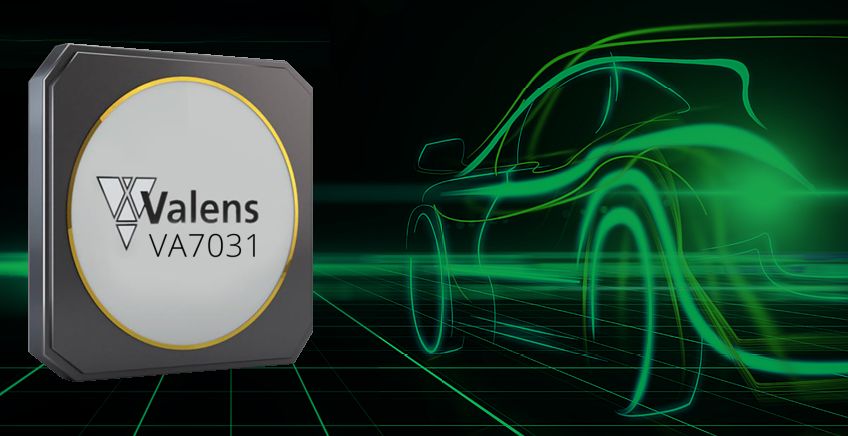
Zelitzki: “This constitutes a very significant achievement for us, and also a great business potential. The whole industry is looking at MIPI, because it is the first standard that provides a solution for the interface between the vehicle and the sensors and cameras in it.” The standard is also compatible with Valens’s next-gen family of chips, VA7000, which is expected to hit the market in 2021 and provide uncompressed in-vehicle communications at speeds of up to 16Gbps.

The VA7000 chips are also designed to connect the sensory systems – such as cameras, LiDAR and radar – to the in-vehicle computing units. “The standard gives us a significant market advantage. The industry knows that the first product on the market that complies with the standard will be ours. We are focused now on execution in order to get the chips out to the market on schedule, and in building the ecosystem of companies such as camera and monitor manufacturers, that support the new standard.”

Daimler’s S-Class includes the previous Valens chip

Valens was founded in 2006 by a group of entrepreneurs from the company Mysticom and employs about 350 people, most of them in Hod Hasharon and the rest in the United States, Germany and East Asia. The technology was originally developed for the consumer electronic market. However, in January 2016 the company made a business shift and decided to adapt its technology to the needs of in-vehicle communications.

In late 2016, Valens announced a partnership with Daimler, which selected its previous chip, the VA6000, to provide the communication infrastructure for the entertainment and telematics systems in its cars. The 2021 S-Class models, launched a few weeks ago, already include Valens’s chips.

Leo Messi Will Promote OrCam’s Low Vision Aid Device

OrCam, a company that develops wearable technologies for visually impaired people, has announced that the renowned soccer player Leo Messi will serve as the company’s ambassador and lead a project to advance the company’s technologies. As part of the joint project, Messi will meet with blind and visually impaired people and award them the OrCam MyEye device. The first meetings of the project took place in Barcelona shortly before the outbreak of the COVID-19 pandemic, in which Messi met 12 blind and visually impaired people from different countries.

Today, about 300 million people across the world live with blindness and visual impairment. The OrCam MyEye device is designed to improve their quality of life. It is a compact wireless device that identifies text from any surface and reads it to the user’s ear in real-time. It is based on artificial vision technology that allows reading texts from newspapers, books, computer and smartphone screens, menus, supermarket products and street signage. The product is equipped with face recognition technology and even allows to scan barcodes and identify banknotes and colors.

OrCam MyEye weighs only 22.5 grams; its size is roughly that of a finger and it attaches to the user’s eyeglass frame using a magnet. It is the only wearable artificial vision technology that is operated by using an intuitive pointing motion or by tracking the user’s gaze, without the need for a smartphone or internet connection. Both of these benefits enable real-time voice communication while fully protecting user privacy. OrCam was founded in 2010 by Prof. Amnon Shashua and Mr. Ziv Aviram, the founders of Mobileye, which is today owned by Intel.

Japan has developed an appetite for Israeli Technologies

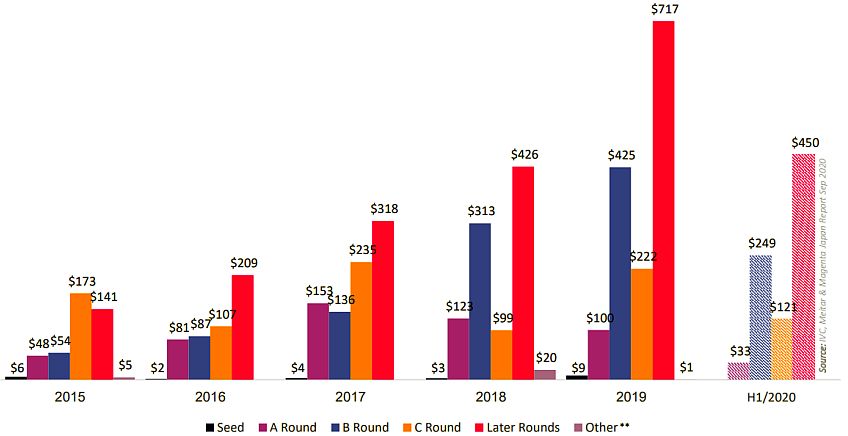
Above: Value of Deals Involving Japanese Investors

Israeli high-tech industry has became a major attraction for Japanese investors. Since 2010, Japanese investment deals in almost all types of Israeli high-tech companies have continued to grow, while the number of investment deals involving Japanese investors in the second half of the decade has nearly tripled compared to the first half. A new market research, Japanese Investments in Israeli High-Tech Companies, predicts that regardless the COVID-19 pandemic – 2020 is expected to be a record year in Japanese activity in Israel.

The newly released study was made by IVC-Online,  Meitar Law Offices and Magenta Venture Partners. The researchers estimate that based on information for the first half of 2020, “Japanese investors’ activity in Israeli hightech companies remained at least at the same level as in 2019, which was a peak year during which Israeli companies raised over $1.5 billion in investment deals involving Japanese investors.”

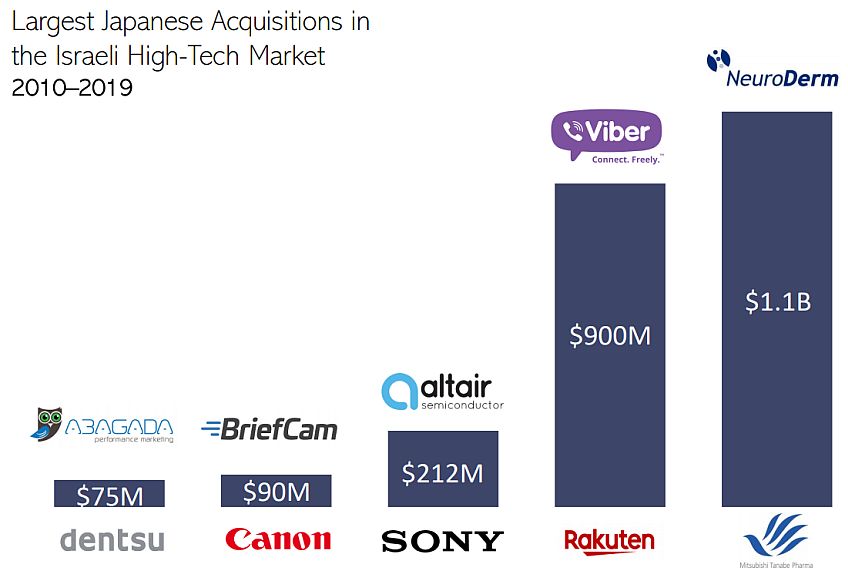
From 2017, there has been increasing diversity in the types of Japanese investors, including car manufacturers, financial institutions, insurance companies and VCs. Based on H1/2020 data, the upward trend in the number of Japanese investors appears to be continuing. In the years 2010–2019, there were 10 M&A deals and buyouts of Israeli companies by Japanese acquirers, with a total value of $2.34 billion.

The acquisition of NeuroDerm by Mitsubishi Tanabe in 2017 for approximately $1.1 billion, is the largest M&A deal in Israel by a Japanese entity. Recent Investments Led by Japanese Investors include the Hailo’s $60 million raising (led by NEC) in March 2020, Cybereason’s fifth round of $200 million (led by SoftBank) in August 2019, and Lemomade’s $300 million funad raising, also led by SoftBank, from April 2019.