Electreon Unveils Wireless EV Charger That Requires No Excavation

Electreon unveiled Lite DOT at IAA Transportation in Hanover, a new wireless charging system designed for electric passenger cars and light commercial vehicles. The new product marks a significant expansion beyond the company’s electric-road projects and charging infrastructure for commercial fleets, as Electreon seeks to turn wireless charging into a product that can be installed at homes, workplaces and commercial parking facilities.

Lite DOT delivers up to 11 kW of charging power, comparable to a three-phase residential AC charger. Instead of plugging in a cable, however, the driver simply parks the vehicle over a charging pad placed on the ground. Charging begins automatically once the vehicle is detected and authenticated. According to Electreon, power-transfer efficiency can reach up to 90% under specified conditions. The system also tolerates some parking misalignment, so the vehicle does not need to be positioned precisely over the center of the pad.

One of Lite DOT’s key features is its installation simplicity. Unlike Electreon’s existing DOT systems, in which charging coils are embedded beneath asphalt or concrete, Lite DOT sits above ground and requires no excavation. The system consists of a charging pad, a unit mounted on a wall or pole, and a three-phase electrical connection.

The pad itself contains no active electronics, and power transfer is activated only after an authorized receiver in the vehicle has been detected. The system is designed to operate in rain and snow and at temperatures ranging from -30°C to 50°C.

The Receiver Is Key

Using the system requires a wireless receiver to be installed underneath the vehicle. Electreon has developed a receiver architecture that can be adapted to different types of vehicles, giving the company two potential routes to market: integrating the receiver into new vehicles on the production line, or retrofitting it into existing vehicles. The receiver connects to the vehicle’s high-voltage system and CAN communications network, with the configuration adapted to each specific model.

This is where the network of partnerships Electreon has built in recent years could become particularly important. The company has worked with automakers including Toyota, Ford, Kia, Stellantis and Iveco, as well as Japanese automotive supplier Denso. Electreon currently cites more than 20 collaborations with vehicle manufacturers.

Its cooperation with Toyota and Denso is particularly relevant to the passenger-car market, as one of the partnership’s objectives is to develop receivers that can be integrated into both new and existing vehicles.

Electreon reported in July that it had completed development of the system, then referred to as “Charging while Parking,” and that it was in discussions with automakers and Tier-1 suppliers interested in manufacturing the receiver as well. Lite DOT is effectively the commercial product to emerge from that development. However, Electreon says the system is not yet commercially available and that its market launch date will be announced later.

Park, and the Car Charges Itself

Another potentially important market for Lite DOT is autonomous vehicles. While a human driver can connect a charging cable, a robotaxi, autonomous delivery vehicle or driverless logistics vehicle also needs a way to recharge without human intervention.

In this context, wireless charging becomes more than a convenience. An autonomous vehicle could drive to a parking space, position itself over the charger, recharge and then leave for its next mission without anyone having to plug it in.

Electreon is already applying this concept in industrial autonomous-vehicle projects, including its collaboration with ATLoS in Portugal. The company has also developed an inductive positioning system that allows an autonomous vehicle to align itself with the charging coils.

Lite DOT’s biggest challenge, however, may not be technological. For residential wireless charging to become a mass-market product, a sufficiently large installed base of vehicles must be equipped with compatible receivers. As long as the receiver remains a specialized and potentially costly addition, the value proposition for a private EV owner compared with a relatively simple and inexpensive conventional wallbox may not be compelling. Efficiency of up to 90% also implies greater energy losses than highly efficient wired charging.

The product’s success will therefore depend heavily on Electreon’s ability to turn the receiver from a specialized add-on into an integrated component of electric vehicles, working through automakers and Tier-1 suppliers.

If it succeeds, Lite DOT could mark the point at which technology originally developed for electrified roads evolves from a complex infrastructure project into an everyday charging product: arrive home, park the car, and charging simply begins.
Toyota chooses Electreon’s Wireless Charging Technology

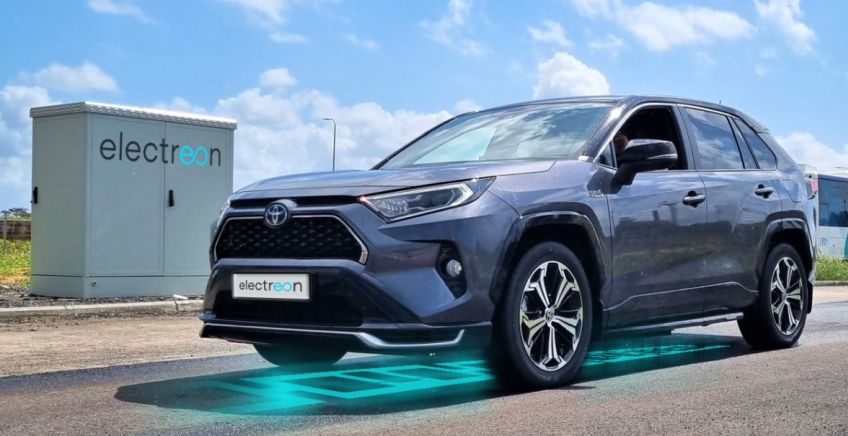
Photo above: Totota’s RAV4 car on Electreon’s Wireless Charging Road

Toyota, Denso and  Electreon Wireless agreed to jointly develop an advanced wireless vehicle receiver based on Electreon’s technology for use in Electric Vehicles. The agreement follows a successful technology evaluation conducted by Toyota and Denso at Electreon’s headquarters in Beit Yanai, Israel. A demonstration of the RAV4-PHEV charging on the wireless road was held at the conclusion of the evaluation.

The parties intend to promote technical development and adoption of wireless charging technology through various joint activities: co-development of an aftermarket wireless kit for current electrified vehicles to utilize wireless charging technology today; integration of the wireless technology into new cars released to the market; collaboration to shape the standardization of wireless EV charging; collaboratively promote a joint pilot project in Japan, the U.S. or the EU, including commercial proof of business.

Toyota announced that dynamic wireless charging technology will will help to solve some issues related to electrified vehicles, by reducing the battery size required in an EV or extend relative driving range. This technology may also help to distribute power demand more evenly, reducing the load on the grid and making it easier to incorporate renewable energy sources. Denso said that”Being greatly impressed to discover the extent of Electreon’s innovation and technology maturity, the company eagerly anticipates combining its expertise with Electreon’s innovative technology to take wireless charging to the next level.”

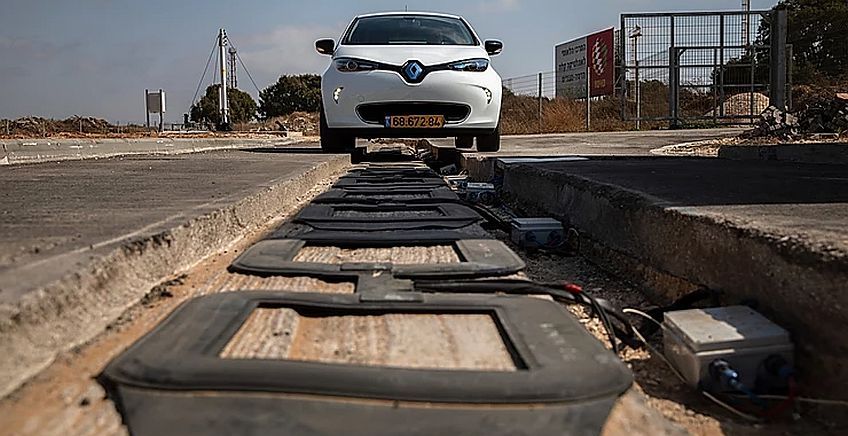
The building of Electreon's Inductive Wireless Charging Road
The building of Electreon’s Inductive Wireless Charging Road

Oren Ezer, CEO and Co-founder of Electreon, said: “This partnership will make wireless charging accessible to a diverse and wide range of drivers and will demonstrate the many benefits of wireless charging as a cost-effective clean solution for charging EVs as well as a catalyst in reducing EVs’ carbon footprint.” Within the next few months, the Parties will execute a detailed joint development agreement for all the joint activities mentioned above.

Electreon has developed a wireless charging solutions for electric vehicles (EVs). The company’s proprietary inductive technology dynamically (while in motion) and statically (while stopped) charges EVs quickly and safely. Electreon collaborates with cities and fleet operators on a “sale” business model, and on a Charging as a Service (CaaS) business model.

Electreon and Ford will deploy first wireless EV charging road in the U.S

Electreon Company won, together with Ford, the State of Michigan RFP to build a wireless Electric Road System (ERS) in Detroit. The project includes deploying a 1 mile wireless charging road and stationary wireless charging stations, in a central mobility innovation district supported by Ford Motor Co. and others. The road is planned to be operational by 2023, and it will be the first wireless EV charging road in the United States.

At the end of 2020 Ford revealed it plan of restoring Corktown district, Detroit’s oldest neighborhood, including the iconic Michigan Central Station, which also be renovated. The purpose of the project is to craft an ecosystem that demonstrates the future global mobility, and allow companies and start-up all over the world to demonstrate their technologies. For this reason, Electreon estimates that the Michigan project might be major component in introducing their technology to the American market, and in generating strategic joint ventures with leading companies in the market.

In addition to Ford Motor Co., other renowned American companies are taking part, to include Jacobs Engineering, which will lead the road design and will support project management and the energy company DTE, which will provide the connection of the new road to the power grid. Other companies in this project are KIEWIT Company, one of the largest infrastructure companies in the USA, which will support infrastructure works’ planning and execution and CleanTech ROUSH Company, specialized in converting industrial vehicles to alternative fuel vehicles, and will provide an electric truck for the project. Electreon will be the provider of its wireless electronic charging technology and will lead the planning, execution and operation of the project.

Electreon Wireless developed an electric road technology that charges the batteries of electric vehicles during their drive on the electrical section. It is based on the use of magnetic coils that are placed under the traffic lanes and charge the vehicles’ chargers wirelessly, using magnetic induction. This helps to reduce the weight of the electric vehicles, since a relatively small battery is needed. The system includes a management unit located on the sides of the traffic lanes of the electric road, and a receiver unit located in the vehicle’s undercarriage.

Electreon to pave its electric road in a toll road in Italy

Electreon Wireless will conduct its first pilot project in Italy, in collaboration with the Italian toll road operator A.p.S Brebemi. The two companies signed a MOU earlier this year, which went into effect this month, as reported by Electreon to the israeli stock exchange this week. It is Electreon first project with a toll road operator. The israeli company stated the engagement with Brebemi has a strategic potential for its business.”The collaboration may promote further penetration of the wireless electric road system into the European and international markets.”

Brebemi operates the A35 toll road in Italy, which connects the cities of Brescia and Milan in the Lombardy region. As a first step, it was agreed that Brebemi would purchase a pilot project from Electreon that includes construction and demonstration of the wireless electric road on a one-kilometer section of road, adjacent to the A35 toll road, for 36 months. The goal of the pilot is to test applicability of the technology in the context of toll roads. If succesful, the pilot may lead to installation of the wireless charging infrastructure into more segments along A35.

The holding of Brebemi was recently acquired by Aleatica SAU, a global infrastructure contractor headquartered in Spain and operates mostly in Latin America. The company manages some 20 franchises around the world, including fifteen toll roads, three ports, one light rail and one airport. SAU Aleatica is owned by the Australian fund IFM, one of the largest investors in infrastructure.

First Electric Roads in Sweden and Tel-Aviv

Electreon Wireless developed an electric road technology that charges the batteries of electric vehicles during their drive on the electrical section. It is based on the use of magnetic coils that are placed under the traffic lanes and charge the vehicles’ chargers wirelessly, using magnetic induction. This helps to reduce the weight of the electric vehicles, since a relatively small battery is needed. The system includes a management unit located on the sides of the traffic lanes of the electric road, and a receiver unit located in the vehicle’s undercarriage.

The company reported last March on the complete integration of the system on a public road on the island of Gotland in Sweden and successfully performed a dynamic and static wireless charging experiment of a heavy electric truck equipped with receivers that it developed. It recently reported the start of an Israeli pilot in collaboration with Dan Bus Company and the Tel Aviv-Yafo Municipality: paving a smart road with infrastructure for charging electric buses on a 2 km section of which the electric road section will be about 600 meters and will connect Tel Aviv University to the nearby train station. Electreon is traded on the Tel Aviv Stock Exchange at a market value of approximately NIS 3 billion.

Electreon and Eurovia to promote electric roads in Europe

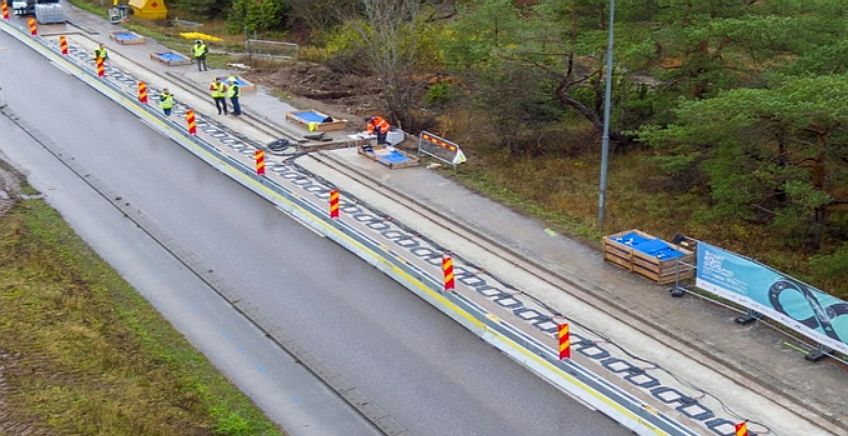
[Image above: Electreon’s electric road installation in Gotland, Sweden]

The Israeli company Electreon has signed a strategic cooperation agreement with Eurovia, a company owned by the VINCI corporation, under which they will promote projects for the construction of electric roads in Germany, France and Belgium. Two of VINCI’s subsidiaries, Eurovia and Omexom, provide services to Electreon as part of a demonstration project in Germany carried out with EnBW, which is one of the largest energy companies in Europe. Eurovia is considered to be one of the largest road construction contractors in the world. It is active in 15 countries around the world and employs 44,000 people. In 2019, its revenues totaled at about 10 billion euros.

The agreement will help Electreon to establish operations also in France and Belgium, strengthen its execution capabilities and promote the full commercialization phase of the technology. As part of the agreement, Eurovia will integrate Electreon’s technology into its existing range of products and will support the construction, design and maintenance of smart electric roads. Electreon will provide the technology that includes installation, operations and maintenance, and will analyze and identify business opportunities . Electreon’s CEO Oren Ezer said working with a company the size of Eurovia “would provide governments and other potential partners with the confidence needed to advance the smart electric road solution.”

First Electric Roads in Sweden and Tel-Aviv

Electreon Wireless developed an electric road technology that charges the batteries of electric vehicles during their drive on the electrical section. It is based on the use of magnetic coils that are placed under the traffic lanes and charge the vehicles’ chargers wirelessly, using magnetic induction. This helps to reduce the weight of the electric vehicles, since a relatively small battery is needed. The system includes a management unit located on the sides of the traffic lanes of the electric road, and a receiver unit located in the vehicle’s undercarriage.

The company reported last March on the complete integration of the system on a public road on the island of Gotland in Sweden and successfully performed a dynamic and static wireless charging experiment of a heavy electric truck equipped with receivers that it developed. It recently reported the start of an Israeli pilot in collaboration with Dan Bus Company and the Tel Aviv-Yafo Municipality: paving a smart road with infrastructure for charging electric buses on a 2 km section of which the electric road section will be about 600 meters and will connect Tel Aviv University to the nearby train station. Electreon is traded on the Tel Aviv Stock Exchange at a market value of approximately NIS 2.7 billion.