
Electreon unveiled Lite DOT at IAA Transportation in Hanover, a new wireless charging system designed for electric passenger cars and light commercial vehicles. The new product marks a significant expansion beyond the company’s electric-road projects and charging infrastructure for commercial fleets, as Electreon seeks to turn wireless charging into a product that can be installed at homes, workplaces and commercial parking facilities.
Lite DOT delivers up to 11 kW of charging power, comparable to a three-phase residential AC charger. Instead of plugging in a cable, however, the driver simply parks the vehicle over a charging pad placed on the ground. Charging begins automatically once the vehicle is detected and authenticated. According to Electreon, power-transfer efficiency can reach up to 90% under specified conditions. The system also tolerates some parking misalignment, so the vehicle does not need to be positioned precisely over the center of the pad.
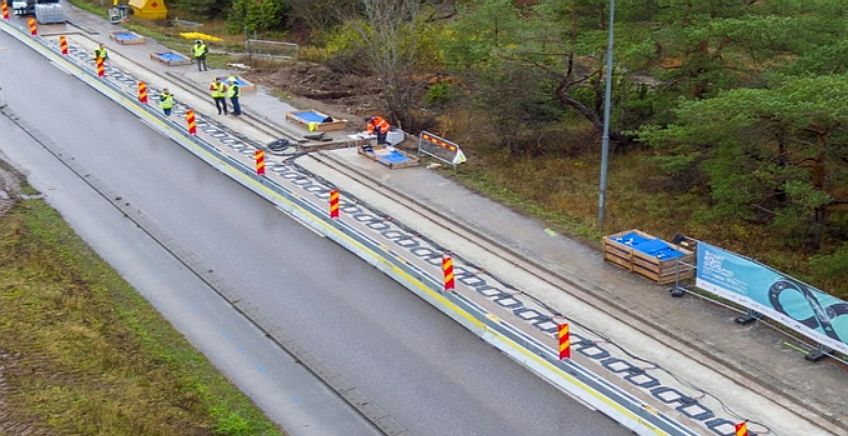
One of Lite DOT’s key features is its installation simplicity. Unlike Electreon’s existing DOT systems, in which charging coils are embedded beneath asphalt or concrete, Lite DOT sits above ground and requires no excavation. The system consists of a charging pad, a unit mounted on a wall or pole, and a three-phase electrical connection.
The pad itself contains no active electronics, and power transfer is activated only after an authorized receiver in the vehicle has been detected. The system is designed to operate in rain and snow and at temperatures ranging from -30°C to 50°C.
The Receiver Is Key
Using the system requires a wireless receiver to be installed underneath the vehicle. Electreon has developed a receiver architecture that can be adapted to different types of vehicles, giving the company two potential routes to market: integrating the receiver into new vehicles on the production line, or retrofitting it into existing vehicles. The receiver connects to the vehicle’s high-voltage system and CAN communications network, with the configuration adapted to each specific model.
This is where the network of partnerships Electreon has built in recent years could become particularly important. The company has worked with automakers including Toyota, Ford, Kia, Stellantis and Iveco, as well as Japanese automotive supplier Denso. Electreon currently cites more than 20 collaborations with vehicle manufacturers.
Its cooperation with Toyota and Denso is particularly relevant to the passenger-car market, as one of the partnership’s objectives is to develop receivers that can be integrated into both new and existing vehicles.
Electreon reported in July that it had completed development of the system, then referred to as “Charging while Parking,” and that it was in discussions with automakers and Tier-1 suppliers interested in manufacturing the receiver as well. Lite DOT is effectively the commercial product to emerge from that development. However, Electreon says the system is not yet commercially available and that its market launch date will be announced later.
Park, and the Car Charges Itself
Another potentially important market for Lite DOT is autonomous vehicles. While a human driver can connect a charging cable, a robotaxi, autonomous delivery vehicle or driverless logistics vehicle also needs a way to recharge without human intervention.
In this context, wireless charging becomes more than a convenience. An autonomous vehicle could drive to a parking space, position itself over the charger, recharge and then leave for its next mission without anyone having to plug it in.
Electreon is already applying this concept in industrial autonomous-vehicle projects, including its collaboration with ATLoS in Portugal. The company has also developed an inductive positioning system that allows an autonomous vehicle to align itself with the charging coils.
Lite DOT’s biggest challenge, however, may not be technological. For residential wireless charging to become a mass-market product, a sufficiently large installed base of vehicles must be equipped with compatible receivers. As long as the receiver remains a specialized and potentially costly addition, the value proposition for a private EV owner compared with a relatively simple and inexpensive conventional wallbox may not be compelling. Efficiency of up to 90% also implies greater energy losses than highly efficient wired charging.
The product’s success will therefore depend heavily on Electreon’s ability to turn the receiver from a specialized add-on into an integrated component of electric vehicles, working through automakers and Tier-1 suppliers.
If it succeeds, Lite DOT could mark the point at which technology originally developed for electrified roads evolves from a complex infrastructure project into an everyday charging product: arrive home, park the car, and charging simply begins.