NEXCOM Partners with Hailo to Launch Next-Generation Vehicular Telematics Solution

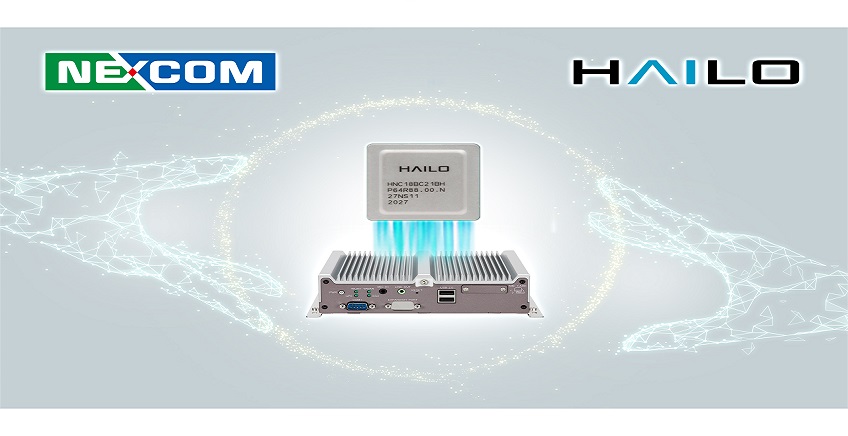
The israeli chipmaker Hailo announced its partnership with NEXCOM, the industrial computer hardware manufacturer, to launch NEXCOM’s VTC 1021, their next-generation AI vehicular telematics solution. NEXCOM’s AI solution features the compact Hailo-8 AI accelerator module, enabling high performance and empowering in-vehicle computers to run intensive AI applications more efficiently.

NEXCOM and Hailo’s joint solution facilitates operational efficiency in public transit and fleet management, including enhanced capabilities such as ADAS (Advanced Driver Assistance Systems). Hailo stated that the in-vehicle solution’s compact, fanless design fits perfectly in cabins with limited space and is designed to withstand demanding automotive conditions, helping bring public transit vehicles and fleets into the smart era. The in-vehicle computer VTC 1021 powered by the Intel Atom x5-E3940 processor is also versatile, with the flexibility to power a variety of telematics applications such as infotainment, fleet management, ANPR, and mobile video surveillance. Among the target applications for the joint solution: driver drowsiness detection, occupant monitoring, pedestrian detection warning, collision avoidance warning, and more

“The future of the automotive industry holds endless promise for safety and comfort, but to achieve this, in-vehicle compute platforms must overcome significant technological hurdles,” said Liran Bar, VP Business Development of Hailo. “Scaling AI to meet these challenges requires ultra-high performance and flexible solutions, which our joint offering provides. With NEXCOM, we will leverage the power of AI to turbocharge the aftermarket platform’s compute power, thus making vehicles safer.”

“Our partnership with Hailo allows us to offer our customers advanced AI solutions which can power sectors such as public transportation and fleet management with more scalable, better-performing solutions,” said Jay Liu, Vice President at NEXCOM. “Our joint platform provides vehicles enhanced capabilities, including state-of-the-art applications which can vastly improve the driving experience as well as safety, ushering in a new era of smart transportation.”

Hailo’s specialized Hailo-8™ AI acceleration modules deliver unprecedented performance to edge devices. The modules are built with an innovative architecture that enables edge devices to run sophisticated deep learning applications that could previously only run on the cloud. Their advanced structure translates into higher performance, lower power, and minimal latency, enabling enhanced privacy and better reliability for smart devices operating at the edge.

W

A FREE TradingView Pro license for 1 year is available when you top-up your account with $300 or more! To keep the free license longer than 3 months, you must complete a minimum of 500,000 trading volume following the date you access the Promotion. View Terms and Conditions.

HOW TO CLAIM YOUR OFFER 1 Deposit $300 or more. 2 Email us at info@fxcmmarkets.com to claim your free TradingView Pro account, quoting FREETRADINGVIEWPRO in the subject line. Ensure you also include your TradingView username and your FXCM account number in the body of the email. 3 A member of our sales team will be in touch to confirm your status upgrade. DEPOSIT NOW Interested in other platforms?


EcoFlow to launch in Israel its innovative solar power station

Mobile power company EcoFlow has launched its brand-new product lines of sustainable, smart, portable solar power stations to the Israeli market. The company aims to positively disrupt the way Israelis think about electricity consumption. 

EcoFlow products are highly suitable for both in-home and outdoor usage and range in size and outage. Indoors, the portable power stations have the ability to power everything from mobile devices to entire homes, lowering the necessity to stay dependent on the national grid. Meanwhile, in an outside setting, the portable electricity supply can be used for anything from cooking equipment to a speaker system, eradicating the need for diesel generators or other less sustainable options.

EcoFlow has been recognized by TIME magazine for its pioneering product development, with the EcoFlow DELTA Pro Portable Power Station named in the prestigious media’s 100 Best Inventions of 2021, in the Sustainability category. The annual list honors the 100 inventions “that are making the world better, smarter, and even a bit more fun.”

Power stations from EcoFlow include remote control access via the EcoFlow App, allowing the user to check the status of their apparatus from anywhere, at any time. Engineers at EcoFlow designed pioneering technology “X-Stream” which creates an efficient, superfast charging capacity when compared to similar products on the market – less than half the time of the closest competitor (under 2 hours vs. over 5 hours). 

EcoFlow’s power stations come in two distinct lines – RIVER and DELTA. The RIVER series includes four smaller, easy-to-carry power stations, weighing between 2.85kg and 7.6kg and holding from 210Wh to 1440Wh of capacity with an extra battery. In contrast, the DELTA series consists of heavier-duty power stations with wheels for easy mobility – even for the largest DELTA Pro – ranging from 10.7kg to 45kg with a capacity from 882Wh to 3600Wh. These All options include several AC outlets and are chargeable either with equipped solar panels, from an AC outlet or even a car charger when necessary, giving the consumer a power solution for all situations. 

EcoFlow’s pioneering solutions have the capability to reduce the carbon footprint of individuals, retailers, or companies by simply unplugging a few devices and appliances. Jenny Zhang, Global Marketing Director of EcoFlow, says: “We created EcoFlow to help combat the rising issues of climate change and increasing global carbon emissions. As the world has started to recognize the major impact fossil fuels have on our global ecology problem and has begun moving towards renewable energy sources, we want to empower the public to use solar energy efficiently and at low cost, to significantly improve the environment.”

Nova is Aiming the Emerging Market of GAA Transistors

Nova from Rehovot, Israel, announced a series of updates to its metrology solutions for semiconductor fabrication, that prepares them for the production of the newly gate-all-around (GAA) technology. “To address GAA needs, process control solutions must be more accurate and applicable for complex 3D structures and new materials, applied to more layers and utilized to more physical and chemical inline parameters.”

Gate-all-around, or GAA transistors, are a modified transistor structure where the gate contacts the channel from all sides and enables continued scaling. Unlike finFETs, where higher current requires multiple side-by-side fins, the current-carrying capacity of GAA transistors is increased by stacking several nanosheets vertically, while the gate is wrapped around these channels. GAA transistors are generally considered as successors to FinFETs, because they can be scaled to the specific performance required, and allows the creation on 3nm transistors.

The updates were added to all its mainstream systems: spectral interferometry system Nova PRISM, the integrated metrology platform Nova i570, providing high-volume profiles of the materials composition through Nova METRION system, the Raman spectroscopy system Nova ELIPSON and the in-die X-ray photoelectron spectroscopy system Nova VERAFLEX IV. Above all Nova announced that all these systems are are unified by the new machine learning software suite, Nova FIT 2.0.

As part of its GAA strategy, Nova recently added chemical metrology capability by acquiring ancosys GmbH, a privately held company headquartered in Germany. The transaction is valued at approximately $90 million, which is paid in cash, and includes a performance-based earnout of approximately $10 million. “Nova’s portfolio is built to meet the challenges of next-generation device fabrication,” said Eitan Oppenhaim, President and CEO.

Stratasys to print 500 parts for a renewed Lotus 62-2 racecar

Stratasys Company manufactures over 500 3D-printed parts for the launch of the renewed Lotus Type 62-2, the legendary racecar. The car is being build by Radford, a global luxury automotive brand and is documented for the Discovery+ show that tells the story of the revival of the art of coachbuilding using technology for the 21st century. The project is led by the car builder and host Ant Anstead and former Formula One champion racecar driver Jenson Button, current owner of Radford Company.

Lotus Cars was a British automotive company that won the Formula One World Championship seven times, and is currently owned by Chinese multinational Geely. In the renewed version, only 62 units were created. The company turned to Stratasys to assist in building the cars for two major reasons: Create a car of less than 1,000Kg and provide the option of producing personalized parts for each client. Ansted: “Stratasys’ 3D printing technology gave us the design freedom and ability to easily create customized, one-off pieces and parts for these two prototype vehicles”.

Within current project, Radford utilizes Stratasys FDM®, PolyJet™, and stereolithography 3D printing technologies. The parts are designed using Stratasys’ GrabCAD Shop™ workflow software. As of today, two cars were built with over 500 3D-parts, using a fleet of up to 20 different Stratasys 3D printers at one time in five different global sites. For Stratasys – it was a genuine demonstration of distributed manufacturing. Among the printed parts were complex mounting features for interior speakers, a fuel filler mount and for the luggage compartment, side mirror housings, radiator ducts, body vents and more.

In the project, several industrial printers were used – F900®, F770™, Fortus 450mc™, F370® and J55™ 3D printers, each used to achieve different desired outcomes for each part. Among other, they were used to create large solid composite firewall sandwich core inside the car which provides passenger protection in case of fire. The automotive industry is a focal target market of Stratasys, and several customers demonstrated already how 3d printers are incorporated in this industry. For example, the Malaysian Solidify Company manufactures silicon rubber moldings that are used for a European automotive client whose car had gone out of production, but still required spare part supplies.

The Italian Skorpion Engineering Company is famous as a pioneer in advanced automotive prototypes and subsystems for luxury brands. Today, the company depends on its arsenal of Stratasys PolyJet and FDM 3D printers.

Canadian Solaxis Company uses Stratasys’ technology to print handles and other accessories that are used to compose car doors in mass production lines. The Spanish-Italian automotive design studio Italdesign purchased the Stratasys J750 printer, through which it manufactures the complete interior parts of the DaVinci concept car that was built to celebrate the 500th anniversary of Leonardo DaVinci.  Continental Company, a leading provider of car components, integrated the Stratasys Fortus 450mc printer in its production line, in order to mass-produce replacement production tools and parts. 

Arc and Bezeq International Partner to Deliver Network Connectivity Between the UAE, Bahrain and Israel

Arc Solutions, a telecom infrastructure solutions provider across the region based in Dubai, has signed an agreement with Bezeq International, Israel’s leading ISP and IT solutions provider, to deploy its network in Bezeq International’s data centre in Tel Aviv. Arc and Bezeq International are creating the lowest latency route between regional hubs in datamena UAE, Global Zone Bahrain,  Smarthub UAE and Israel,  combining network footprints, enabling partners and customers to access a rich portfolio of destinations and services.

“Arc’s partnership with Bezeq International is a great step forward for the growing co-operation between Israel and the UAE. Our customers can now access the lowest latency routes to Europe via Israel and support users with a high quality of experience when using their applications and services,” said Mahesh Jaishankar [pictured above], CEO at Arc. “We are excited to offer this route to customers and enable them to diversify how they connect across the region. Bezeq International is a great partner, and it is great to be working with the team in Israel on this landmark initiative.”

Israel is a world leader in innovation and entrepreneurship with more start-ups per capita than any other country, making it a key market in the Middle East. As the country’s Public and Private Sector and foreign investment scale investment in infrastructure to support emerging digital technologies such as cloud, IoT, and AI, strong interconnection with regional and international networks is vital.

“There are tremendous growth opportunities for Arc and Bezeq International as we collaborate to connect digital innovation across the region. Arc shares our belief in seamless inter-regional connectivity and delivering new choice when connecting locally and across the globe,” said Ron Glav, VP Business Division & Global Alliances at Bezeq International. “The Israel–United Arab Emirates agreement has just found us ready to supply, taking advantage of Israel’s unique geographic position as a hub connecting between Europe, Asia and Africa and new Middle Eastern markets. Together, we are providing the foundation for both Bezeq International and Arc customers to extend their reach, expand their portfolio and access new opportunities in key markets across the Middle East.”

Arc is dedicated to making connectivity in the Middle East as simple as possible, with a vision of a highly interconnected Middle Eastern market that accelerates how network-centric businesses optimise, grow and innovate in cloud, content and communications.

Deci launches new models for enhancing Deep Learning on CPU 

Photo above:Deci’s founders (from left to right): Jonathan Elial- COO, Yonatan Giefman- CEO and Ran El Yaniv- Chief scientist. Credit: Deci

Deci, the deep learning company harnessing Artificial Intelligence (AI) to build AI, announced a new set of image classification models, dubbed DeciNets, for Intel Cascade Lake CPUs. According to Deci, its proprietary Automated Neural Architecture Construction (AutoNAC) technology automatically generated the new image classification models that significantly improve all published models and deliver more than 2x improvement in runtime, coupled with improved accuracy, as compared to the most powerful models publicly available such as EfficientNets, developed by Google.

While GPUs have traditionally been the hardware of choice for running convolutional neural networks (CNNs), CPUs, already more commonly utilized for various computing tasks, would serve as a much cheaper alternative. Although it is possible to run deep learning inference on CPUs, generally they are significantly less powerful than GPUs. Consequently, deep learning models typically perform 3-10X slower on a CPU than on a GPU.

As explained by Deci, its DeciNets closes the gap significantly between GPU and CPU performance for CNNs. With DeciNets, tasks that previously could not be carried out on a CPU because they were too resource intensive are now possible. Additionally, these tasks will see a marked performance improvement: by leveraging DeciNets, the gap between a model’s inference performance on a GPU versus a CPU is cut in half, without sacrificing the model’s accuracy.

“As deep learning practitioners, our goal is not only to find the most accurate models, but  to uncover the most resource-efficient models which work seamlessly in production – this combination of effectiveness and accuracy constitutes the ‘holy grail’ of deep learning,” said Yonatan Geifman, co-founder and CEO of Deci. “AutoNAC creates the best computer vision models to date, and now, the new class of DeciNets can be applied and effectively run AI applications on CPUs.”

All networks were compiled and quantized using OpenVino, with latency measured on AWS instance c5.4xlarge with Cascade Lake CPU (16 vCPUs, batch size = 1)

“There is a commercial, as well as academic desire, to tackle increasingly difficult AI challenges. The result is a rapid increase in the complexity and size of deep neural models that are capable of handling those challenges,” said Prof. Ran El-Yaniv, co-founder and Chief Scientist of Deci and Professor of Computer Science at the Technion – Israel Institute of Technology. The hardware industry is in a race to develop dedicated AI chips that will provide sufficient compute to run such models; however, with model complexity increasing at a staggering pace, we are approaching the limit of what hardware can support using current chip technology. Deci’s AutoNAC creates powerful models automatically, giving users superior accuracy and inference speed even on low-cost devices, including  traditional CPUs.”

In March 2021, Deci and Intel announced a broad strategic collaboration to optimize deep learning inference on Intel Architecture (IA) CPUs. Prior to this, Deci and Intel worked together at MLPerf, where on several popular Intel CPUs, Deci’s AutoNAC technology accelerated the inference speed of the well-known ResNet50 neural network, reducing the submitted models’ latency by a factor of up to 11.8x and increasing throughput by up to 11x.

Deci enables deep learning to live up to its true potential by using AI to build better AI. With the company’s end-to-end deep learning development platform, AI developers can build, optimize, and deploy faster and more accurate models for any environment including cloud, edge, and mobile, allowing them to revolutionize industries with innovative products.  The platform is powered by Deci’s proprietary automated Neural Architecture Construction technology (AutoNAC), which automatically generates and optimizes deep learning models’ architecture and allows teams to accelerate inference performance, enable new use cases on limited hardware, shorten development cycles and reduce computing costs. Founded by Yonatan Geifman, Jonathan Elial, and Professor Ran El-Yaniv, Deci’s team of deep learning engineers and scientists are dedicated to eliminating production-related bottlenecks across the AI lifecycle.

Verto Launches Online Service for AI-driven 3D Product Visualization

Verto, the AI-based startup and 3D imaging innovator, announced today the expansion of its AI-driven 3D product visualization solution, making it commercially available to customers across various industries. A growing business with a proven track record in jewelry and eyewear imaging, the company’s expansion will help online retailers, e-commerce companies, web developers, and product developers, to dramatically reduce the time, effort, and cost of 3D imaging for use on websites and digital catalogs.

Using advanced AI-based imaging techniques, Verto fully recreates a product, whether it is a piece of jewelry, shoes, eyewear, or another product. The software renders and creates a fully-fledged 3D object, including a 360-degrees video image of any item from just a few pictures taken from any smartphone. Users of the service upload either photographs or CAD files to Verto’s website, where once processed will be altered to a fully rendered 3D video for immediate use. It is a simple shoot, upload, download three-step process.

Vetro’s growing customer base includes jewelry companies such as 77 Diamonds, Israel Diamond Exchange, and Martin Flyer, and now the company is expanding its footprint to eyewear and footwear, with early adopter customers such as GlassesUSA.com.

Verto is now collaborating with the Israeli Diamond Exchange. The joint venture will be conducted for two months, during which Verto will provide its service to small-scale jewelers who are members of the exchange. Verto’s solution has been recently recognized by the Israeli Diamond Institute as a cutting-edge solution for e-commerce product visualization.

“Consumer spending over the last two years has continued to shift into online due to lockdowns and changing of purchasing behaviors,” said Nadav Dadon, CEO and co-founder of Verto. “What we are offering is a way for e-tailers, designers, architects, and product development teams to offer a full 3D view of an item that consumers can literally inspect every corner of by rotating it in any angle. All without having to invest in costly photographers or 3D scanner equipment and software.”

A rapidly growing business, interest in Verto has been met with enthusiasm. The company recently completed seed funding, which it received from a group of private investors led by Chaim Chizik. This adds to the grants it has already received from the Israel Innovation Authority, totaling $3.5M in funding that it continues to invest in developing its software and systems.

While 3D solutions are not new, they take time, money, and skills to create, with specialized 3D artists and software costing tens of thousands of dollars. With Verto, the barrier to entry is almost zero, as users do not need to have any professional photographic knowledge, and the accuracy is superb. Additionally, Verto’s SaaS-based cloud offering can process a single item for use, or up to a full catalog of images. A popular application of its technology allows a consumer to virtually engage with the 3D product online and change the colors, textures, and elements of an item – in essence customizing the product to meet their personal preference.

“The need for affordable 3D visualization technology is driving the demand for smart solutions that require minimal effort from the customer. There are almost no companies that can automatically create 3D content at the speed and precision that Verto can,” added Nadav Dadon.

“GlassesUSA.com has always been focused on using tech to deliver breakthrough customer experiences,” noted Hila Shtram, Chief Design Officer at GlassesUSA.com. “Verto is an ideal partner to enhance and offer a transformative way for our customers to purchase sunglasses online.”

The Verto imaging services can be available and purchased via a SaaS-based licensing or subscription model. Pricing is determined via the size of an organization and the number of deliverables required and is suitable for both SMBs and enterprise customers. Verto was founded in 2017 by Didi Dvash (CTO) and Nadav Dadon (CEO).