Synopsys Delivers New ZeBu Empower Emulation System for Hardware-Software Power Verification

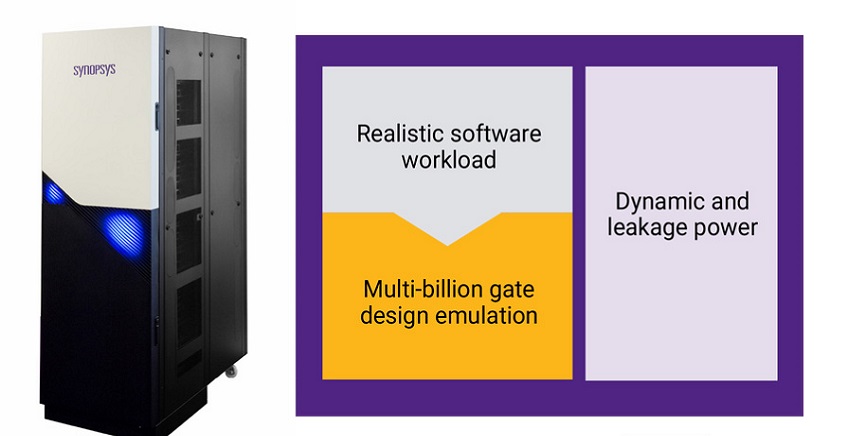
Synopsys, Inc. (Nasdaq: SNPS) announced the immediate availability of ZeBu® Empower emulation system, delivering breakthrough technology for fast hardware-software power verification of multi-billion gate SoC designs. The performance of ZeBu Empower enables multiple iterations per day with actionable power profiling in the context of the full design and its software workload. With ZeBu Empower, software and hardware designers can utilize the power profiles to identify substantial power improvement opportunities for dynamic and leakage power much earlier. The ZeBu Empower emulation system also feeds forward power-critical blocks and time windows into Synopsys’ PrimePower engine to accelerate RTL power analysis and gate-level power sign-off.

Traditionally, power analysis with realistic software workloads is performed post-silicon, introducing a high amount of risk to miss critical high-power situations, which exposes companies to significant cost and product adoption risk. By taking advantage of high-speed emulation in ZeBu Empower, design teams can perform verification earlier in the design cycle, dramatically reducing risks of power bugs and missed SoC power goals.

“The industry’s need to shift-left software development from post-silicon to pre-silicon has driven tremendous adoption of our ZeBu Server over the last five years,” said Manoj Gandhi, general manager of the Verification Group at Synopsys. “Our breakthrough technology in ZeBu Empower addressees our customers’ need for hardware-software power verification enabling them to develop a new generation of power optimized SoCs.”

“As high-performance designs and workloads continue to grow in complexity, achieving leadership performance within a thermal envelope is important for our products,” said Alex Starr, Corporate Fellow, Technology and Engineering at AMD. “Solutions that allow us to efficiently profile power consumption across real workloads in a pre-silicon environment help us achieve our product goals. Synopsys’ ZeBu Empower, operating in collaboration with servers using 2nd Gen AMD EPYCTM processors, has enabled us to perform pre-silicon power analysis more efficiently in a quicker time.”

The Synopsys ZeBu Empower emulation system for hardware-software power verification solution is available now.

Synopsys offers a comprehensive solution for low power design and verification, including RTL-based early power exploration to the industry’s golden power signoff; from early static verification to emulation-based hardware-software power verification. Synopsys’ innovative low power solutions are deployed across some of the most demanding designs, globally.

French hospitals adopt Polytex’s technology to combat contamination

Israeli Workwear management company Polytex Technologies has witnessed explosive growth in the French market over the past year. Seven new hospitals throughout the country have purchased the company’s fully automated workwear management solution that provides improved protection for health workers, which has become even more critical during the COVID-19 pandemic and leads to significant reduction in the expenses on uniforms

Over the past twelve months, Polytex has won contracts at major French hospitals in Rouen, Rennes, Pithiviers, Dax, Poissy, Ajaccio and at a large hospital laundry service in the Paris region. This is in addition to the eight hospitals and a pharmaceutical industrial site in various parts of the country, which have already installed Polytex’s workwear and scrubs management solution.

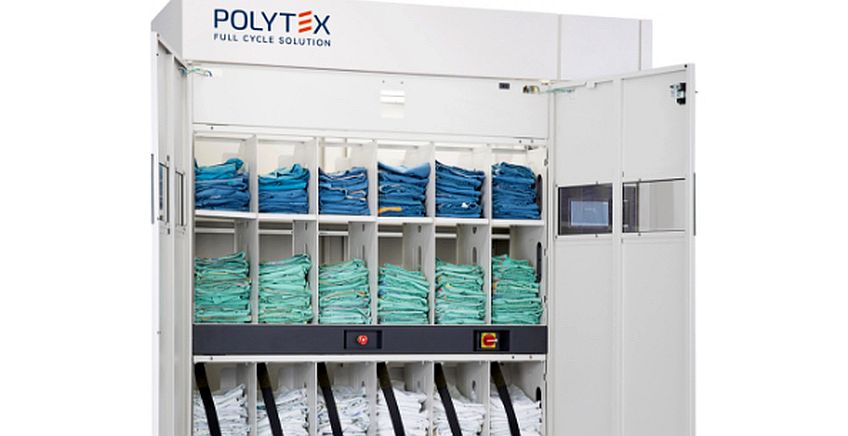
The Polytex solution is fully automated and enables hands-free dispensing and collecting of individual uniforms. The system itself is sealed, keeping garments in a clean environment that is opened only by laundry professionals during collection and restocking. The system is available on a 24/7 basis and often installed at multiple locations enabling staff to receive and return garments in seconds, thereby avoiding unnecessary crowding.

Refilling the machines with fresh clothing is very quick and takes only a couple of minutes.

The units can also be moved to special temporary wards dedicated to infectious diseases like COVID-19. The Polytex automated system is backed by a centralized cloud-based management and monitoring applications for end-to-end tracking.

There are currently over 3,000 Polytex units operating in 20 countries, including the U.S., France, Germany, Spain, and Israel, alongside countries in eastern Europe and Asia.

“In the past year we have nearly doubled our presence in France as the global pandemic has made hygiene an even more critical issue for hospitals,” said Yariv Matzliach, CEO of Polytex. He added that “France is currently one of our largest and strategic markets in Europe and has tremendous growth potential.”

“Polytex’s technology system helped to simplify the distribution of workwear in the hospital and led to a 40% reduction in expenses on uniforms,” said Bernard Loulier, laundry manager at the Centre Hospitalier Regional d’Orleans (CHR), the largest hospital in Orleans. He noted that the actual volume of workwear was reduced as were the amount of storage space needed. The first Polytex station in Orleans was installed at the 5000-staff hospital in 2016. The hospital currently has ten stations installed for dispensing and return of uniforms.

“Data Centers to Adopt High Voltage DC Power Sources”

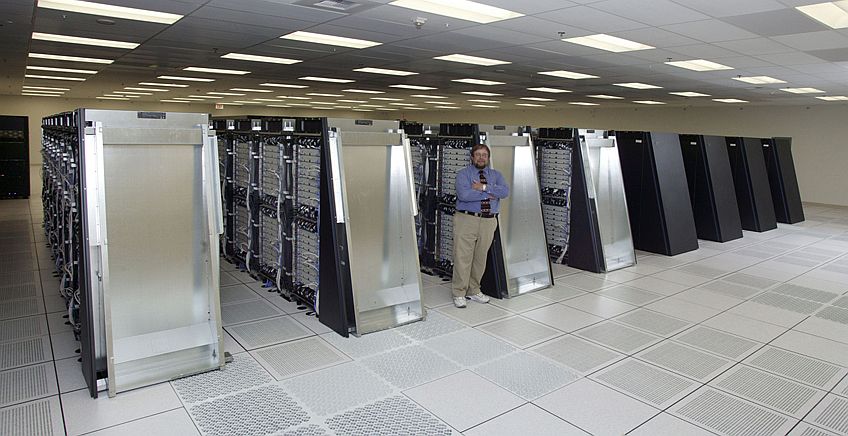
Above: IBM’s Blue Gene computer paved the way for powerful AI Data Centers

“The large data centers are undergoing a deep structural change. We anticipate more datacenters moving away from Alternating Current (AC) in favor of 260-410V DC infrastructures to better cope with the massive increases in power needs of high-performance computing,” told Lev Slutskiy, Vicor’s EMEA Business Development Manager for High Performance Computing. “Google started testing the concept secretly back in 2015 and today companies like Nvidia are performing experiments with high voltage, that haven’t been published yet.”

According to Slutskiy, the Open Compute Project Foundation is also testing the new approach. The OCP was established 10 years ago by Facebook and now it brings together the biggest manufactureres of processors, servers and data center infrastructures. They are tackling an old electrical dilemma: Since the electric power is a multiplication of the voltage by current, using a high direct voltage at low currents saves a lot of energy (P = I²R). Until recently the problem was marginal: standard database servers consumed approximately 5kW each – and power systems that passed energy into the server circuits at a voltage of 12V and 416 Amps current – were good enough.

What can be done with 1,000 Amps

But times change and around 2015 the average power consumption of database servers increased to 12kW, with currents ranging up to 1k Amps. Most of the manufacturers dealt with the high currents using very large conduction cables, but this solution is beginning to reach the end of its ability. Especially in the last year in which the growing use of artificial intelligence and machine learning multiplied the power usage of the database servers: Vicor reports that in the large data centers the usage increased to about 20kW, and in some cases even to 100kW.

This means that the power distribution systems need to deal with huge currents of appoximately 1k Amps. At this point the OCP consortium started to define a format of database servers working at higher voltages of 48V. This decreases the current in the circuit by 4 and minimizes the power loss in the conduction cables by 16. Thus for instance, the current required for 12kW server will be only 250 Amps.

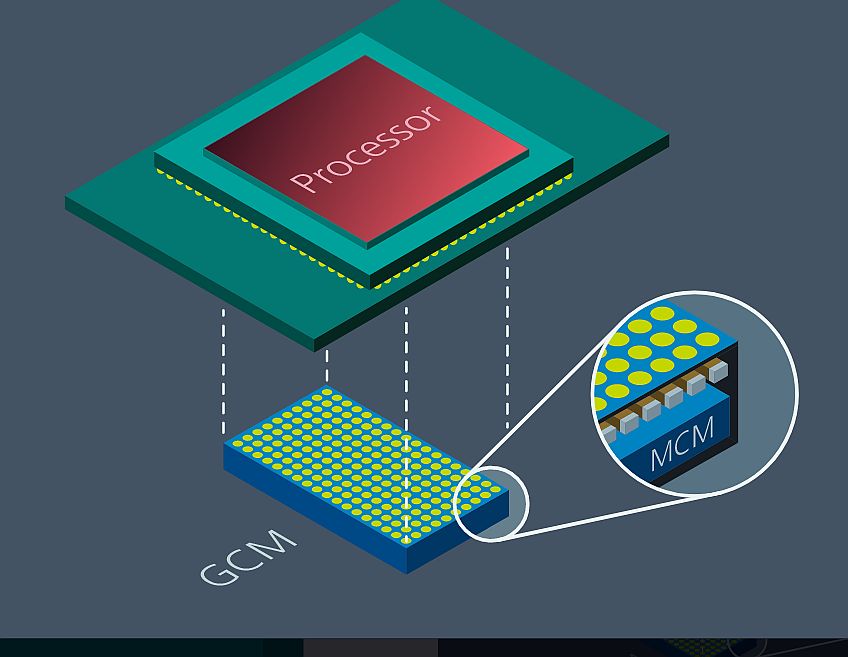
Vicor’s approach for direct power supply to the processors in the data center

According to Jain Ajithkumar, Vicor’s Sr. Director for Strategic Accounts in Data Center, HPC and AI Business, this is just the first move in a larger trend and it holds further technological implications. “We are now at the beginning of a new era. The computer rooms will receive direct voltage of 350V, that will be converted to 48V at the racks level, and then to the exact voltage needed by each specific chip in the server.

“We are dealing here with two additional issues: today the processors work at 1.8V and 0.8V. When we minimize the width of the transistor to 5 nanometers, the voltage may reach down to 0.4V. There is a need for an advanced technology to answer this need – and to do it without compromising the space dedicated to the multitude of densed data links populating modern processors.”

Looking for the next Startup

This is where Vicor’s Factorized Power Architecture technology, originally developed for IBM’s 2007 Blue Gene supercomputer, comes into the picture. Blue Gene was powered by 350V, delivered through Vicor’s power distribution system, starting with high power rails, middle stages and ending with a dedicated chip directly connected to the CPU’s power connections. “We have developed a technique for pushing the power supply to each processor of Blue Gene.

“Now we are making that technology available for startup companies too, and therefore it is very important for us to exist in the Israeli Market. Out of all the influential startup companies in the world, just 5% come from Europe. Thus Israel’s foothold in the European market is very large. Today there are over 300 HPC startup companies in Israel, and most of the startups that are being sold to global companies are Israeli. We are offering to supply them with chips and full planning methodologies – including converting supply networks to voltages of hundreds of volts, bringing energy to the consumption point, lowering to a voltage of 48 volts and supply the required voltage for each processor.”

NeuReality raises $8M seed funding to set a new performance standard for AI compute infrastructure

NeuReality, an Israeli startup developing high performance AI compute for cloud data centers and edge nodes, emerged from stealth last week with $8M seed from Cardumen Capital, OurCrowd and Varana Capital to fuel the growth of real-life AI applications running at scale. NeuReality will introduce its first AI platform early this year.

NeuReality also announces the appointment of Dr. Naveen Rao, an AI industry expert, and former General Manager of Intel’s AI Products Group, to its Board of Directors.  Prior to his role at Intel, Dr. Rao had been the CEO of Nervana Systems (acquired by Intel in 2016).

NeuReality exponentially enhances ultra-scale inference for AI applications. Despite huge advances in deep learning acceleration, hyperscalers such as Facebook, Microsoft and Amazon are facing scalability challenges with recommendation systems, digital assistants (such as Alexa and Siri), language-based applications (such as translations and natural language processing) and computer vision use cases. Enterprises are facing the limits of today’s solutions and experiencing spiraling costs with their growing deep learning demands on-premises and in the cloud.

“Our mission is to deliver AI users best in class system performance while significantly reducing cost and power,” said Moshe Tanach, Founder and CEO of NeuReality. “We are already consuming huge amounts of AI in our day-to-day life and it will continue to grow exponentially over the next five years. In order to make AI accessible to every organization we must build affordable infrastructure that will allow innovators to deploy AI-based applications that cure diseases, improve public safety and enhance education. NeuReality’s technology will support that growth while making the world smarter, cleaner and safer for everyone. The cost of the AI infrastructure and AIaaS will no longer be limiting factors.”

NeuReality was established in 2019 by CEO Moshe Tanach, VP Operations Tzvika Shmueli and VP VLSI Yossi Kasus. Prior to founding NeuReality, Tanach served in several executive roles as Director of Engineering at Marvell and Intel, and AVP R&D at DesignArt-Networks (later acquired by Qualcomm). Tzvika Shmueli served as VP of Backend at Mellanox Technologies and VP of Engineering at Habana Labs. Yossi Kasus served as Senior Director of Engineering at Mellanox and the head of VLSI at EZChip.

Gonzalo Martinez de Azagra, General Partner at Cardumen Capital and former head of Samsung Ventures in Israel commented: “The AI market is growing very rapidly and NeuReality will become the de facto standard in this segment. By focusing on the AI computing system as a whole, NeuReality will deliver AI computing infrastructure that is more powerful and more cost-efficient to meet the industry’s growing demands. We are proud to support NeuReality in its journey to make this a reality.”

One segment that will find NeuReality’s solution very relevant is healthcare, due to the growing scale challenges related to COVID-19 research and vaccine development. NeuReality enables customers to easily scale their AI utilization while significantly cutting costs, lowering energy consumption, and shrinking the overall computing-infrastructure footprint.

“After seeing so many AI companies focusing on deep learning accelerators at the device level, NeuReality intrigued me with their refreshing view of overall AI deployment barriers and their unique system-level approach that will eclipse today’s outdated data center architecture,” said Dr. Naveen Rao. “NeuReality’s innovative design solves AI scalability and cost challenges.”

Record Number of Investments in Israeli Start-ups

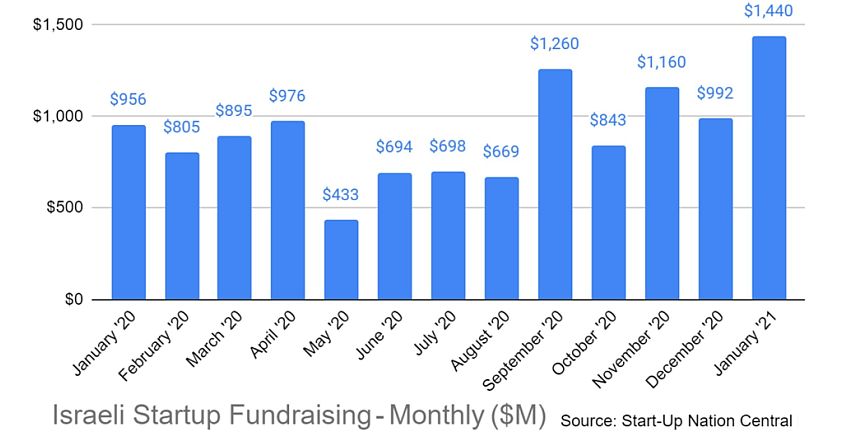
During January 2021, the month that COVID-19 reached its peak in Israel, local Start-ups raised $1.44B – a record amount of investments in Israel during a single month. Six start-ups raised more than $100M each (mega rounds) during the month. According to Start-Up Nation Central (SNC) the mega-rounds in January 2021 alone, equal close to 30% of the total number of mega-rounds in the entire year of 2020.

It is the highest number of both mega-round and general investments made during a single month in Israeli start-ups. The year 2020 witnessed 21 ‘mega-round’ investments during the whole of 2020, equivalent to 33% of capital raised. As a monthly comparison, there were three ‘mega-rounds’ in January 2020, none in January 2019 or January 2018. The mega-rounds in January were led by US investors.

Fintech was the dominant sector with two ‘mega-rounds’ and $413M raised. It is a continuation of Fintech’s strong performance since September 2020 with $1.4B in investments compared to only $340M raised in the first eight months of 2020. Director of Research at(SNC), Meir Valman, said that the record level of fundraising is driven by the increasing maturity of the Israeli tech ecosystem, when rapidly growing startups are able to raise much larger rounds.

The six ‘mega-rounds’ which were announced during January 2021 were: Rapyd Financial Network (Fintech, $300M), Drivenets (Network Infrastructure, $208M), OwnBackup (Enterprise solutions, $167.5M), K Health (Digital health, $132M), Resident Home (Ecommerce, $130M) and Melio (Fintech, $110M).

Start-Up Nation Central is a non-profit organization that helps tackle global challenges by connecting Israeli technologies with multinational corporations, governments, investors, as well as NGO’s from around the world.

REE enters NASDAQ with a valuation of $3.1 Billion

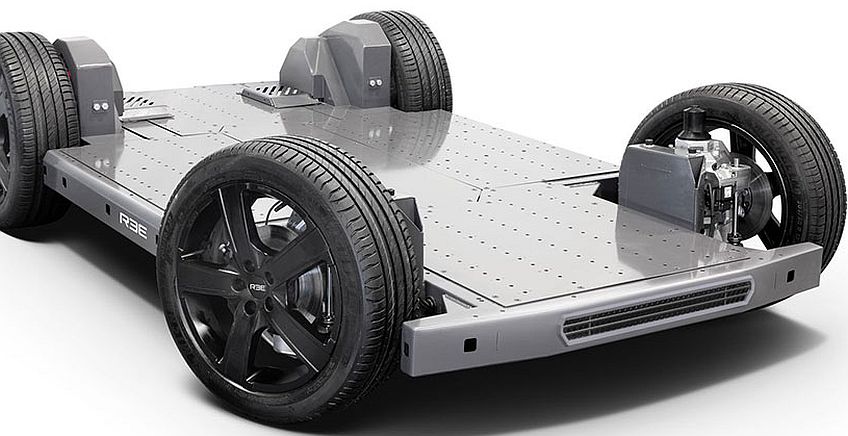
The Tel Aviv-based REE Automotive and 10X Capital Venture Acquisition Corp (“10X SPAC”) have entered into a merger agreement for a business combination that would result in REE becoming a publicly listed company. Following the close, NASDAQ will list the combined company under the ticker “REE”. REE Automotive has developed EV platform which is completely flat, scalable and modular. The transaction values the combined company at a value of $3.1 billion.

REE’a platform is based on two core innovations: the REEcorner integrates all traditional vehicle components into the arch of the wheel, and the REEboard that provides a completely flat and modular electric platform. Each REECorner is completely independent and powered by its own ECU and consists of Electric motor, Single wheel steer-by-wire, Single wheel brake-by-wire, Multi-ratio drivetrain, Preventive maintenance AI and OTA updates.

The REEboard’s scalable technology allows it to carry a very large variety of different permutations without the need to design a new platform for each vehicle type. Since it does not store any drive components it can be designed to take any shape. It is accessibility from all sides and utilizes CANopen and supports any ADAS interface.

The combined company is expected to receive approximately $500 million in gross cash proceeds from a combination of US $201 million in cash held in 10X SPAC’s trust account, and $300 million from committed strategic investors including Koch Strategic Platforms, Mahindra & Mahindra and Magna International. The capital will accelerate mass production of REEcorner technology and modular EV platforms, expected to begin in 2023.

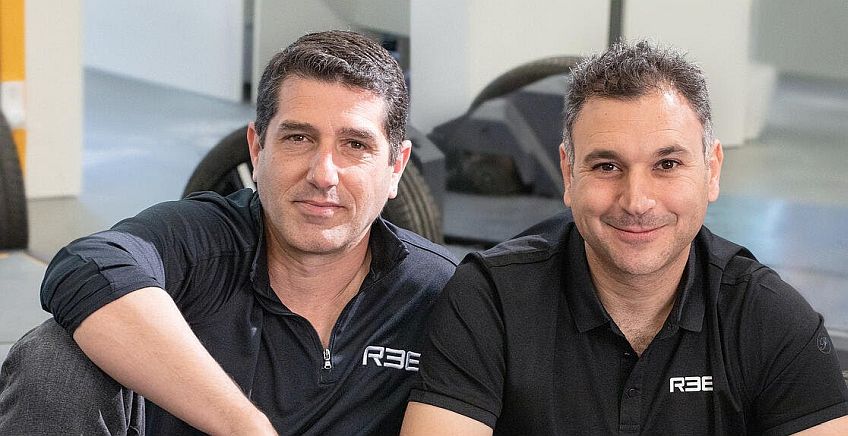
Daniel Barel (left), REE Co-Founder & CEO and Ahishay Sardes, REE Co-Founder & CTO

REE is planning to utilize manufacturing capacity via a secured and exclusive global network of Tier 1 partners in over 30 countries, with point-of-sale assembly. This strategy is expected to enable REE to reach profitability by 2024. The existing shareholders and investors will continue to hold their equity ownership, including Mitsubishi Corporation, American Axle, and Musashi Seimitsu Industry.

Check-Cap to produce its own X-ray source

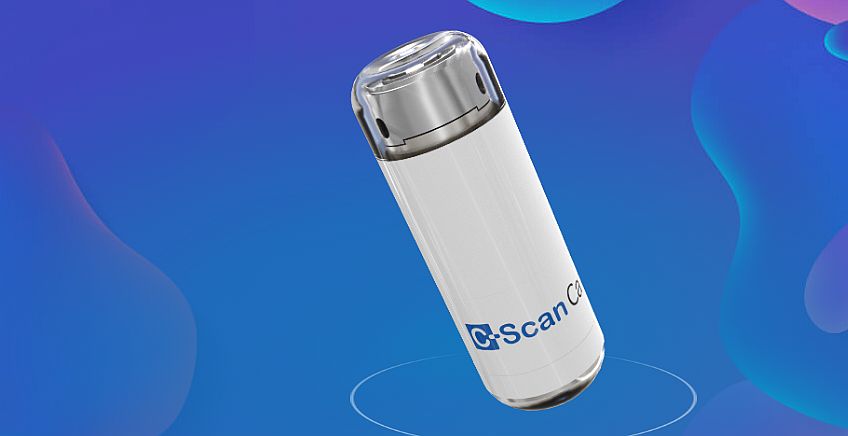
The israeli clinical stage medical diagnostics start-up Check-Cap plans to build an in-house manufacturing line to produce the x-ray source for its C-Scan capsule, a patient-friendly preparation-free screening test to detect polyps before they may transform into colorectal cancer – as the CEO of the company, Alex Ovadia, announced last week in a letter to investors. In the letter, Ovadia also disclosed that Check-Cap was recently awarded a 750k dollar grant from the Israel Innovation Authority to support the transition from R&D to production, and the company will invest a similar sum in the project as well.

An x-ray source is a radioactive isotope with an extra neutron, which emits X radiation when the extra neutron is released from the atom’s nucleus. Check-Cap uses an isotope from the osmium element in their capsule. This isotope has a short half-life. As such, by the time the capsule exits the body, the source will have already been extinguished and thus does not require a complex evacuation procedure.

Ovadia told Techtime that the establishment of the local production line is a part of the company’s business and logistic strategy. “Since the half-life of the x-ray source is relatively short, we may need to build local production facilities in our future markets, in order to ensure availability. It is a model similar to that common in the nuclear medicine field.”

Currently, Check-Cap has a production line in the US that was established by GE. The production line in Israel will also be used for a widespread clinical trial that the company is planning to hold in Israel throughout the year. The trial will take place in 10 medical centers and will include 250 patients at an average risk for colon cancer. The company added that recruitment of patients was going slower than expected because of the Covid-19 pandemic, but the trial is set to begin soon. The aim of trial in Israel is to gather additional clinical data that will allow continued improvement of the system’s functionality.

The main goal the company is preparing for these days, is the Pivotal trial in the US, which will be the last clinical hurdle before seeking marketing approval from the FDA. In November, Check-Cap submitted a request to perform the trial (IDE) to the FDA, and they are now in the process of responding to comments that they’ve received from the FDA.

The company also announced that it was notified by Nasdaq that it regained compliance with the minimum $1.00 bid price rule. Over the last month, after a continuous trampling, Check-Cap’s stock jumped by about 370% and is now traded at a market value of 74.4 million dollars. Ovadia: “Many significant things are happening in the company, in all aspects, and we came to the conclusion that we should give periodical updates from time to time. It is important that people know what is happening in our interesting company.”

Check-Cap, located in Isfiya near Haifa, Israel, develops an ingestible capsule-based system for preparation-free colorectal cancer screening. The C-Scan utilizes ultra-low dose X-ray and an wireless communication sub-system. The capsule is used to create a 3D map of the inner lining of the colon, which allows physicians to look for polyps and other abnormalities. C-Scan is non-invasive and requires no preparation or sedation, allowing the patients to continue their daily routine with no interruption as the capsule is propelled through the gastrointestinal tract by natural motility.